B y the time a B2B buyer opens your website, an AI system has usually already told them what you do. Whether it got that right comes down to your AI data readiness.
96% of B2B marketers now use AI in their day-to-day work (Demand Gen Report, 2026 B2B Trends Research Report), while only 44% of organizations say their data quality and accessibility are adequate for AI (Adobe 2026 AI and Digital Trends Report). Meanwhile, 94% of B2B buyers now use AI somewhere in the purchase process, and generative AI has become the single most-cited information source across every buying phase (Forrester, The State Of Business Buying, 2026). AI isn’t replacing your buyers. It’s front-running them — and it can only front-run you accurately if your data and content are clean, structured, and machine-readable.
What is the AI data readiness gap in B2B?
The AI data readiness gap is the distance between how many organizations use AI and how many have the data foundation to run it well. Right now that distance is wide.
Demand Gen Report surveyed more than 300 B2B marketers for its 2026 B2B Trends Research Report and found 96% using AI in their roles, with 45% citing efficiency as the top benefit. Separately, Adobe and Oxford Economics surveyed 3,000 executives and practitioners in customer experience roles for the Adobe 2026 AI and Digital Trends Report. Only 44% said their data quality and accessibility were currently adequate for AI.
A quick note on the math, because it matters: those are two different surveys of two different populations. Subtracting one from the other to get a tidy “52-point gap” makes a better headline than it does a statistic. The directional finding is solid, though and Adobe’s own numbers hold it up internally:
- 52% say their ability to advance AI initiatives is limited by their current level of data unification and structure (Adobe, 2026 AI and Digital Trends in Content Creation and Management)
- 39% have a shared customer data platform capable of supporting agentic AI (Adobe, four key takeaways)
- 75% report that data integration and quality issues are major obstacles to implementing agentic AI (Adobe)
That last one is the number to sit with. Three out of four organizations say the thing they’re most excited to build is blocked by the thing they’ve most neglected.
Why does bad data infrastructure cost revenue?
Because every AI output is downstream of a data input. Lead scores, personalization, content recommendations, chat answers all of it inherits whatever mess sits underneath.
“Inadequate data infrastructure” usually means some combination of:
- Siloed systems. CRM, marketing automation, and ERP that don’t share a schema or a customer ID.
- Inconsistent taxonomy. The same field means three things in three places, so models miscategorize records.
- Stale records. Personalization fires on facts that stopped being true two quarters ago.
- Unstructured content. Specs locked in PDFs and image files that nothing can parse.
None of this is new. What’s new is the cost. Most B2B stacks were assembled one tool at a time a CRM here, a MAP there, a CMS bolted on later. That worked when humans did the interpreting. It breaks when models do.
The result is a revenue problem wearing an IT costume. Weak data means weak lead scoring and weak pipeline quality. And when AI systems can’t parse your product information, they don’t pause to ask. They move on to a vendor they can read.

Are AI agents replacing human B2B buyers?
No, and this is where a lot of 2026 commentary overreaches. AI is now the starting point for B2B research, not the decision-maker.
Forrester’s The State Of Business Buying, 2026, based on a survey of nearly 18,000 global business buyers, found that generative AI searches now open the buying process. But buying groups got bigger, not smaller. A typical decision now involves 13 internal stakeholders and nine external influencers, and that rises for complex purchases. Buyers use AI for speed, then turn to peers, analysts, and vendors to validate what it told them.
Their skepticism is earned. Only 36% of buyers said generative AI made them more confident they’d made a better-informed decision, and Forrester’s 2025 research found 20% felt less confident after using it, because they hit unreliable or inaccurate information.
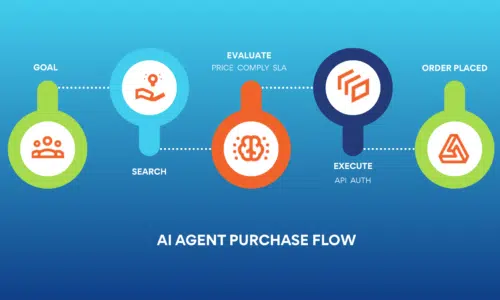
So the honest framing isn’t “the robots buy now.” It’s this: an AI system very likely summarizes your company, compares your capabilities, and shapes a shortlist before a human ever loads your homepage — and then a large, skeptical committee pressure-tests that summary.
Where autonomous agents actually show up
Fully autonomous vendor selection is still emerging. The near-term movement is in procurement and negotiation.
Forrester predicts that in 2026, at least one in five B2B sellers will have to respond to AI-powered buyer agents with dynamically delivered counteroffers through their own seller-controlled agents. It also found that 61% of purchase influencers say their organization has or will use a private generative AI engine to support purchasing company-deployed tools with access to internal data, not consumer chatbots.
Treat that as a forecast, not a finished fact. Plan for it anyway, because the readiness work is identical to the work you already owe your human buyers.
Does structured data help you get found by AI?
It helps machines understand your content. It is not a shortcut into AI answers, and anyone selling it that way is overselling.
Here’s the accurate version. Schema.org is a shared structured-data vocabulary founded in 2011 by Google, Microsoft, Yahoo, and Yandex. As of 2024, more than 45 million web domains used it to mark up over 450 billion Schema.org objects. Applications from Google, Microsoft, Pinterest, and Yandex use those vocabularies to power richer experiences. It’s the closest thing the web has to a standard for telling machines what your content actually means.
But Google has been explicit about the limits. Its AI optimization guide warns against overfocusing on structured data, stating plainly that it isn’t required for generative AI search and that there’s no special Schema.org markup to add for it. Google’s AI features documentation says the same: no additional requirements, no new machine-readable files, no AI-specific schema needed to appear in AI Overviews or AI Mode.
Google still recommends keeping structured data as part of an overall SEO strategy, because it supports rich result eligibility and entity clarity. That’s the real value: helping systems resolve who you are and what you sell without guessing.
The FAQ schema change most teams missed
If your structured data playbook still leans on FAQPage markup for visibility, update it. On May 7, 2026, Google added a deprecation notice to its FAQ structured data documentation: FAQ rich results no longer appear in Google Search (Search Engine Journal). The rollout continued in stages; the Search Console report and Rich Results Test support ended in June 2026, and Search Console API support ends in August 2026.
Two things stayed true. FAQPage is still a valid Schema.org type you can keep on your pages. And Google still uses FAQ structured data to understand pages it just won’t render the dropdown anymore.
The practical read: the SERP feature died, the content didn’t. Well-written question-and-answer content still does the heavy lifting for both human readers and AI systems.

What’s actually worth doing
- Use JSON-LD for
Organization,Product, andOffermarkup; Google’s preferred format and the most maintainable at scale. - Get specs, pricing structures, and integration lists out of PDFs and images and into real text.
- Make sure markup matches what’s visible on the page. Mismatches get ignored.
- Validate with the Rich Results Test for supported types, and stop using it as a gate for FAQ.
- Fix crawlability first. If a page can’t be indexed, no markup saves it.
What is an “intelligent buyer interface”?
It’s a website that responds to what a visitor is trying to accomplish, instead of serving everyone the same static path.
Dave Foster, CEO of the B2B agency AvreaFoster, made the case in an August 18, 2026 Forbes Agency Council post. His argument is worth quoting accurately, because it’s about human buyers as much as machines. B2B websites, he writes, have traditionally stayed static; same experience on the first visit and the tenth, same content hierarchy regardless of prior behavior. Marketers optimize after the fact, from analytics. What’s changing is that AI can interpret behavioral signals as they happen, letting a site respond while the decision is still unfolding.
Foster is careful about scope. The goal isn’t a unique site for every visitor; he calls that disorienting and a bad experience. It’s customizing content order, recommendations, CTAs, and navigation based on meaningful signals. A visitor reading implementation content might get technical docs and a case study. Someone arriving from an industry-specific search might see everything framed through that vertical.
He also makes a point about conversational interfaces that connects directly to the data problem. AI chat tools have moved past glorified site search and can use a site’s content ecosystem as a knowledge base. Buyers describe a problem in their own words instead of decoding your product-versus-solution nomenclature. But those answers are only as good as the content behind them — which is why he stresses that this evolution needs clear positioning, structured content, sound data practices, and a real understanding of the buyer journey, not a plug-and-play chatbot.
The upside he identifies is one most teams underrate: the site becomes a listening tool. Repeated questions expose content gaps. Consistently ignored content signals irrelevance or bad information architecture. That’s buyer insight you can’t get from page views and form fills.
What should B2B marketing and IT leaders do now?
The data gap, the AI-assisted buying shift, and the website evolution are one problem in three costumes. Work them together.
For marketing leaders:
- Audit data quality before buying more AI. Given that 44% readiness number, most teams haven’t done this rigorously. Do it before the next tool lands.
- Read your key pages as a machine would. Can a system extract your capabilities, pricing model, and differentiators from structured text alone? If the answer lives in a PDF or a graphic, it doesn’t exist.
- Build content that survives validation. Forrester’s buyers don’t trust AI summaries on their own; they check with peers and analysts. Proof points, trials, and third-party validation matter more, not less. Over 60% of buyers now use trials.
- Map what an AI system needs to shortlist you. What would it look for? Where would it fail to find it? That exercise surfaces real gaps fast.
For IT and operations leaders:
- Prioritize interoperability. API standardization, consistent field mapping, and routine data hygiene beat another point solution.
- Implement Schema.org markup at scale with correct expectations. It aids machine understanding and rich result eligibility. It is not an AI visibility hack.
- Assess your content architecture. Modular, headless, or composable structures serve dynamic and conversational interfaces better than a monolithic CMS. That doesn’t automatically mean a replatform. It means knowing where the bottlenecks are.
- Govern AI adoption. Every new tool should have defined data input and output standards. Without governance, entropy compounds.
The funnel didn’t disappear. It moved earlier.
Awareness, consideration, decision; that sequence still holds. What changed is who does the first pass.
AI compresses early research into something faster and more systematic. By the time a human buyer engages, the shortlist may already exist and the criteria may already be set. That makes the pre-human phase the most consequential stage in B2B and the one most vendors have done the least work on.
Winning there doesn’t require a moonshot. It requires machine-readable content, honest data hygiene, and a site that answers questions instead of just displaying pages. The technology is the easy part. The foundation is the work.
Frequently Asked Questions
What is the AI data readiness gap in B2B?
It’s the distance between AI adoption and data infrastructure maturity. 96% of B2B marketers use AI (Demand Gen Report, 2026), while just 44% of organizations rate their data quality and accessibility as adequate for AI (Adobe, 2026). Those figures come from two separate surveys, so treat them as directional rather than a single clean statistic.
Are AI agents replacing human B2B buyers?
Not yet. Forrester found that 94% of B2B buyers use AI in the purchase process and generative AI is the most-cited meaningful information source, but buying groups have grown to 13 internal stakeholders and nine external influencers. Buyers use AI to start research, then validate it with people. Forrester does predict that one in five B2B sellers will face agent-led quote negotiations during 2026.
Do I need special schema markup to appear in AI Overviews or AI Mode?
No. Google’s documentation states there are no additional requirements or special optimizations to appear in AI Overviews or AI Mode, and no special Schema.org markup to add. Google still recommends structured data as part of an overall SEO strategy for rich result eligibility and entity clarity.
Is FAQ schema still worth implementing in 2026?
FAQPage remains a valid Schema.org type, and Google still uses FAQ structured data to understand pages. But FAQ rich results stopped appearing in Google Search on May 7, 2026, Search Console reporting and Rich Results Test support ended in June 2026, and API support ends in August 2026. Keep the markup if the Q&A is real and visible. Don’t expect the dropdown.
How widely is Schema.org actually used?
As of 2024, more than 45 million web domains marked up pages with over 450 billion Schema.org objects. The vocabulary was founded in 2011 by Google, Microsoft, Yahoo, and Yandex.
What is the difference between a content platform and an intelligent buyer interface?
A content platform publishes information and waits for someone to find it. An intelligent buyer interface interprets behavioral signals in real time and adjusts content order, recommendations, CTAs, and navigation accordingly. The term comes from Dave Foster’s August 2026 Forbes Agency Council piece, which frames it primarily as responsiveness to human buyers — with conversational AI acting as a new layer of navigation rather than a replacement for information architecture.


 By Aaron Shapiro