
A gentic commerce is here, and it's moving faster than most B2B teams expect.
The short answer: it’s both a revenue unlock and a control risk. Teams that treat it like a channel win early. Teams that ignore governance pay for it later.
You’re not deciding whether it will happen. You’re deciding how much control you keep.
What is Agentic Commerce?
Agentic commerce means AI agents can browse, evaluate, and complete purchases on behalf of users or businesses. These agents don’t just recommend products — they execute tasks like vendor selection, price comparison, and checkout.
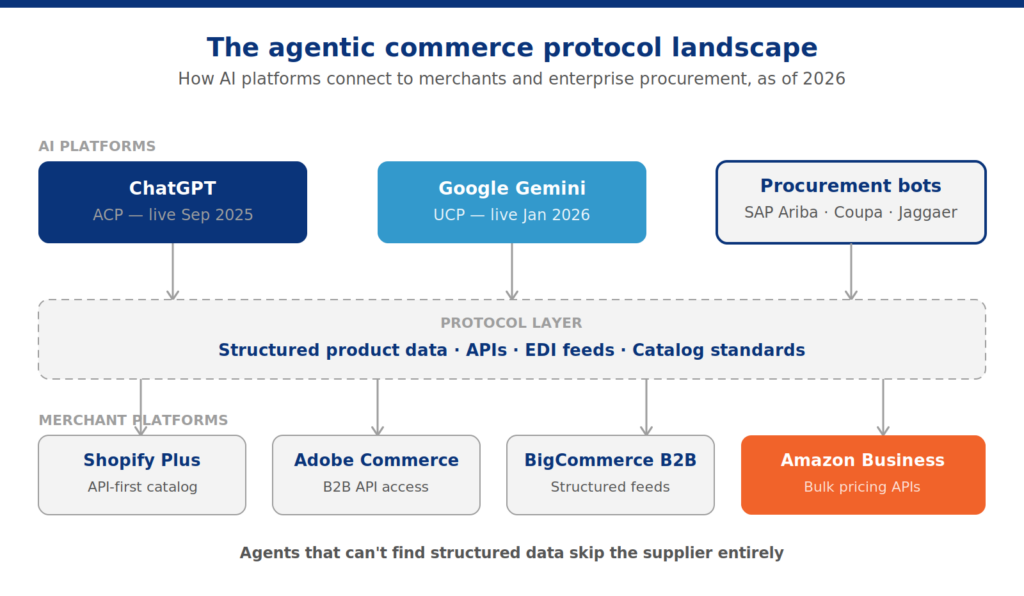
This is no longer theoretical. OpenAI launched its Agentic Commerce Protocol (ACP), built with Stripe, in September 2025, enabling purchases directly inside ChatGPT without the buyer ever visiting a merchant’s site. In January 2026, Google launched the Universal Commerce Protocol (UCP) with partners including Walmart, Target, Shopify, and Etsy. On the enterprise side, procurement bots integrated into SAP Ariba and Coupa are already running structured purchasing workflows.
That means your buyer may not visit your site at all. The agent might.

Why Does This Matter for B2B eCommerce?
B2B buying is already structured, repeatable, and rules-driven. That’s exactly what agents handle well.
Gartner’s shift-to-digital forecast proved out: by 2025, 80% of B2B sales interactions between suppliers and buyers were occurring in digital channels. That’s now the baseline. But Gartner’s 2025 follow-up research adds a wrinkle worth noting; for complex, high-stakes deals, buyers are trending back toward wanting human involvement. The appetite for rep-free experiences is softening at the top of the deal spectrum.
For B2B agentic commerce, that’s actually clarifying rather than discouraging. It means agents will dominate routine, structured, repeat purchasing (exactly the workflow they’re built for) while humans remain in the loop for strategic or complex buys. Know which bucket your transactions fall into.
McKinsey’s 2024 B2B Pulse Survey confirms the momentum: 39% of B2B buyers are now willing to place orders of $500,000 or more through digital self-service or remote channels, up from 28% just two years earlier.
The behavior is there. Agents compress the journey further.
Here’s the key shift: you’re no longer optimizing for a human buyer alone. You’re optimizing for a decision system.

How Does Agentic Commerce Actually Work?
At a basic level, an agent follows a loop:
- Understand the goal (e.g., reorder 500 units of industrial valves under $20 each)
- Search suppliers and compare options
- Evaluate constraints like price, delivery time, and contract terms
- Execute the purchase through an API or web interface
In B2B, this often connects to procurement platforms like SAP Ariba, Oracle NetSuite, or Coupa. Many teams are already exposing product catalogs via APIs or structured feeds to make this easier.
Here’s the part most teams miss: agents rely heavily on structured data. If your catalog is messy, you’re invisible.
Where Agentic Commerce Drives Real Upside
It reduces friction in repeat purchases. That sounds simple, but it compounds fast.
If a procurement agent can reorder from you without human input, you become the default vendor. That increases retention and lifetime value.
It also rewards clarity. Clean pricing tiers, clear shipping terms, and consistent product data improve your chances of being selected.
Amazon Business pushes in this direction with its API-driven purchasing and bulk pricing models, making it an easy target for agent-based buying. Smaller suppliers can compete if they match that machine-readable clarity.
Agentic commerce also expands your reach. Your product can surface in decision flows you don’t control, including AI assistants embedded in ERP systems and procurement platforms.
That’s new distribution.
Where the risks show up
Agents optimize for the buyer, not for you.
If your pricing is inconsistent, agents find cheaper alternatives. If your delivery estimates are vague, you lose to vendors with precise SLAs.
Margin pressure is the first hit. Agents compare faster than any human buyer ever could.
Brand also takes a hit. If the agent makes the decision, your differentiation must be explicit in data, not just in messaging.
There’s also a governance risk. If an agent places an order incorrectly, who owns the error? In B2B, a wrong order can mean thousands of dollars in losses.
Security matters too. Granting agents access to accounts, pricing, and checkout flows opens new attack surfaces. Early rollouts have already surfaced real friction: OpenAI’s Instant Checkout launch faced merchant onboarding difficulties and order errors, leading the company to evolve its approach as of early 2026. The technology works, but it isn’t frictionless yet, and the gaps tend to show up in governance and data quality.
The Part Most Teams Miss
Agent readiness is not a feature. It’s an operating model.
Many teams think adding an API or chatbot solves this. It doesn’t. The real work is upstream: product data normalization, contract and pricing logic in machine-readable formats, near-real-time inventory accuracy, and clear rules for approvals and exceptions.
Without this, agents either fail or bypass you.
Agent behavior also isn’t static. It learns. That means your performance today affects future selection. Miss SLAs consistently, and agents will downgrade you.
How to Prepare Without Overcommitting
Start by treating agents as a new buyer segment.
Audit your catalog. Are your SKUs consistent? Do you expose attributes like dimensions, compliance standards, and lead times clearly?
Next, expose structured access through APIs, EDI, or clean product feeds. Shopify Plus, Adobe Commerce, and BigCommerce B2B Edition all support API-first catalog access. If you’re targeting enterprise procurement, prioritize integration with SAP Ariba, Coupa, or Jaggaer these are where enterprise agents are already operating.
Then define guardrails. Set rules for pricing exposure, order limits, and authentication. Don’t let agents transact without controls.
Test agent flows directly. Use tools like ChatGPT or Gemini to simulate how an agent interprets your product data. You’ll find gaps fast.
Revolution or Liability?
It’s both. The difference comes down to control.
Structure your data, expose clean access, and set rules: agentic commerce becomes a growth channel. Ignore it: it turns into a margin drain and a visibility problem.
The shift mirrors early marketplace adoption. The winners weren’t the first to join. They were the first to operate well inside the system.
Frequently Asked Questions
What’s the difference between agentic commerce and traditional eCommerce automation?
Traditional eCommerce automation handles rules-based tasks you define in advance — auto-reordering when stock hits a threshold, for example. Agentic commerce goes further: the AI agent interprets goals, searches and compares options across suppliers, evaluates constraints like price and delivery time, and executes the purchase — all without a human in the loop. It’s the difference between a workflow trigger and an autonomous decision-maker.
Does agentic commerce only apply to large enterprise B2B buyers?
No, but enterprise is where it’s moving fastest right now, given existing integrations with procurement platforms like SAP Ariba, Coupa, and Jaggaer. That said, the infrastructure is broadening quickly. OpenAI’s Agentic Commerce Protocol and Google’s Universal Commerce Protocol are open standards, meaning mid-market buyers using tools like Shopify or even ChatGPT can already run agent-assisted purchasing flows. Smaller suppliers who get their data clean early will be better positioned than larger ones who move slowly.
How do I know if my product catalog is “agent-ready”?
A quick test: open ChatGPT or Gemini, describe your product category and a set of buying constraints (price, lead time, compliance standard), and see if your business surfaces — and how accurately it’s represented. If key attributes like dimensions, certifications, or shipping terms are missing or inconsistent, agents will either skip you or return wrong information. SKU consistency, structured data feeds, and accurate inventory are the three most common gaps.
Who’s liable if an AI agent places a wrong order?
This is still largely unsettled, and it’s one of the most important governance questions B2B teams need to answer before scaling agent access. In practice, liability tends to fall on whoever granted the agent authorization — which means the buyer’s organization. For suppliers, the risk is fulfilling an order that later gets disputed. The safeguard is setting clear order limits, authentication requirements, and approval thresholds before any agent can transact against your catalog.
Will agentic commerce reduce the role of our sales team?
For repeat, structured purchasing, probably yes, over time. That’s the workflow agents are best suited for, and it’s also where your sales team adds the least unique value. For complex, high-value, or strategic deals, the answer is different: Gartner’s 2025 research shows buyers are actually trending back toward wanting human involvement for high-stakes transactions. The smarter framing isn’t “will agents replace sales?” but “which parts of the funnel should agents own so your sales team can focus where humans still win?”
What to do Next
Audit your product and pricing data within the next 30 days. Pilot one agent-friendly integration next quarter. Define governance rules before scaling access.
That’s enough to move from reactive to prepared. The window to shape how agents interact with your business is still open, but it’s closing faster than most teams realize.


 By Aaron Shapiro