What Goes Into a Typical B2B Implementation, and What Usually Makes It Hard?

Honey Olesen

A typical B2B implementation is not a storefront redesign. It is a sales process, an account model, and a pricing model turned into software.

Shopify B2B centers that model on companies, company locations, and customer contacts, while Adobe Commerce B2B centers it on company accounts, shared catalogs, quotes, and company roles.

That is why B2B projects feel bigger than they first look. The visible site is only one layer. The harder work is deciding who owns customer data, where prices come from, how approvals work, and how orders move between commerce and ERP systems. Oracle’s NetSuite Connector docs make that clear by defining syncs for item and transaction data at set intervals between storefronts and NetSuite.

What does the platform actually need to do?

The platform needs to support company buying, not just product browsing. In Adobe Commerce, enabling company support turns on shared catalogs, B2B quotes, and B2B payment and shipping methods, while Quick Order and Requisition List are enabled separately. In Shopify B2B, companies control pricing, products, payments, delivery options, and other account-specific settings.

The first challenge is that teams often mistake “native B2B features” for “little implementation work.” That is rarely true. Shopify’s Quick order list requires either an updated theme or custom Liquid or JavaScript, and Shopify labels that work as advanced. Adobe also starts with B2B features disabled by default, which means activation, configuration, and testing are part of scope from day one.

So platform selection should follow the operating model. If your buyers need branch-specific catalogs, negotiated quotes, payment terms, or fast SKU ordering, those needs should drive the decision. A polished demo matters less than whether the platform can model how your customers actually buy.

Why does ERP integration expand the whole project?

ERP integration expands the project because it decides where business truth lives. Oracle says NetSuite Connector pulls data from one system and pushes it to another, using syncs for item and transaction-related data at defined intervals. It also says the flow depends on the availability and integrity of the data in both NetSuite and the storefront.

That sounds clean on paper. The real challenge is data ownership and data quality. You need to decide whether ERP owns the item master, inventory, customer master, payment terms, tax status, and fulfillment state, or whether some of those rules live in commerce. If that decision is fuzzy, the integration may run, but the business process still breaks.

The part most teams miss is duplicate and mismatched customer records. Oracle’s own order sync guidance says NetSuite Connector matches customers by company name or by name and email, and if multiple matches exist, it uses the oldest record by creation date. That is a direct warning that messy account data can route orders to the wrong customer record, even when the API itself works.

A young woman in a warehouse working with a laptop uses a barcode scanner enters data into the program

Why does pricing logic get messy so fast?

Pricing logic gets messy because B2B rarely has one price. Shopify B2B supports quantity rules, minimums, maximums, increments, and volume pricing, with up to 10 price breaks per product. Adobe Commerce adds negotiated quotes, where buyers and sellers can keep updating quantities and discounts until they reach an agreement.

This is where a mild contradiction usually shows up. Teams say pricing is simple because they already have a price list. Then they also want branch pricing, contract pricing, volume breaks, quote exceptions, and payment terms. Those goals can all be valid, but they stop being simple the moment more than one pricing source applies to the same order.

Shopify’s own catalog rules show why this matters. If the same company location receives the same product from two catalogs at different prices, Shopify displays the lowest price. If two catalogs tie on the lowest price, Shopify uses the quantity rules and volume pricing from the first catalog created. That means pricing precedence should be settled before build starts, not during user acceptance testing.
B2B Implementation - BB Controls

What should customer accounts support?

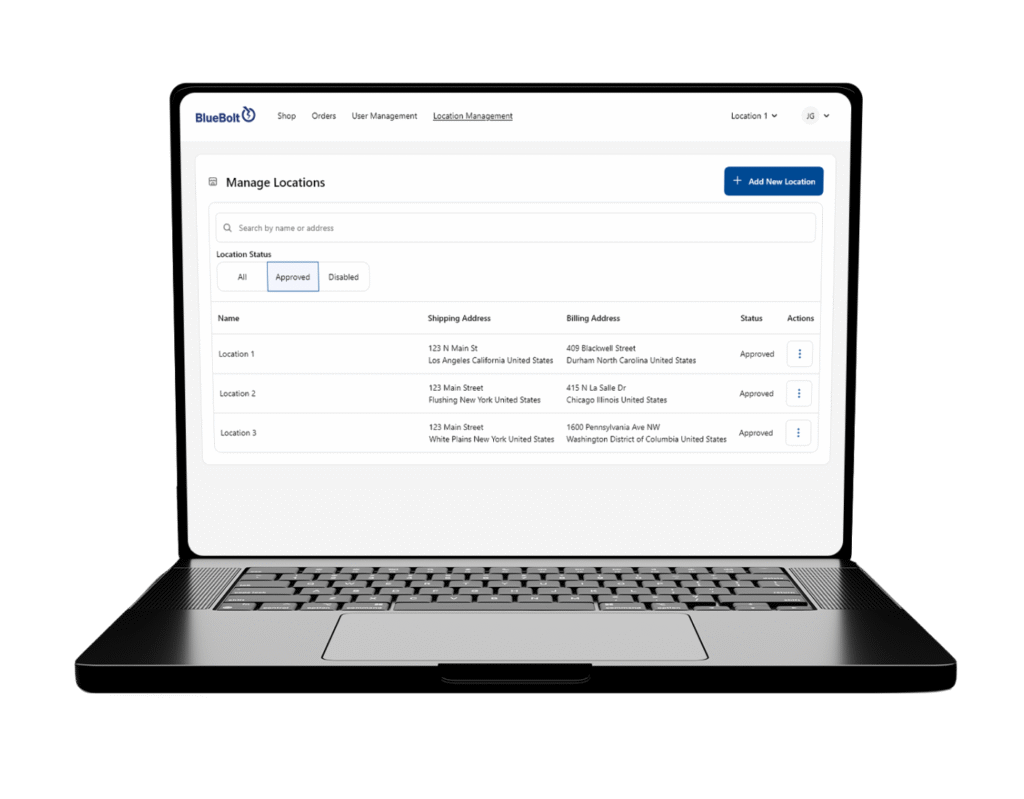
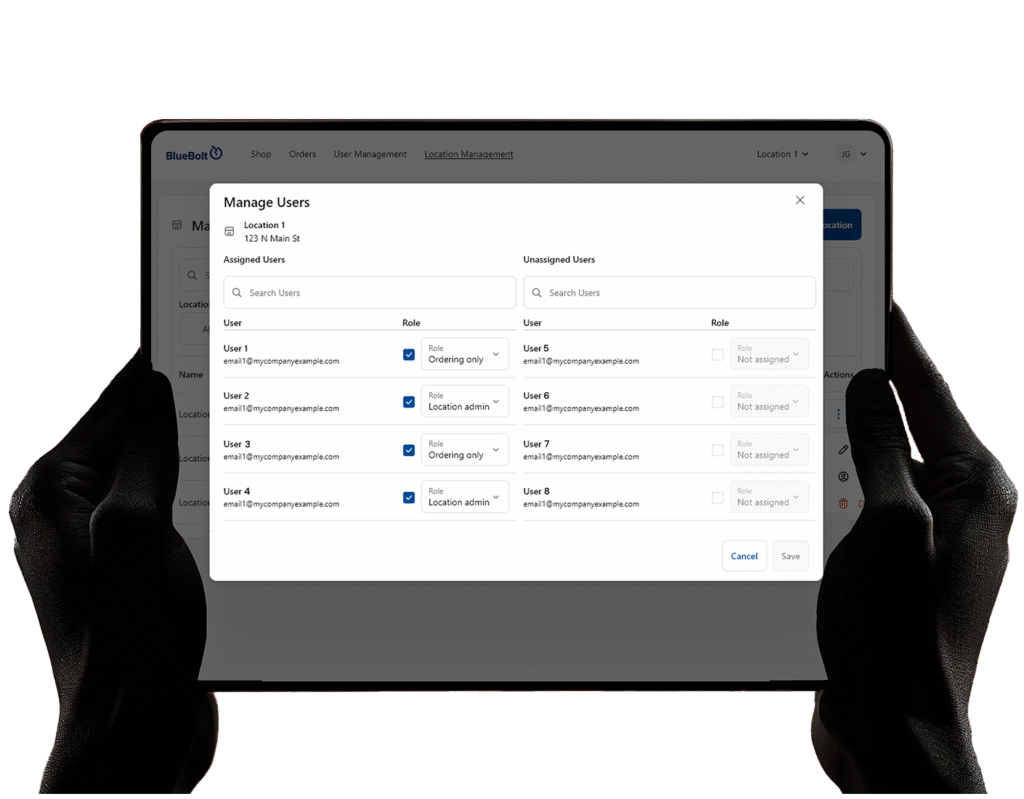
In B2B, the account model is the product. Shopify says each company location can have its own tax ID, tax exemptions, shipping and billing addresses, pricing, payment terms, checkout settings, and contacts. Shopify’s developer docs also note that catalogs can be assigned only to a company location, not generically to the whole company.

Adobe Commerce takes a similar view from a different angle. Its company account structure can reflect teams, divisions, and subdivisions, and the company administrator can assign roles and permissions to users. Adobe even documents example roles such as Senior Buyer and Assistant Buyer, which shows how quickly permissions become part of the implementation, not just an admin task after launch.

The challenge is that many projects still flatten B2B into one customer record and one shared login. That saves time at kickoff, but it creates manual work later. Branch-level addresses, branch-specific payment terms, separate approvers, and different buyer permissions all become hard to manage once the underlying model is wrong.
Customer Accounts

What makes dealer onboarding harder than it looks?

Dealer onboarding is not a registration form. It is an approval workflow that turns a prospect into a valid trading account. That usually includes company details, location data, buyer contacts, payment terms, shipping rules, tax status, permissions, and the right catalog assignment before the first order is placed.

Shopify’s company account request flow makes this explicit. A submitted request can create a company, customer, and location for review, and by default that new company cannot place orders or access B2B pricing until it is approved. Adobe says storefront company requests remain in Pending Approval until an administrator reviews and approves or rejects them.

A common onboarding snag is gating. Shopify says company account requests cannot be used on a dedicated gated B2B-only store because the form is not accessible to non-logged-in visitors. So teams need to choose early between a public intake flow with hidden sensitive content, or a fully gated store with a more manual dealer application process.

Tax and compliance add another layer. Avalara says exemption certificates can be validated in real time and reconciled directly within the tax workflow, producing audit-ready documentation. For wholesale and dealer channels, that work belongs in onboarding. If you bolt it on later, the sales team ends up fixing avoidable tax and account problems by hand.

What drives B2B adoption (and where it breaks)

Adoption usually comes down to speed:

  • Buyers expect to order faster than email, phone, or spreadsheets
    • Teams underestimate how important fast reordering is
  • Fast ordering tools are critical for repeat purchases of known SKUs
    • Adobe Quick Order supports bulk SKU entry and rapid ordering
  • B2B buyers are not browsing, they are executing known purchases
    • Shopify Quick Order can support this, but often requires theme updates or custom code
      • Shopify classifies this as an advanced implementation task
  • Budgets often prioritize ERP integration over frontend usability
    • The result is a functional system that buyers avoid using

Frequently Asked Questions

  • What is a B2B implementation?

    A B2B eCommerce implementation is the process of building a digital sales channel for business buyers. It includes platform setup, ERP integration, pricing logic, customer account structures, payment terms, and dealer onboarding workflows. The goal is to match the system to how your business already sells, not just launch a website.

  • How is a B2B implementation different from B2C?

    B2C usually centers on one shopper, one price, and a fast checkout. B2B usually involves company accounts, branch locations, negotiated pricing, payment terms, tax handling, and approval steps. That means the scope is wider even when the storefront looks simple. A B2B build has more business rules behind it.

  • What does a typical B2B implementation include?

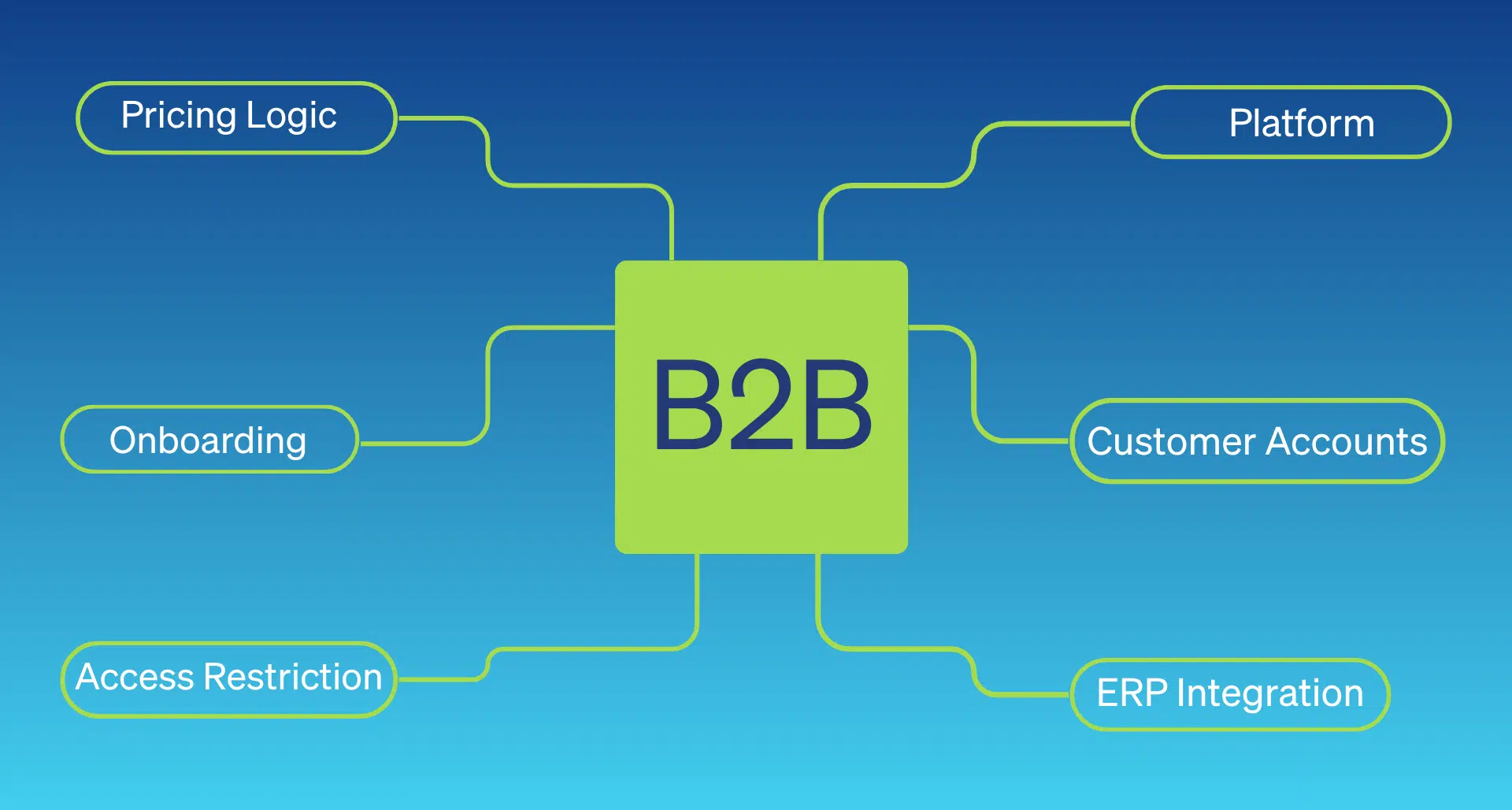
    A typical B2B implementation includes five core areas: platform configuration, ERP integration, pricing logic, customer account setup, and dealer onboarding. It may also include payment terms, tax handling, approval workflows, and bulk ordering tools. These elements work together to support real-world B2B buying processes.

  • Why is ERP integration such a big part of the project?

    ERP integration matters because it controls how data moves between teams and systems. If products, pricing, inventory, or customer records are wrong in the ERP handoff, the storefront will expose those problems fast. The technical connection is only part of the work. The harder part is deciding who owns each data point and what happens when records conflict.

  • What are the biggest challenges in a B2B implementation?

    The biggest challenges are usually data quality, pricing complexity, account structure, and unclear ownership between teams. Many projects stall because the business rules are not settled before build starts. Teams may agree on the platform, but still disagree on who owns pricing, how approvals should work, or how customer records should be grouped.

  • How long does a typical B2B implementation take?

    A typical B2B implementation can take anywhere from 3 to 9 months, depending on complexity. Projects with heavy ERP integration, custom pricing logic, and detailed account structures tend to take longer. Clear requirements and clean data can shorten timelines.

A B2B eCommerce implementation succeeds or fails long before launch day. The difference is not the platform or the design. It is whether the business rules behind pricing, accounts, ERP data, and onboarding are clearly defined and tested. Teams that treat this as an operating model project build systems that scale. Teams that skip that step end up patching gaps after go-live. If you get the foundations right, the platform becomes a growth channel, not just a digital catalog.

Plan Your B2B Implementation the Right Way

How Shopify Markets Simplifies International eCommerce

Aaron Shapiro

What Is Shopify Markets and How Does It Simplify International eCommerce?

Shopify Markets is Shopify’s native solution for managing international eCommerce from a single store. It allows merchants to localize pricing, currencies, domains, taxes, and content by region without creating multiple storefronts.

Shopify Markets simplifies global eCommerce by:

  • Eliminating the need for multiple stores
  • Centralizing operations in one Shopify admin
  • Localizing pricing, currency, and payment methods
  • Calculating duties and taxes at checkout
  • Supporting international SEO and domains

Why Shopify Markets Replaces Multi-Store Setups

Before Shopify Markets, international expansion required:

  • Separate Shopify stores per region
  • Duplicate product catalogs
  • Manual pricing updates
  • Fragmented analytics

Shopify Markets eliminates this model by allowing region-specific customization within a single backend.

Result: Lower operational overhead and faster global scaling.

Key Benefits of Shopify Markets for Global eCommerce

1. Localized Currencies and Payments

International conversion rates often drop at checkout due to unfamiliar currencies or limited payment options.

Shopify Markets automatically:

  • Detects customer location
  • Displays prices in local currency
  • Enables region-specific payment methods

For example:

  • China → Alipay
  • Netherlands → iDEAL
  • United States → Credit cards

Why it matters: Payment localization is a top driver of international conversion rate optimization.

Shopify Markets: Currencies

2. Market-Specific Pricing and Catalogs

Different markets require different pricing strategies due to purchasing power, competition, and demand.

With Shopify Markets, you can:

  • Set regional pricing rules
  • Adjust margins by country or region
  • Customize product availability per market

B2B advantage: Wholesale pricing and negotiated rates can be managed without creating duplicate stores; critical for scaling complex commerce operations.

3. Duties and Taxes

International selling used to mean endless confusion about duties and import taxes. Shoppers would abandon carts the moment they saw “taxes calculated at delivery” or got hit with surprise fees. Unexpected import fees are one of the top causes of cart abandonment in cross-border commerce.

Shopify Markets:

  • Calculates duties and import taxes upfront
  • Displays total landed cost at checkout
  • Eliminates surprise fees at delivery

Result: Increased trust, fewer abandoned carts, and reduced customer support issues.

4. SEO and Content Localization

To rank high in local search engines, you need localized content and SEO. Shopify Markets supports local domains, languages, and SEO. Ranking in international search results requires more than translation; it requires localization.

Shopify Markets supports:

  • Country-specific domains (e.g., .de, .co.uk)
  • Multi-language storefronts
  • Regionally optimized SEO signals

Example:
German customers see German-language content and localized SEO structure, improving visibility in regional search engines.

SEO Impact:
Localized SEO signals improve rankings in regional search engines and AI-generated answers.

5. Unified Operations in One Store

The biggest operational advantage is consolidation.

Instead of managing multiple stores, Shopify Markets allows you to:

  • Maintain a single inventory system
  • Centralize order management
  • View unified analytics and reporting
  • Manage customers in one database

Business impact:

  • Faster decision-making
  • Reduced operational complexity
  • Cleaner data
people shopping and world flags

Real-World Example of Shopify Markets in Action

Take a consumer electronics brand that managed four separate Shopify stores: one for the US, one for the UK, one for the EU, and one for Australia. Every product launch meant uploading products four times. Every price change required adjustments in four different backends. Reporting meant manually combining numbers from four separate dashboards.

This led to:

  • Duplicate product uploads
  • Manual price updates across stores
  • Fragmented reporting

After migrating to Shopify Markets:

  • All operations moved into a single store
  • Regional experiences remained fully localized
  • Reporting became centralized and accurate

Outcome: Reduced operational overhead and improved scalability.

Why Shopify Markets Matters for eCommerce Growth

Global eCommerce is rapidly expanding, but operational complexity often limits growth.

Shopify Markets removes key barriers by:

  • Eliminating the need for multiple storefronts
  • Delivering localized customer experiences
  • Simplifying backend operations

Bottom line:
Merchants can scale internationally without scaling complexity.

Shopify Markets vs Multiple Stores

FeatureShopify MarketsMultiple Stores
Store ManagementSingle adminMultiple backends
LocalizationBuilt-inManual
ReportingUnifiedFragmented
ScalabilityHighLimited
Operational CostLowerHigher

FAQ: Shopify Markets

What is Shopify Markets?

A built-in Shopify solution that enables merchants to manage international selling from a single store while delivering localized experiences.

Do I need multiple Shopify stores to sell internationally?

No. Shopify Markets eliminates the need for separate regional stores.

Can I control pricing by country?

Yes. You can set market-specific pricing and product availability.

Does Shopify Markets handle taxes and duties?

Yes. It calculates and displays duties and taxes at checkout.

Is Shopify Markets good for B2B?

Yes. It supports region-specific pricing and helps manage complex global buyer structures.

Key Takeaways

  • Shopify Markets = single-store global commerce infrastructure
  • Eliminates store duplication
  • Improves conversion rates through localization
  • Reduces operational complexity
  • Supports international SEO and discoverability

Final Takeaway

Shopify Markets transforms international eCommerce from a fragmented, high-maintenance model into a centralized, scalable system. For merchants, that means: lower operational costs, faster expansion into new markets, and better data and insights. For customers, it means a seamless, localized shopping experience anywhere in the world. As a certified Shopify Plus Partner, BlueBolt can help.

Built for Brands Managing Complex Global Commerce

Agentic Commerce: How to Prepare Your Backend for AI Buyers

Honey Olesen

A gents of AI are beginning to research, compare, and complete purchases on behalf of human buyers.

This shift (called agentic commerce) will favor merchants with clean data, fast APIs, and real-time inventory accuracy. Here is what it means and how to get ready.

What is agentic commerce?

Agentic commerce is the use of autonomous AI software (agents) to carry out purchasing decisions on behalf of a person or organization. Rather than a human browsing a site, adding items to a cart, and checking out, an AI agent receives a goal, evaluates options across multiple suppliers, and executes the transaction.

This is distinct from chatbot-assisted shopping. An agent does not need a human in the loop for routine decisions. It acts on pre-set parameters: budget, preferred suppliers, delivery requirements, and compliance rules.

Why is this happening now?

Several converging developments have made agentic commerce viable in 2024 and 2025:

  • Large language models can now reliably parse product specifications, compare structured data, and execute multi-step tasks without human supervision.
  • Major platforms are shipping purpose-built shopping agents. Amazon deployed its Rufus assistant for multi-step purchasing tasks. Google Gemini added shopping agents capable of planning and sourcing in a single session. OpenAI has embedded decision-making models across its platform ecosystem.
  • B2B procurement software is beginning to integrate agentic capabilities, targeting the high-volume, repeat-purchase workflows where automation delivers the clearest ROI.

Projected global agentic commerce volume by 2030 (McKinsey)

Year-over-year increase in AI traffic to US retail sites, Black Friday 2025 (Adobe)

Customers who abandon purchases due to insufficient product data (Mirakl)

How do AI agents actually make purchasing decisions?

Agents do not read web pages the way humans do. They query structured data endpoints, evaluate responses against their parameters, and either proceed or move on; typically in milliseconds.

Consider a concrete B2B example: a dental clinic network runs low on surgical masks. Its inventory software triggers a purchasing agent. That agent queries connected suppliers, checks real-time stock levels, confirms negotiated pricing tiers, calculates estimated delivery windows, and places the order; all without a human opening a browser tab.

Three things determine whether your business is selected or skipped:

  1. Data clarity: complete, structured, consistently formatted product information that an agent can parse without ambiguity.
  2. API reliability: fast, well-documented endpoints that return accurate responses under automated load.
  3. Real-time accuracy: stock levels, pricing, and availability that reflect actual state, not a batch update from last night.

If any of these fail, the agent does not file a support ticket. It queries your competitor.

What is the visibility gap, and why does it matter for attribution?

In conventional ecommerce, merchants see the full funnel: impressions, click-throughs, product page views, cart additions, and drop-offs. In agent-mediated commerce, that visibility collapses. The discovery, comparison, and shortlisting phases happen inside an AI interface. Merchants only see the transaction if it completes.

conversion

This has direct consequences for retail media, personalization strategies, and any analytics model built on behavioral data. Adobe’s Black Friday 2025 report documented the scale of the problem: AI-driven traffic to retail sites surged 805% year-on-year, but conversion rates on that traffic lagged significantly because most merchant infrastructure was not built to serve agents cleanly.

What technical requirements do AI agents have?

Structured product data

Agents do not infer meaning from design or marketing copy. They read schema.org/Product markup, Global Trade Item Numbers (GTINs), standardized attribute sets, and clean product feeds. Incomplete GTINs, inconsistent attributes, or thin descriptions result in your products being excluded from agent shortlists. The Mirakl benchmark puts the cost of this at a 42% purchase abandonment rate a threshold agents apply programmatically, at scale.

Real-time inventory and pricing APIs

Batch-updating inventory once daily is no longer sufficient. When an agent builds a multi-item order, and one product appears available but is actually out of stock, the transaction fails, and your reliability score drops. Agents and the platforms running them maintain supplier quality signals. Repeated inaccuracies move you down the preference stack.

ERP and PIM integration

The most common failure point we see in B2B and mid-market merchants is the gap between front-end commerce platforms and back-end systems like NetSuite, Microsoft Dynamics, or SAP. When product information lives in a PIM like InRiver or Akeneo but does not sync instantly to the commerce layer, agents receive stale data. The fix is not a new platform; it is a proper integration architecture between the systems you already have.

Fast, documented API gateways

Your API is now a primary sales channel. It needs to be secure, rate-limit-tolerant, versioned, and capable of handling concurrent automated requests without degrading response times. Poorly documented or unstable APIs are filtered out by agent platforms that maintain supplier quality registries.

How to prepare your commerce infrastructure for AI agents

You do not need to rebuild your stack. You need to audit it honestly and fix the integration gaps that currently exist. Here are the four areas that move the metric:

Run your product catalog through Google’s Rich Results Test and the Schema Markup Validator. Every product needs a complete schema.org/Product entry: name, description, GTIN, brand, offers (with price and availability), and relevant category attributes. Products missing these fields will not surface in agent-driven shortlists or AI-generated shopping responses.

Map the data path from your PIM or ERP to your commerce platform. Where does data wait in a queue? Where is it transformed manually? Every manual step is a latency risk. Automated, event-driven sync (where a stock update in your warehouse system triggers an immediate update in your product feed) is the target state.

Replace batch inventory jobs with event-driven updates. Most modern ERP and WMS platforms support webhooks or change-data-capture. If yours does not, a middleware integration layer can bridge the gap without a full platform replacement.

Review your API documentation, rate limits, and uptime SLAs. Agents query at high concurrency during demand spikes. If your API degrades under load or returns inconsistent responses, you will be removed from agent preference lists. Implement caching, circuit breakers, and structured error responses that agents can parse and act on.

Frequently asked questions

Is agentic commerce only relevant for large enterprises?

No. B2B wholesale, mid-market manufacturing suppliers, and specialist retailers are early targets precisely because their purchasing patterns are repeat-heavy and rule-based, exactly the workflows agents handle best. The infrastructure requirements are the same regardless of company size.

Will human shoppers disappear?

No. High-consideration, emotionally complex, or first-time purchases will remain human-driven. Routine replenishment, specification-matched B2B procurement, and commodity purchasing are where agents will dominate first.

How quickly is this happening?

The foundational technology is already deployed. Walmart, Target, and Home Depot are investing in agent-ready infrastructure now. The brands that have clean data and reliable APIs in 2025 will be the default selections for AI agents in 2026 and beyond. Merchants who wait will face a steeper remediation curve.

What is the biggest mistake merchants are making right now?

Investing in front-end AI features (chatbots, recommendation widgets, visual search) while ignoring the data and integration quality that determines whether agents can transact with them at all. The visible layer is not the bottleneck. The plumbing is.

Why Your B2B PDPs Must Speak AI in 2026

Aaron Shapiro

B uying expectations have shifted permanently. B2B buyers no longer want to dig through static spec sheets or wait days for a basic quote.

They expect consumer-grade ease combined with enterprise-grade accuracy. Your product detail page (PDP) is no longer just a digital catalog entry. It is a system that must answer complex questions, reduce purchasing risk, and accelerate decisions across procurement, engineering, and operations.

For business leaders driving digital commerce strategy, this reality is both an opportunity and a strict design requirement. Buyer expectations demand self-serve clarity, personalized guidance, and the ability to seamlessly compare options within complex catalogs. You need PDPs structured so AI and search engines can interpret them, rich enough to answer real questions, and integrated enough to reflect live pricing and inventory.

This guide explores what it means to build AI-ready PDPs. We will cover the foundational data requirements, practical design patterns, platform considerations, and the metrics you need to track success.

The Shift: PDPs are Now Decision Engines

Most B2B platforms fail the buyer because they treat the PDP as a passive information repository. When buyers land on your site, they arrive with specific, complex problems. They need to know if a part fits their specific machine model, if a component meets regulatory compliance, or if an item ships fast enough to prevent factory downtime.

When your PDP acts as a decision engine, it actively helps the buyer navigate these hurdles. AI tools, including generative and agentic AI, are completely reshaping B2B workflows by automating complex purchasing tasks. However, AI cannot function on a foundation of fragmented data. If your product truth is buried in PDFs or siloed in legacy systems, AI cannot surface it.

Transforming a PDP into a decision engine requires cleaning up technical debt and structuring your data so that artificial intelligence can read, understand, and serve it directly to the buyer precisely when they need it.

What “Speaking AI” Actually Means for B2B

Many teams hear “AI” and immediately picture a basic customer service chatbot. In reality, an AI-ready PDP is about making your core product data usable across multiple channels and systems. When your PDP speaks AI, it powers highly functional, revenue-driving features.

First, it enables on-site search and recommendations that actually understand user intent. Instead of requiring an exact part number, an AI-powered search can understand queries like “fits a 2018 compressor” or “meets FDA compliance.”

Second, it allows for guided selling flows that drastically reduce wrong orders and costly returns. AI can analyze compatibility, compliance rules, and performance thresholds to ensure the buyer selects the exact right configuration.

Third, it provides massive support deflection. By automatically answering common questions with product-specific data, you free up your sales and support teams to handle high-value interactions. Speaking AI ultimately means speaking structure, context, and confidence.

Man shopping for a vest online

The Baseline: AI-Ready Product Content and Data

The biggest roadblock to AI integration is not the software you choose. It is the underlying product data model. For AI-supported experiences to work, your baseline must include strong product information management, clear taxonomy, and consistent metadata.

An AI-ready PDP requires clear product naming conventions, including both internal and customer-facing part numbers. It needs normalized attributes, meaning units, ranges, and materials are formatted consistently across the entire catalog. Variant logic must match how your customers actually buy, rather than how your ERP stores SKUs.

This is where backend plumbing becomes critical. Integrated solutions built to perform require seamless connections between your ERP for pricing and availability, your PIM for product attributes, and your digital asset manager for CAD files and safety data sheets. If your PDP content cannot be reliably reused for site search, dynamic filters, and comparison tables, your site simply is not AI-ready. We specialize in the complex technical plumbing required to solve these backend problems and drive real ROI.

Practical PDP Patterns to Improve the Buyer Experience

You do not necessarily need a total site rebuild to start seeing results. Many of the highest-impact improvements come from practical patterns you can apply through targeted optimization. Here are several ways to streamline your operations and enhance engagement right now.

“Choose Your Path” Purchasing Clarity

B2B buyers arrive with entirely different intents. A procurement officer might know the exact part number, while an engineer might need documentation before they can approve a purchase. Your PDP should support multiple entry points. A clear, simple navigation block near the top of the page can route buyers instantly to configuration tools, compatibility charts, or technical documentation.

Specification Tables That Answer Questions

Specs should be highly scannable, comparable, and ready for filtering. Instead of a massive, unorganized list, group your data by buyer concerns. Categorize specs into performance metrics, materials, compliance certifications, and environmental ratings. Structuring specs this way drastically improves the user experience and makes downstream AI integration much easier to implement.

Trustworthy Compatibility Modules

For manufacturers with complex catalogs, a compatibility module is often the most critical element for conversion. Make this tool trustworthy by allowing buyers to search by equipment model and clearly displaying known compatible accessories. Providing “verified by manufacturer” language builds trust, and including edge-case notes about fit constraints prevents frustrating returns.

Guided Selling for Complex Configurations

If your product requires selecting specific voltages, mounting types, or finishes, use a guided flow. Explain each choice in plain language, prevent invalid hardware combinations, and update lead times dynamically based on the configuration. This reduces friction and supports procurement teams that prioritize correctness above all else.

Operational Truth Blocks

Buyers care deeply about how a product arrives and how it is maintained over its lifecycle. Include clear operational details like palletization notes, warranty intervals, and recommended spare parts. Placing these details front and center reduces back-and-forth emails and shortens the overall sales cycle.

A professional buyer shopping online.  Computer screen shows a table form of products.

Choosing the Right Platform

Scalable solutions require a robust foundation. Platforms like Shopify Plus and Optimizely are excellent choices for supporting B2B manufacturing outcomes. The right fit depends heavily on your specific catalog complexity, account-level pricing rules, and dealer network structure.

Shopify Plus offers a highly flexible architecture for custom attributes and account experiences, which is vital when procurement workflows require multi-level approvals. Optimizely is highly valued by manufacturers for its strengths in structured content and enterprise-grade commerce patterns.

Regardless of the platform, the goal is strategy aligned to execution. You need a platform that handles your specific technical debt while providing a scalable foundation for future growth. We help evaluate, curate, and implement these platforms, ensuring your digital strategy is built on execution you can trust.

A Phased Approach to Modernization

You do not have to endure the chaos of a massive, overnight replatforming project. Often, a phased approach reduces risk and delivers a faster return on investment.

Start by defining your exact outcomes. Clarify whether the PDP must enable self-serve purchasing, RFQ generation, or complex dealer ordering. Next, audit your product data. Identify the missing attributes and inconsistent documentation that block discovery.

From there, design a scalable PDP template system using modular blocks for specs and compatibility. Implement the data foundations and integrations first to unlock live pricing and inventory. Finally, launch in waves. Start with a high-impact product family, measure the results, and optimize continuously. This step-by-step strategy minimizes downtime and ensures the new system actually serves your business goals.

Metrics That Matter

To ensure your AI-ready PDP efforts connect directly to revenue and efficiency, you must track the right data. Avoid vanity metrics and focus on indicators of true business impact.

Track your PDP-to-cart and PDP-to-RFQ rates by product family to understand baseline conversion. Monitor search success rates and filter usage to gauge discoverability. Look closely at conversion rates separated by buyer type, comparing logged-in dealers against guest procurement users.

Pay attention to documentation engagement. If buyers are downloading CAD files and data sheets, your content is doing its job. Finally, track return rates and indicators of wrong orders. A successful AI-driven PDP will actively reduce the number of support tickets tied to incorrect configurations.

Moving Forward with Confidence

AI is already influencing how B2B buyers research and purchase. The companies that win will be the ones with PDPs built to support this reality. Upgrading your digital presence starts with structured data, modular design, and integrations that reflect operational truth.

For over two decades, BlueBolt has translated ambitious business goals into powerful, reliable digital platforms. We are an extension of your team, providing the strategic guidance and deep technical expertise to architect, build, and optimize the systems that power your growth. If you need a partner who provides expert-built custom solutions, we know the best path forward.

Need Help Modernizing Your PDP?

The Five Obstacles That Quietly Cripple B2B eCommerce

Honey Olesen

E very year, merchants ask the same question. Why is B2B eCommerce so hard?

Short answer. It isn’t the technology. Not really. The obstacles tend to live inside the business itself. Process problems. Data problems. Habit problems.

Five show up over and over again. Let’s walk through them.

1. Pricing Complexity That Nobody Wants to Untangle

B2B pricing can get… messy. Fast.

A distributor might have:

  • contract pricing
  • volume tiers
  • customer group discounts
  • quote-based orders
  • negotiated freight rates
  • rebate programs tied to quarterly spend

Some industrial suppliers may have up to 17 different pricing tables inside their ERP. Seventeen. And half of them may override, layered on top of overrides, because someone once promised a deal at a trade show in Chicago in 2022.

No eCommerce platform handles that elegantly right out of the box. Not Shopify Plus, not Adobe Commerce, not BigCommerce B2B Edition.

They can support complex pricing. But they require structure. Clean logic. And many companies… well, they don’t have that.

Here’s the snag. eCommerce forces pricing discipline. The moment you publish pricing rules digitally, all the inconsistencies become visible. Painfully visible. Merchants sometimes think they need better software. Often, they need better pricing governance. That’s a harder project.

2. The ERP System Runs the Show

Most B2B companies run their operations inside an ERP system. Inventory. Orders. Customer credit. Pricing. Everything. Which means the eCommerce platform is rarely the source of truth. Instead, it’s a guest. Sometimes a slightly unwelcome guest.

Systems like NetSuite, Microsoft Dynamics 365, and SAP S/4HANA were never designed for modern eCommerce traffic. They were designed for internal operations. Batch jobs. Scheduled updates.

So when a B2B site launches, merchants suddenly discover:

  • Inventory updates lag 20 minutes
  • Pricing syncs every hour
  • Order approval workflows break the checkout

Customers notice.

Suppliers can lose large-dollar orders because the customer hit checkout at 4:58 PM, and the credit approval workflow shut down at 5:00 PM due to hardcoded office hours in the ERP logic. Those mistakes can happen. Integration isn’t glamorous work. But it’s the work that determines whether B2B eCommerce actually functions.

man frustrated sitting in front of a laptop

3. Sales Teams Who Quietly Resist eCommerce

This one is delicate. Sales teams sometimes see eCommerce as competition. Not support.

Imagine you’re a territory rep who’s built relationships with buyers for 12 years. You take them to lunch. You answer urgent phone calls at 6:30 AM. You solve shipping issues. Then the company launches a website. Suddenly, leadership says customers should “self-serve.” You can see the tension.

The part most teams miss is that B2B eCommerce works best when it strengthens the sales team, not replaces it. Online ordering handles routine reorders. Sales reps focus on complex deals, cross-selling, and new accounts. Still, that alignment takes effort. Compensation plans have to change. Territory rules need updating. Otherwise, the quiet resistance begins. Orders mysteriously stay offline.

4. Product Data That Isn’t Ready for Digital

B2B catalogs can be enormous. A building materials distributor might carry 30,000 SKUs. An electronics component supplier might list 120,000 parts. Some industrial catalogs reach half a million items. Now imagine trying to sell those products online with product descriptions like this: “Valve assembly. See spec sheet.” That’s not a joke; it happens.

eCommerce needs structured product data:

  • dimensions
  • compatibility details
  • installation instructions
  • certifications
  • images and technical diagrams

Without that, the search fails. Filters break. Customers can’t find what they need.

And here’s the uncomfortable truth.

Most B2B companies have spent decades storing product information inside spreadsheets, PDFs, and sometimes the heads of employees who have worked there since 1998. Good people. Institutional knowledge machines. But knowledge trapped in someone’s memory doesn’t scale digitally.

A PIM system. Product Information Management. Tools like Akeneo or Salsify help solve this. They’re not glamorous projects either. But they’re necessary.

people sitting at a table talking

5. B2B Buying Workflows Are… Weird

B2B purchasing rarely looks like B2C checkout.

A typical order might involve a purchasing manager, an operations supervisor, an accounting approval, and a project manager; all before the order ships.

Then add requirements like:

  • Purchase order numbers
  • Split shipments
  • Credit limits
  • Partial approvals
  • Tax exemptions

Now the checkout flow starts to look less like eCommerce and more like procurement software. Platforms can handle this. Many do. But merchants underestimate the complexity. They launch a site with a simple checkout and assume customers will adapt. They won’t.

2B buyers want digital ordering that matches their existing workflow. Not something that forces them to change how their company buys. Which means features like approval chains, quick order forms, saved carts, and PO-based checkout become essential. Without them? Customers quietly go back to emailing spreadsheets.

One Slightly Contrarian Thought

People often say B2B eCommerce is “behind” B2C. We’re not convinced that’s entirely true. B2B commerce is simply solving harder problems. More stakeholders. More rules. More data.

Actually, some B2B companies are behind. Way behind. But the leading B2B merchants are doing things B2C retailers never attempt. Customer-specific catalogs. Contract pricing. Multi-user accounts. Budget controls. That’s sophisticated commerce. Just harder to implement.

The Real Obstacles

Technology gets blamed for most B2B eCommerce struggles. That’s convenient. But the real obstacles are operational. Pricing logic. ERP integration. Product data discipline. Sales alignment. Buying workflows. Fix those and the platform choice becomes almost secondary. Almost.

Anyway. That’s another blog.

Do You Have B2B Obstacles?

What Universal Commerce Protocol Means for B2B Manufacturing eCommerce

Aaron Shapiro

I n B2B manufacturing, your ecommerce site is rarely just a storefront. It is the front end of a larger system that includes ERP, PIM, OMS, CRM, dealer tools, and sometimes procurement networks.

When leadership teams talk about growth, they usually mean a better buying experience, faster rollout of new products and pricing, and fewer manual steps for sales and customer service.

Think of a “Universal Commerce Protocol” (UCP) as a practical agreement your business makes across systems: a shared way to define and exchange the core commerce facts that buyers and internal teams rely on. It is not about one tool doing everything. It is about making sure every tool speaks the same language for customers, products, pricing, inventory, and orders.

In this survival guide, we will use UCP as a simple, repeatable framework for digital commerce strategy and delivery on Shopify, Shopify Plus, and, where it is a better fit, complementary approaches that can include platforms like Optimizely.

The outcomes leaders actually want (and what gets in the way)

Most B2B manufacturing brands are trying to achieve a short list of outcomes:

  • Make self-service viable for repeat purchases without disrupting sales-assisted buying
  • Improve the b2b buyer experience with accurate availability, contract pricing, and fast reordering
  • Reduce internal effort: fewer emails, fewer spreadsheets, fewer “can you send me a quote” loops
  • Support channel complexity: dealers, reps, distributors, and account hierarchies
  • Ship faster by eliminating order entry friction and integration gaps

What tends to get in the way is not platform choice. It is misalignment across systems: product data that differs by channel, pricing rules that live in too many places, inventory signals that are not timely, or customer permissions that are unclear. UCP is the method to align those pieces so your eCommerce implementation becomes predictable.

The UCP building blocks

A useful UCP is made of a few building blocks. You can implement them in phases, but you want clarity on each one.

  • Identity and accounts: who the buyer is, what company they belong to, roles and permissions, tax and shipping rules
  • Catalog and product data: SKUs, variants, attributes, documents, compatibility, and how products are grouped
  • Pricing and terms: contract price lists, tiers, volume breaks, payment terms, and quote logic
  • Inventory and fulfillment: warehouse availability, lead times, backorders, and shipping constraints
  • Orders and post-purchase: order status, tracking, returns policies, reorder workflows, and support handoffs
  • Content and merchandising: categories, search behavior, recommendations, and “how to buy” guidance
  • Analytics and governance: what you measure, how you define metrics, and who owns change control

The goal is to decide, up front, which system is the source of truth for each element and how updates flow between systems.

Practical scenarios you can design for (without reinventing everything)

Here are common UCP moments for B2B manufacturing brands with complex catalogs, dealer networks, or procurement workflows.

Scenario 1: Contract pricing and customer-specific assortments

Example: a national account sees negotiated pricing and an approved assortment, while a dealer sees a different price book.

UCP choices that help:

  • Define price as a governed object: price book ID, currency, effective dates, and discount rules
  • Decide where pricing is mastered (often ERP) and how Shopify receives it (batch, API, or middleware)
  • Keep a consistent rule for what happens when pricing is missing (for example, hide purchase options or route to request a quote)

Scenario 2: Complex catalogs and compatibility-driven discovery

Example: a buyer needs the right parts for a machine model, not just a product name.

UCP choices that help:

  • Make compatibility attributes first-class data in your PIM or product model
  • Align filters and search facets with how buyers think (model, material, rating, standard, application)
  • Tie merchandising and eCommerce website design to real task completion, not just aesthetics

Scenario 3: Procurement workflows and operational constraints

Example: buyers need PO numbers, ship-to approvals, and cost center capture.

UCP choices that help:

  • Standardize required checkout fields and validation rules per account
  • Align shipping methods to account rules and warehouse constraints
  • Define a clear order status contract so procurement, customer service, and buyers all see the same truth
The UCP puzzle

A step-by-step playbook for Shopify and Shopify Plus

This is the simplest path to implementing UCP in a way that supports eCommerce replatforming or a major optimization effort.

  1. Map buying journeys by persona and channel
    Include dealer, direct, inside sales assisted, and procurement. Identify where buyers need certainty: price, availability, lead time, documentation, and reorder.
  2. Define the commerce contract (your UCP)
    Document the key objects and rules: customer account model, price book rules, inventory logic, order status definitions, and how exceptions are handled.
  3. Assign sources of truth and update frequency
    A practical baseline looks like this:
    • ERP: customer records, terms, pricing, order status
    • PIM: product attributes, documents, enriched content
    • WMS or OMS: inventory by location and fulfillment constraints
    • Shopify: storefront experience, cart and checkout flow, promotions, content execution
  4. Design integrations around “events that matter”
    For example:
    • Customer created or updated
    • Price book updated
    • Inventory threshold crossed
    • Order submitted, released, shipped, invoiced
  5. Implement the experience in phases
    Phase 1: search, navigation, product detail pages, and a reliable reorder path
    Phase 2: customer-specific pricing, account permissions, and advanced checkout requirements
    Phase 3: deeper automation and eCommerce optimization, such as improving merchandising, speed, and conversion paths

Shopify and Shopify Plus support a wide range of B2B patterns when you plan the data contract and integrations carefully. For brands with more complex requirements, we will evaluate approaches that best support operational needs and change velocity, sometimes including complementary tooling alongside Shopify, or alternate architectures where a platform like Optimizely is a better fit for specific priorities.

Integration patterns that scale without overcomplicating your stack

You generally have three healthy patterns for eCommerce integration:

  • Middleware-led: an integration platform manages transformations, retries, and monitoring (useful when you have many systems and frequent changes)
  • API-led: direct services and APIs, often best when you have strong internal engineering and want fine control
  • Batch plus exceptions: scheduled sync for stable data (catalog, pricing) with real-time updates for high-impact signals (inventory, order status)

A practical rule: keep Shopify focused on the buying experience and commerce workflows, while your back office remains the system of record for financial and operational truth. The right answer depends on priorities like speed-to-market, cost of ownership, and customization.

What success looks like (metrics and operating rhythm)

UCP is successful when it improves outcomes and reduces friction. Choose a small scorecard:

  • Self-service adoption: percent of orders placed online by existing accounts
  • Conversion and revenue quality: conversion rate for logged-in buyers, repeat rate, average reorder time
  • Operational efficiency: reduction in manual order entry, fewer pricing disputes, fewer “where is my order” tickets
  • Data health: percent of products with complete attributes and documents, sync success rate, time-to-fix for integration errors
  • Buyer experience signals: search-to-product-view rate, add-to-cart rate, checkout completion for procurement accounts

Then operationalize it: monthly governance for catalog and pricing rules, quarterly roadmap for buyer experience improvements, and clear owners for each UCP building block.

Conclusion and next step

A Universal Commerce Protocol is not another piece of software. It is the shared agreement that turns your commerce stack into a coordinated system, especially in b2b manufacturing eCommerce where complexity is normal. If you want Shopify or Shopify Plus to deliver predictable growth, define the commerce contract first, then implement integrations and experience in phases.

Don’t know where to start?

Is This the End of Click-Based Commerce?

Aaron Shapiro

F or years, digital commerce growth meant improving how buyers click through category pages, search results, filters, and product detail pages.

That structural foundation still matters deeply. In complex B2B eCommerce, specifications, compatibility, and procurement rules shape every purchase. So, how can B2B companies prepare for chat-led discovery?

What is changing right now is where discovery starts. More buyers begin with a question rather than a click. They ask chat interfaces to help them shortlist products, understand complex options, compare tradeoffs, and decide what to do next. Sometimes that chat is a general assistant. Sometimes it is built directly into your site experience. Either way, the buyer expectation remains the same: “Help me find the right fit quickly.”

For B2B leaders, this represents a crucial strategic moment. The winners will not be the brands with the loudest artificial intelligence story. They will be the brands with the cleanest product data, clearest content, and best-connected workflows. When your data is clean, chat-led discovery routes buyers directly into a confident path to purchase.

The Data Driving Conversational Discovery

We are seeing a rapid evolution in how buyers research and select vendors. This shift is not anecdotal; the numbers paint a clear picture of changing buyer behavior.

Currently, 33% of companies in the U.S. B2B eCommerce sector have fully implemented AI into their operations, and nearly half are actively considering it. Buyers are driving this demand. Research shows that 56% of tech buyers now rely on chatbots as a top source for vendor discovery. They prefer to ask specific questions rather than dig through menus and PDFs.

We also see the rise of agentic commerce, where AI agents handle tasks like quoting and ordering autonomously. These tools do not just answer questions. They take action based on what the buyer is trying to do, checking inventory and applying negotiated pricing. But these tools only work when they have a solid data foundation to pull from.

What Do B2B Buyers Actually Want?

In B2B, discovery rarely means browsing for inspiration. It usually means reducing risk. Buyers want to validate fit, availability, compliance, and total cost while moving fast. They need answers they can trust.

Common discovery goals we hear include:

  • Finding the exact right product by specification, use-case, or equipment model
  • Confirming compatibility, substitutes, and approved alternates
  • Understanding pricing, lead times, and minimum order quantities
  • Following procurement workflows like purchase orders, credit terms, tax rules, and approval chains
  • Navigating dealer networks and territory rules without friction
  • Getting to a quote or assisted checkout with the correct context attached

Chat interfaces can help buyers reach those outcomes significantly faster. However, this only happens when strong product information, clear policies, and reliable eCommerce integration support the underlying B2B buyer experience.

a woman on a laptop asking questions about her orders

Practical Discovery Examples in Complex Catalogs

Here are a few practical scenarios where chat-led discovery perfectly complements traditional navigation and search.

Complex Catalog and Spec-Driven Buying

A buyer types: “I need a stainless sanitary pump for CIP, 3 inch tri-clamp, 20 GPM, food-grade compliance.”
A strong conversational experience guides them to the right product family. It filters down to qualifying options and clearly explains why each item fits the required specifications.

Replacement Parts and Compatibility

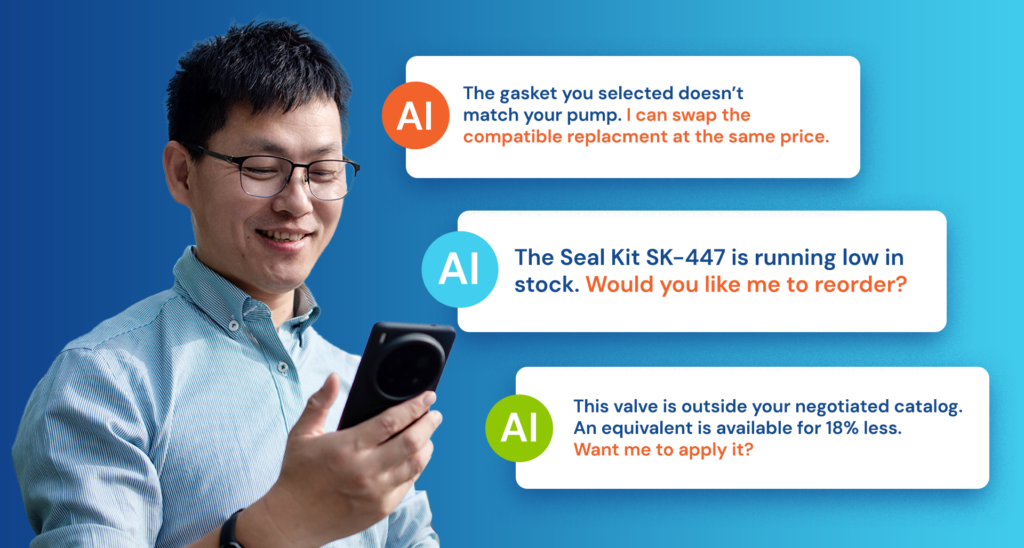
A technician asks: “Which gasket fits Model X, revision 3, built after 2021?”
A chat-led flow routes them to the exact part immediately. It shows viable alternatives and attaches the required documentation, ultimately reducing customer service calls and product returns.

Dealer Network and Service Coverage

A buyer asks: “Who can supply this in Ontario with installation support?”
A conversational path combines a dealer locator with inventory visibility. It then provides a clean handoff to the right sales channel without making the buyer jump through hoops.

Complex Procurement Workflows

A purchasing manager asks: “Can I reorder the last PO, apply net terms, and split ship to two sites?”
A well-designed flow takes them directly to a saved list. It confirms account rules and guides the user through checkout or quote creation.

These scenarios are not about replacing your eCommerce website with a simple chat box. They are about making discovery easier and routing the buyer to the right next step.

Preparing Your Commerce Foundation

If discovery is moving into chat interfaces, you must ask a core question: Is your commerce foundation readable, trustworthy, and actionable when a buyer asks for help?

A practical eCommerce optimization plan usually includes a few critical steps.

Clarify High-Intent Questions

Start by collecting the top 25 to 50 questions from your sales team, customer support, and site search logs. Map each of these questions to a best next step. This could be a product detail page, a comparison chart, a specification table, a quote request, or a contact form.

Strengthen Product Data and Taxonomy

Your data must be impeccable. Normalize your attributes, units of measure, and naming conventions. Define strict compatibility rules, authorized substitutes, and constraints. Ensure all technical documentation is complete, updated, and easy for both humans and machines to find.

Design Realistic Conversational Paths

Build flows that match reality. Some use cases require guided “choose your application” flows. Others just need fast SKU resolution and instant reordering. Always plan for assisted selling alongside self-serve options. Make sure the handoff to a human representative is seamless and retains the context of the chat.

Connect Key Systems

Prioritize eCommerce integration where it matters most. Connect systems for real-time pricing, inventory signals, customer-specific catalogs, and account rules. In many B2B use cases, teams need flexibility around ERP-driven pricing logic or specific contract terms. We always plan this architecture up front to avoid roadblocks later.

Build Governance and Measurement

Define exactly who owns product content, attribute quality, and policy updates within your organization. Track ticket deflection, conversion rates, and quote velocity. Do not guess; use your analytics to measure how effectively these new tools serve your buyers.

How Can You Get Ready?

BlueBolt builds and supports B2B brands across major platforms like Shopify Plus and Optimizely. Each of these platforms can support powerful chat-led discovery when paired with the right strategy and delivery.

During eCommerce replatforming or optimization, we evaluate several key considerations:

  • Structured product content: We ensure attributes, metafields, and content models can power precise filters and guided flows.
  • Search and merchandising: We make sure buyers can narrow choices quickly and confidently.
  • B2B experiences: We implement account-based pricing, custom catalogs, quoting, and role-based access.
  • Integration patterns: We select the APIs and middleware choices that actually fit your operational model.
  • Extensibility: We select applications and build custom components based on long-term maintainability.

The best-fit platform decision is rarely about a single feature. It is about aligning your requirements, timelines, and operating model to a foundation your team can run confidently. We have built these systems before, and we know the best path forward.

Metrics That Matter for Success

As discovery becomes more conversational, we still measure success in hard business outcomes. The difference is you will also track whether buyers can get answers without friction.

A simple scorecard for B2B eCommerce should include:

  • Discovery efficiency: You want to see fewer broad searches per successful product view and higher engagement with specification content.
  • Conversion health: Track the add-to-cart or quote-request rate by segment, paying special attention to new visitors.
  • Revenue quality: Look for higher reorder rates and fewer returns tied to fit or compatibility issues.
  • Sales productivity: Measure the volume of qualified inbound requests that arrive with a complete context attached.
  • Service impact: Watch for fewer basic “what fits” support tickets and faster resolution times for complex issues.

Next Steps for Your Digital Strategy

Click-based journeys are not going away, but the scope of product discovery is expanding rapidly. More buyers will begin with a question in a chat interface. They expect your brand to guide them accurately to the right product, the right workflow, and the right next step.

Start by auditing your product data and identifying the most common questions your buyers ask. Clean data and connected systems are the prerequisites for this new era of commerce. When you are ready to build a more intelligent, scalable foundation for your buyers, we are here to help you architect that future.

Have questions? Our experts are here to help.

7 AI-Powered eCommerce Search Solutions to Boost Your Revenue

Aaron Shapiro

A customer lands on your site with a clear goal: find and buy a specific product.

If your search bar returns irrelevant results—or worse, no results at all—that potential sale vanishes. Gone are the days when a search function was just a “nice-to-have.” Today, it is a critical part of a successful digital strategy, directly impacting conversion rates, average order value, and customer loyalty.

The right eCommerce search solution does more than match keywords. It understands user intent, anticipates needs, and guides shoppers to the perfect product. We’ve worked with countless businesses to optimize their digital platforms, and we know the pitfalls of a poor search experience. Here, we’ll explore seven proven eCommerce search solutions that use advanced technology to transform product discovery and drive measurable growth.

The Power of AI in Product Discovery

Before we dive into the specific platforms, it’s important to understand why intelligent search solutions is a game-changer. Traditional search engines often struggle with subjective or complex queries. Modern shoppers don’t just search for “red shoes”; they search for “comfortable red heels for a wedding.” AI-driven solutions use natural language processing (NLP), machine learning, and behavioral data to understand the context and intent behind these queries, delivering far more relevant results. This capability turns your search bar into a trusted digital sales associate.

eCommerce Search Solutions

1. Bloomreach: The Commerce Experience Cloud

Bloomreach offers a comprehensive suite that combines AI-powered discovery, a headless content management system (CMS), and marketing automation. It’s a powerful tool designed to create highly personalized customer experiences across every touchpoint.

  • Key Features: At its core is Loomi AI, a commerce-specific artificial intelligence trained on over a decade of ecommerce data. This enables advanced features like conversational search, which understands long, natural-language queries, and visual search, allowing customers to find products using images.
  • Business Impact: Businesses using Bloomreach have reported significant gains, including up to an 8.5% increase in revenue per visitor and a 23% lift in conversion rates. Its intelligent merchandising tools can generate a 34% revenue lift on their own.
  • Why It Stands Out: Bloomreach excels at understanding user intent rather than just keywords. Its recognition as a Leader in the 2024 Gartner® Magic Quadrant™ for Search and Product Discovery underscores its market authority. For businesses aiming to unify their content, marketing, and search strategies, Bloomreach provides a robust, integrated platform.

2. Algolia: AI-Powered Search and Discovery

Algolia is renowned for its speed and relevance, processing over 1.75 trillion searches each year. It provides an API-first platform that empowers developers to build consumer-grade search experiences without a complex setup.

  • Key Features: Algolia’s NeuralSearch™ technology uses a proprietary neural hashing engine to handle both exact-match and conceptual searches simultaneously. It learns continuously from user behavior to personalize results in real time, all while maintaining response times under 20 milliseconds.
  • Business Impact: Algolia reports that its platform can deliver an average ROI of 382%, with some clients seeing conversion rates increase by as much as 360%. It’s a solution built to turn every search into a sale.
  • Why It Stands Out: Algolia combines speed, AI, and developer-friendly APIs, making it a highly scalable and customizable option. It’s an ideal partner for businesses that need to deliver lightning-fast, relevant results at a global scale.

3. Elasticsearch: The Open-Source Powerhouse

As part of the broader Elastic Stack, Elasticsearch is the most popular open-source enterprise search engine. It offers unparalleled flexibility and customization for businesses with the technical resources to leverage it.

  • Key Features: Built on Apache Lucene, Elasticsearch uses a distributed architecture that allows it to handle massive datasets with high-throughput indexing and querying. Its flexible JSON structure and RESTful API provide developers with maximum control.
  • Business Impact: A Forrester study found that Elasticsearch customers achieved a 293% ROI and a payback period of less than six months. This is driven by revenue improvements, IT labor savings, and reduced licensing costs from other platforms.
  • Why It Stands Out: Elasticsearch is the go-to solution for enterprises that require deep customization. While other platforms offer a managed service, Elasticsearch gives your team the keys to build a search and analytics engine tailored precisely to your operational needs, from product discovery to backend observability.

Voyado has established itself as a leading customer experience platform in Nordic retail by integrating customer engagement tools with AI-driven product discovery. It’s designed to turn scattered customer data into unified, personalized shopping journeys.

  • Key Features: Voyado combines a customer data platform (CDP), loyalty engine, and product discovery in one solution. Its AI-powered engine learns from clicks, searches, and purchases to deliver real-time personalization.
  • Business Impact: Retailers using Voyado see tangible results. Case studies show a 24.6% lift in purchases from loyalty members and a 33% higher average order value. This demonstrates the power of connecting search behavior with a holistic customer profile.
  • Why It Stands Out: Voyado’s strength lies in its retail-specific, all-in-one approach. For businesses struggling to connect disparate systems for search, recommendations, and loyalty, Voyado offers a cohesive solution that fosters customer retention and boosts lifetime value.

5. Klevu: AI for Complex Catalogs

Klevu leverages natural language processing (NLP) to masterfully connect shopper intent with product discovery, making it particularly effective for B2C and B2B retailers with complex product catalogs.

  • Key Features: Klevu’s AI automatically enriches product catalogs with relevant synonyms, allowing it to understand and accurately respond to complex or niche search queries. It also offers smart autocomplete and robust merchandising controls for fine-tuning product visibility.
  • Business Impact: Customers report up to a 46% increase in sales after implementing Klevu. Shoppers who use the search functionality become three to five times more likely to convert.
  • Why It Stands Out: Klevu specializes in intent-driven search. Its deep expertise in NLP makes it an excellent choice for businesses in industries where technical specifications, jargon, or long-tail keywords are common.

6. Constructor : AI-Driven Merchandising

Constructor was built from the ground up with “AI in its DNA” to serve the unique needs of retailers. It uses clickstream data and advanced AI to optimize search results for revenue and other key business metrics.

  • Key Features: Constructor utilizes transformers and large language models (LLMs) to decode search intent and rank products dynamically based on individual user behavior and business priorities. It also provides advanced A/B testing to validate the effectiveness of different experiences.
  • Business Impact: Constructor delivers consistent, measurable growth, including a 9% increase in search revenue and a 15% boost in revenue per user, with a reported ROI of over 20X.
  • Why It Stands Out: Transparency is a key differentiator. Unlike some “black box” AI solutions, Constructor gives merchandisers visibility into its algorithms, allowing them to understand and influence how results are optimized. This makes it a trusted partner for data-driven retailers.

7. Zoovu: Conversational and Guided Selling

Zoovu addresses “choice paralysis” by turning static product catalogs into interactive, guided shopping experiences. Its platform excels at simplifying complex purchasing decisions through conversational discovery.

  • Key Features: Zoovu helps businesses build product finders, quizzes, and advisors that replicate the expertise of a top sales representative. Its AI interprets customer needs through a series of questions and contextual data to provide confident product recommendations.
  • Business Impact: Companies using Zoovu have seen conversion rates increase by up to 200% and average order value rise by 65%. It is particularly effective for products with complex features or customization options.
  • Why It Stands Out: Zoovu excels at guided selling. It transforms the search process from a simple query-and-response into a helpful dialogue, increasing shopper confidence and reducing the likelihood of cart abandonment due to uncertainty.
intelligent site search

Choosing the Right Solution for Your Business

Selecting the best eCommerce search solution is a strategic decision that depends on your business goals, technical capabilities, and customer needs. Whether you need the open-source flexibility of Elasticsearch, the all-in-one approach of Voyado, or the lightning-fast performance of Algolia, each of these platforms offers a proven path to enhancing product discovery.

Investing in a modern, AI-powered search solution is an investment in your customer experience and your bottom line. By helping shoppers find what they’re looking for quickly and intuitively, you not only increase conversions but also build the trust that fuels long-term growth. Our team is experienced in evaluating and implementing these complex systems. If you’re ready to transform your site search into a powerful revenue driver, we’re here to help you find the best path forward.

Transform Your Site Search

AI Agents Are Coming for Your Checkout: What Retailers Need to Know About Universal Commerce

Aaron Shapiro

Y our next biggest customer might not be a person at all; it might be an algorithm with a purchase order.

What is Universal Commerce, and Why it Matters Now

“Universal commerce” is the idea that buying does not happen in one place anymore. Your customers might start in a portal, an email, a product data sheet, a procurement system, a marketplace, or a chatbot. The expectation is consistent: accurate product information, correct pricing, reliable availability, and a smooth path to order confirmation.

Now add AI agents to the mix. Instead of a buyer clicking through your eCommerce website design, an agent can research, compare, assemble a cart, request approvals, and execute checkout. For B2B manufacturing eCommerce teams, this is not a futuristic edge case. It is a natural next step for time-starved buyers and procurement workflows that already prioritize speed, accuracy, and repeatability.

The opportunity is not about replacing your sales team or relationships. It is about making your digital commerce strategy resilient, so you can serve humans and agents with the same trusted data and rules

How AI agents Change the B2B Buying Journey

In manufacturing, buyers rarely want a simple add-to-cart experience. They want confidence:

  • The right SKU, pack size, and compatible accessories
  • The right price for their account, contract, or tier
  • Clear lead times and substitutions when needed
  • The right purchasing path (credit card, PO, terms, or invoicing)
  • Documentation (spec sheets, compliance, warranty, SDS, certificates)

AI agents can help buyers navigate this complexity. But agents also surface a hard truth: if your commerce stack relies on manual steps, hidden rules, and one-off exceptions, an agent will struggle to complete an order reliably. That does not mean your stack is “wrong.” It means the next wave of eCommerce optimization will focus on clarity, consistency, and integration.

In other words, the checkout is becoming an interface for systems, not just a page for people.

What “Agent-Ready Checkout” Means in Practice

Agent-ready does not mean you need a fully automated robot buyer. It means your commerce experience is structured so that an assistant, a procurement integration, or a customer service rep can all achieve the same outcome with fewer back-and-forth steps.

Here is a practical definition: an agent-ready checkout is one where pricing, eligibility, and fulfillment rules are explicit, accessible, and enforceable across channels.

Key capabilities to plan for:

  • Clean product data: normalized attributes, variants, units of measure, and compatibility rules
  • Account-aware pricing: customer-specific price lists, contract pricing, and promotions applied consistently
  • Inventory and lead time clarity: availability, backorders, and realistic shipping promises
  • Identity and permissions: who can see what, who can buy, who can approve
  • Integrations that behave predictably: ERP, PIM, OMS, CRM, tax, shipping, and payments
  • A consistent API surface: so tools can query catalog, pricing, and cart rules without scraping pages

This is not only about AI. These are also the fundamentals of strong eCommerce implementation in B2B.

Practical Examples for Complex B2B Manufacturing Workflows

Universal commerce becomes real when it meets the scenarios your team handles every day. Here are a few examples where AI agents can add value, and what your platform and integrations need to support.

Example 1: Dealer networks and channel visibility

Scenario: A dealer should see dealer pricing, limited assortments, and specific freight options.

What to support:

  • Segmented catalogs and customer groups
  • Price lists by account or group
  • Shipping rules tied to region, warehouse, or dealer tier
  • Clear role-based access for reps and dealer users

Result: An agent can assemble the right cart without accidentally selecting restricted SKUs or incorrect terms, protecting the dealer relationship and the b2b buyer experience.

Example 2: Procurement workflows (POs, approvals, and controls)

Scenario: A buyer needs to build a cart, submit for approval, then place the order on terms.

What to support:

  • Quote-to-order workflows, or draft orders with approvals
  • Purchase order capture and reference fields
  • Payment terms and invoicing paths where appropriate
  • Audit trails and user permissions

Result: Your checkout becomes a controlled process, not just a payment page.

Example 3: Configurable products and compatibility

Scenario: A buyer needs a motor, mounting kit, and controller that must be compatible.

What to support:

  • Structured product attributes and compatibility mapping (often PIM-led)
  • Guided selling or bundled recommendations
  • Clear documentation and constraints surfaced on product pages and in cart rules

Result: An agent can recommend and validate combinations, reducing returns and support burden.

Example 4: ERP-driven availability and lead times

Scenario: Availability changes by warehouse and customer priority, and lead times vary.

What to support:

  • Real-time or near-real-time inventory signals (with sensible caching)
  • Backorder rules and split shipment options
  • Clear messaging and order confirmation behavior

Result: Fewer surprises after checkout and fewer manual interventions, which is a major lever for eCommerce re-platforming ROI.

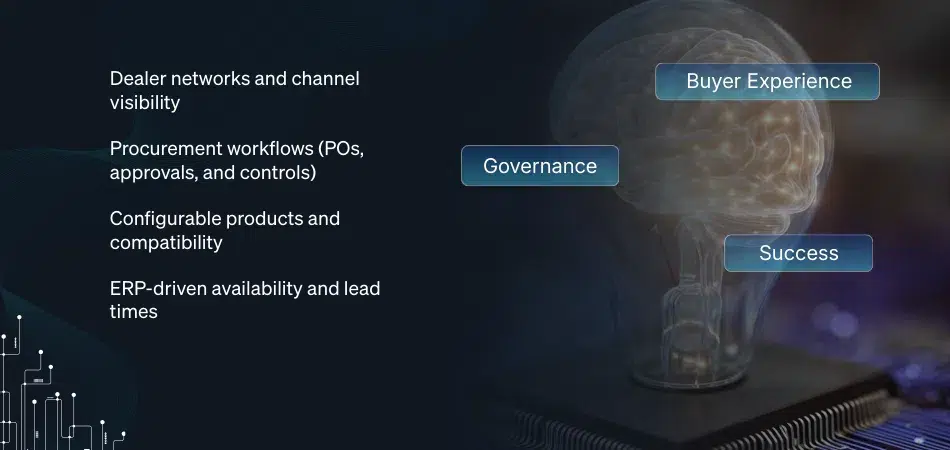
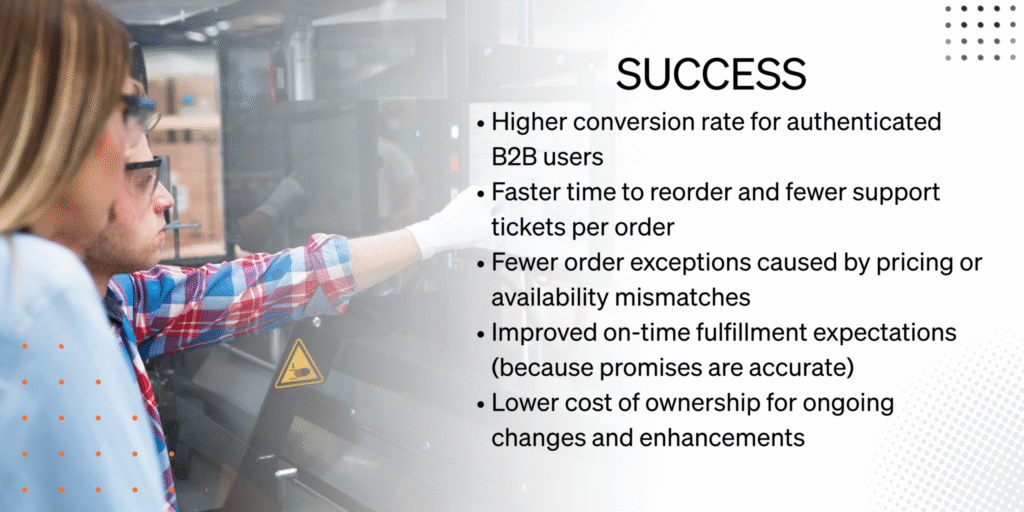
AI Agents for B2B. Governance, Success and Buyer Experience.

Platform-Positive Implementation Considerations

For B2B manufacturing brands, platforms like Shopify Plus and Optimizely can all be strong foundations. The right fit depends on priorities like speed-to-market, cost of ownership, required customization, and the complexity of your integrations.

A few platform-positive considerations to evaluate:

  • Data model alignment: how your catalog structure, pricing, and account hierarchy map to the platform
  • Extensibility: the best approach for custom workflows (apps, APIs, middleware, or platform features)
  • Integration strategy: where to put business logic so it is reusable across channels
  • Operational ownership: who maintains what after launch, and how change requests are handled

In some use cases, teams may want additional flexibility around pricing logic, quoting, or procurement integrations. This is where a complementary tool or a different architecture can be a better fit, while still keeping the commerce platform as the system of experience.

At BlueBolt, we stay platform-positive and requirements-led. If Shopify Plus is the best fit, we lean into its ecosystem and speed. If Optimizely aligns better with your content, experimentation, or commerce roadmap, we design around that. The goal is a maintainable, scalable foundation that supports universal commerce patterns.

A Roadmap: How to Prepare Your Universal Commerce Stack in 60 to 120 days

You do not need to boil the ocean. Start by making your current buyer journey more explicit and more integrated.

Step 1: Map your “checkout truth table”

Document the rules that determine whether an order is valid:

  • Who can buy which products
  • How pricing is determined
  • What minimums apply (MOQs, pack sizes, pallet quantities)
  • What shipping and payment options apply by account
  • What approvals are required

This becomes the blueprint for agent-ready commerce.

Step 2: Fix the data foundations

Prioritize:

  • Product attributes and variants that reflect how buyers actually specify products
  • Units of measure and packaging clarity
  • Documentation that is easy to find and consistently structured
  • A plan for PIM (if needed) to reduce platform-side workarounds

Step 3: Design your integration layer for reuse

Many brands benefit from integration patterns that centralize rules and reduce point-to-point fragility:

  • ERP and OMS for availability and order creation
  • PIM for product content and attributes
  • Tax and shipping services for accurate totals
  • Middleware or iPaaS for orchestration where it improves reliability

This is the heart of eCommerce integration and a key lever for long-term eCommerce optimization.

Step 4: Upgrade the buyer experience with clarity, not complexity

Focus on high-impact improvements:

  • Account-aware navigation and merchandising
  • Saved lists, reorders, and quick order by SKU
  • Clear lead time messaging and backorder behavior
  • Quote request paths for products that require it

Step 5: Add governance for agent-driven interactions

Define:

  • What an agent can do (and cannot do) on behalf of a user
  • Approval thresholds and audit logging
  • Rate limits and monitoring for automated activity
  • Support workflows when an order fails validation

This is operational readiness, not just technology.

Universal commerce B2B success metrics

What Success Looks Like (Metrics and Governance)

Universal commerce readiness should show up in measurable outcomes:

  • Higher conversion rate for authenticated B2B users
  • Faster time to reorder and fewer support tickets per order
  • Fewer order exceptions caused by pricing or availability mismatches
  • Improved on-time fulfillment expectations (because promises are accurate)
  • Lower cost of ownership for ongoing changes and enhancements

Equally important: internal confidence. Your sales, service, and operations teams should trust that the eCommerce experience enforces the same rules they do.

Conclusion and Next Step

AI agents will not replace your relationships, your expertise, or your channel strategy. But they will raise the bar for how clearly your commerce systems express pricing, eligibility, and fulfillment logic. For B2B manufacturing brands with complex catalogs, dealer networks, or procurement workflows, this is a practical moment to modernize your foundation and make every channel easier to buy from.

Do you need a platform-positive, end-to-end partner for website design and implementation on Shopify or Optimizely?

Reflecting on 2025 eCommerce: Insights That Shape 2026 and Beyond

Honey Olesen

T he global eCommerce landscape underwent significant transformation in 2025.

Shoppers gravitated toward mobile-first experiences, brands doubled down on direct-to-consumer (D2C) strategies, and B2B digitization accelerated to new heights. These changes brought opportunities and challenges particularly around trust, intensifying competition, and scalability.

Drawing from SellersCommerce’s 2025 eCommerce Statistics Report, we now have clarity on how last year’s numbers are validating and shaping the strategies driving success in 2026. Below, we reflect on the key data points from 2025 and analyze their implications for the year ahead.

Global and U.S. eCommerce Growth: 2025 in Review

2025 brought another wave of digital commerce growth, laying the groundwork for ongoing expansion in 2026.

Major Global Takeaways

  • 2.77 billion people shopped online in 2025. This milestone (about a third of the global population) matched industry forecasts and laid the foundation for the expected rise to 2.86 billion digital shoppers in 2026.
  • Global eCommerce sales reached $6.86 trillion in 2025, closely tracking predictions and confirming a sustained momentum toward the projected $8 trillion by 2027 (CAGR: 7.8%).

U.S. Market Realities

  • U.S. eCommerce sales hit $1.29 trillion in 2025, supporting nearly 9% annual growth forecasts through 2029.
  • Digital’s share of total retail rose to 16%, underscoring the sector’s shift from an alternative channel to a core component of the buying experience.

B2B eCommerce: A Powerhouse Confirmed

B2B’s dominance was unmistakable in 2025, with the market valued at $32.11 trillion and on track for $36.16 trillion in 2026 (CAGR: 14.5%). The scale not only validated earlier projections but highlighted new pressures on infrastructure and integration.

The BlueBolt Advantage:
Sustained growth in both B2C and B2B eCommerce last year has reinforced the need for scalable, enterprise-grade ecosystems. Our teams leverage Optimizely, Shopify Plus, and custom builds to help businesses prepare eliminating bottlenecks and future-proofing platforms for what’s next.

Mobile and Social Commerce: 2025 Set the Stage

Mobile phone of a company selling apparel

2025 made clear that desktops are no longer the primary engine for online shopping. Consumers made purchases wherever—and whenever—convenience struck.

  • Mobile commerce (mCommerce) accounted for $2.51 trillion in global sales last year, advancing 21% and staying on course for the $3.44 trillion benchmark forecasted for 2027.
  • In China, 64% of all eCommerce activity occurred via mobile, affirming global trends toward in-app shopping.
  • 68% of U.S. consumers purchased through social platforms. Social commerce, a trend already surging in 2025, is now projected to reach $2.9 trillion globally in 2026.

The BlueBolt Advantage:
2025 validated both the necessity and ROI of mobile-first strategies and seamless social integrations. That’s why we focus on robust, responsive design, integrated shopping experiences, and shoppable content built for where customers already spend their time.

Competition, Marketplaces, and the Strength of D2C

2025 saw unprecedented market density and fuelled a new wave of D2C innovation.

  • There were more than 28 million eCommerce sites in operation worldwide, with 2,100+ new stores launching every day—a testament to both opportunity and fierce competition.
  • Shopify closed out the year powering 29% of global eCommerce sites; Wix accounted for 20%.
  • 15% of shoppers chose to buy directly from brands, a pattern significantly higher in Australia (23%) and France (22%), signaling a shift in consumer trust and preference toward D2C.

The BlueBolt Advantage:
Last year’s data made one truth clear: success now depends on something more than simply being present and jumping on the next trend. We help retailers build brand-owned digital experiences that stand out delivering complex migrations, tailored UX, and digital strategies designed to cut through the noise.

Trust, Reviews, and Evolving Consumer Motivation

2025 demonstrated that trust is the lynchpin of conversion, and that consumers are diligent (if not vigilant) about making informed decisions.

  • A remarkable 99% of shoppers read reviews before committing to a purchase.
  • The research phase began for 44% of buyers on search engines, 41% on Amazon or retailer websites, and 14% on social media; data that confirms the need to optimize multiple touchpoints.

Top Five Motivators for Completing a Purchase (2025)

  1. Free shipping (50.6%)
  2. Discounts/coupons (39.3%)
  3. Easy returns (33.2%)
  4. Streamlined checkout (30.6%)
  5. Customer reviews (30.5%)

Category Spending and Market Leaders: 2025 Benchmarks

Strategically, understanding last year’s category spending and leading players illuminates potential moves for 2026.

2025’s Top Product Categories

  • Consumer Electronics: $922.5B
  • Fashion: $760B
  • Food & Beverages: $708.8B

U.S. eCommerce Market Share (2025)

  • Amazon: 37.6%
  • Walmart: 6.4%
  • Apple: 3.6%
  • eBay: 3%
  • Target: 1.9%

Real-World Impact: BlueBolt Client Success

Laptop on a desk.  The Cover Guy customization page is showing on the laptop.
  • SRAM: Unified B2C portal via Optimizely led to seamless brand integration and user-driven configurators. SRAM Case Study
  • HarperCollins Publishers: Transition to Shopify Plus with headless CMS enabled global scale and flexible content management. HarperCollins Publishers
  • HockeyShot: Multi-region migration delivered a 29% conversion increase across North America and Europe. HockeyShot
  • The Cover Guy & Godiva: Shopify Plus redesigns with custom configurators and tailored UX resulted in elevated brand presentation and customer experience. The Cover Guy Godiva

What 2025 Taught Us—and Where 2026 Is Going

Looking back, 2025 was a validation year for many eCommerce trends: accelerated digital adoption, elevated consumer expectations, and the ongoing imperative to build trust. These lessons have informed, and in many cases fueled, strategies for sustainable growth in 2026.

Retailers poised to lead in 2026 will be those who:

  • Invest in adaptable, scalable digital platforms
  • Make mobile-first and D2C models a core focus
  • Double down on customer trust, reviews, and discoverability
  • Integrate automation and secure, frictionless systems across every touchpoint

At BlueBolt, our nearly two decades of experience empower us to turn the hindsight of 2025 into actionable foresight for 2026. Our commitment to strategic consultation, tailored development, and continuous optimization positions our partners for measurable growth. Connect with BlueBolt Solutions and let’s turn last year’s insights into your next chapter of digital commerce growth.

Are You Ready for 2026?

Top 5 Proven Practices for ROI in eCommerce

Honey Olesen

M aximizing your return on investment (ROI) goes beyond simply cutting costs. It’s about getting the most out of the systems and strategies you’ve already put in place.

For eCommerce merchants, the line between an average month and a stellar quarter often comes down to how well you optimize what you already have.

Recent research highlights that eCommerce businesses can see up to a 60% drop in order processing times and a 45% boost in online sales by adopting the right digital practices and technology integrations. The best part? You don’t need to overhaul your entire budget to see meaningful progress. Focus on proven, scalable steps, and you’ll notice gains in efficiency, conversions, and outcomes you can measure.

Let’s walk through five proven practices to help you strengthen your eCommerce ROI.

1. Optimize Your Product Pages for Clarity and Speed

Your product page is where decisions happen. If shoppers can’t quickly understand what you offer or if the page drags, they’re likely gone for good.

Why It Matters

A slow or confusing product page adds unnecessary friction. Shoppers today expect answers (shipping info, sizing, great images) in seconds. Any delay or clutter sends them elsewhere. Speed and clarity here are directly tied to your conversion rate, one of ROI’s fastest levers. Sites that load in 1 second convert up to 3× better than ones that take 5 seconds (Shopify).

How to Make It Happen

  • Make Speed a Priority: Regularly check load times. Compress your images and cut unnecessary scripts—every second saved helps with SEO and discourages visitors from bouncing.
  • Highlight the Action: Your “Add to Cart” button should stand out. Contrasting colors, clear text, and prominent placement (especially on mobile) can make all the difference.
  • Rich, Useful Content: Use sharp photos and, where it fits, video. Write thorough descriptions that answer the questions customers ask most—this reduces returns and support headaches.

2. Leverage Email Marketing for Retention

Retaining customers is much less expensive than finding new ones. That’s why email remains the heavyweight champion for eCommerce ROI and customer lifetime value.

laptop on a table with email showing

Why It Matters

When you own your email list, you’re not at the mercy of changing social algorithms. Well-crafted, automated campaigns work for you behind the scenes, nurturing loyalty and repeat sales.

Recent figures show email marketing offers an average ROI of $36 to every $1 spent, ranking it as digital marketing’s top performer (Designmodo, 2026). Automated flows (like welcome messages and cart reminders) can generate up to 320% more revenue than emails sent manually.

How to Make It Happen

  • Set Up Automated Flows: Put “set it and forget it” campaigns in place—Welcome Series for new subscribers, Abandoned Cart nudges for hesitators, and thoughtful post-purchase touchpoints.
  • Segment Effectively: Not every customer is the same. Use behavior, purchase history, and status (VIP, new, lapsed) to serve relevant messages and offers.
  • Personalize for Impact: Move beyond basic greetings. Tap into data to recommend products users are actually interested in.

3. Use Data Analytics to Drive Decisions

Guesswork doesn’t cut it in eCommerce. Data shines a light on what’s working, what’s not, and where your next opportunity is waiting. Tracking key ecommerce KPIs (conversion, AOV, view-to-cart, etc.) allows precise diagnosis of underperforming pages and quantifies the impact of optimizations (Rework).

Why It Matters

Flying blind means wasted budget, missed conversion leaks, and fixable issues slipping through the cracks. Analytics help you focus on what matters: increasing conversions, growing order values, and improving repeat purchase rates—each directly boosting ROI.

How to Make It Happen

  • Mind the Metrics That Count: It’s easy to be distracted by vanity metrics like “page views.” Instead, invest your energy in Conversion Rate, Average Order Value (AOV), and Customer Acquisition Cost (CAC).
  • See What Users See: Heatmaps and session recordings reveal where shoppers are getting stuck or frustrated. Are people clicking dead spots? Fix them.
  • Test Everything: Don’t just trust your gut—A/B test headlines, images, layouts, and offers, and let your results lead the way.
man at desk looking at statistics.  ROI and analytics

4. Prioritize Customer Experience (CX)

In today’s competitive market, how you make your customers feel is a true differentiator. Every step of the shopping journey should feel seamless, helpful, and frustration-free.

Why It Matters

Clunky checkouts and poor search experiences can ruin your reputation and cost you sales. On the flip side, a smooth path from landing page to post-purchase review creates loyal fans. Studies show that stores focusing on usability get 70% of repeat traffic from features like personalized catalogs and saved carts (Versich, 2026). Making your site mobile-friendly alone can triple mobile orders.

How to Make It Happen

  • Think Mobile First: Shoppers are everywhere—your site must work flawlessly on all screens and devices.
  • Streamline Checkout: Cut out unnecessary steps. Let guests check out, and support a range of payment options like Apple Pay or Google Pay.
  • Support That’s There When Needed: Offer chatbots or robust FAQs so simple questions never hold up an order. Your support team can then focus on thornier issues.

5. Implement Upselling and Cross-Selling Strategies

Getting more from every sale is one of the quickest paths to stronger ROI. When a customer is already in buying mode, help them discover what else they might need. Upselling and cross-selling can increase customer lifetime value (LTV) by 20–40% (launchtip).

Why It Matters

Raising your Average Order Value (AOV) means you generate more revenue per order—not by driving more traffic, but by better serving the customers you already have. Upselling and cross-selling, done right, solve problems for your customer and support your bottom line.

How to Make It Happen

  • Bundle and Save: Offer clear deals for buying complementary products together (“Camera + Bag + Memory Card: 15% off bundle”).
  • Recommend Right in the Cart: Suggest proven add-ons or essentials (warranties, accessories, care kits) when customers check out.
  • Capitalize After the Sale: Display a limited-time offer right on your “Thank You” page. Buyers are still in decision mode—a timely nudge often lands.

Conclusion

There’s no magic switch for perfect ROI, but consistent, practical improvements pay off. When you fine-tune your product pages, make the most of email, leverage data insights, focus on customer experience, and thoughtfully raise basket size, you’re building a foundation for results that last.

PracticeProven ROI Impact
Product Page OptimizationUp to 200% higher conversion + bounce reduction
Email & Lifecycle Marketing$36–$68 per $1 spent
AnalyticsDrives data-backed decisions, cuts waste
Customer ExperienceIncreases retention & LTV
Upsell/Cross-sell20–40%+ lift in LTV, substantial revenue contribution

We’ve helped teams work through common eCommerce pitfalls and chart the path to real growth. Start with these five moves, track your wins, and turn your digital platform into a reliable engine for growth.

Unlock Your eCommerce Growth Potential Today!

Beyond Search: Is Your Store Ready for Agentic Commerce?

Chris Risner

T he fundamental rhythm of eCommerce has been the same for twenty years: a person searches, browses, clicks, and buys. But that rhythm is changing.

We’re at the beginning of a major architectural shift, moving from an era of human-driven search to one of AI-delegated action. This is the dawn of agentic commerce, and it represents a change as profound as the invention of the search engine itself.

For business leaders and technical teams, this isn’t a “wait and see” trend. With AI-driven traffic to retail sites surging 805% year-over-year, the platforms that are ready today will be the ones that lead tomorrow. The core question is no longer just about driving traffic; it’s about whether your infrastructure is built to speak the language of AI.

What is Agentic Commerce?

Person holding a cell phone

Agentic commerce describes transactions that are partially or fully handled by an autonomous AI agent acting on a consumer’s behalf. It’s the difference between a person searching for “best waterproof running shoes” and simply telling their AI assistant, “Find and buy the best-rated, waterproof trail running shoes in my size for under $150, and get them here by Friday.”

In this scenario, the AI agent performs the discovery, comparison, verification, and purchase. It interacts directly with a store’s data, not its visual interface. This transition from “searching” to “doing” is already underway, and its momentum is building fast.

  • Market Projections: McKinsey forecasts that agentic commerce will drive $5 trillion in global volume by 2030.
  • Traffic Transformation: Adobe has already tracked an 805% increase in AI-driven traffic to retail sites.

This is a clear signal that a new, high-volume channel is opening up. However, access to this channel depends entirely on your store’s technical readiness.

Agents need structured, machine-readable data to understand product attributes like size, material, and compatibility.

The Visibility Gap: Why Legacy Systems Are Invisible to AI

AI agents don’t browse. They don’t get swayed by beautiful design or clever marketing copy. They parse data. They query APIs. Their decision-making is ruthlessly efficient, and if your platform can’t answer their questions in milliseconds, you are functionally invisible.

This creates a “visibility gap” for many businesses running on traditional or monolithic platforms. These systems often fail at two critical tasks:

  1. Providing Real-Time Data: An AI agent must verify product availability instantly. If your inventory data is updated on a delay, the agent can’t trust it. It will move on to a competitor whose system can provide immediate confirmation.
  2. Structuring Product Information: Agents need structured, machine-readable data to understand product attributes like size, material, and compatibility. Without proper schema markup, an agent has to guess, and AI agents are programmed to avoid ambiguity. They will simply ignore products with messy or incomplete data.

In the age of agentic commerce, poor data quality isn’t just a backend headache—it’s a direct barrier to revenue.

Shopify’s Open Ecosystem vs. The Walled Garden

As this new landscape takes shape, two competing philosophies are emerging.

On one side are the “walled gardens” like Amazon and Walmart. These giants are integrating agentic AI to keep customers within their closed ecosystems. While effective for them, this strategy turns third-party brands into commodities and keeps valuable customer data away from the merchants themselves. The AI serves the marketplace, not your business.

On the other side is Shopify’s open ecosystem model. Instead of building higher walls, Shopify is helping build the universal standards for the future of retail. Through the co-developed Universal Commerce Protocol (UCP) with Google, Shopify is standardizing the language of agentic shopping.

This approach gives merchants a powerful advantage. It ensures your product catalog is a structured, validated data feed ready for AI assistants like Google Gemini. By choosing an open standard, you make your products discoverable by any agent, on any platform that adopts the protocol. You retain control over your brand, your data, and your customer relationships.

The Technical Foundation for an AI-Driven Future

Preparing for agentic commerce isn’t about adding a chatbot. It’s about ensuring your core infrastructure is built for data-first interactions. Shopify’s platform, especially its Agentic Plan, is engineered to provide these foundational capabilities.

  • Real-Time Inventory Sync: Shopify’s APIs are built for high-velocity synchronization, giving agents the instant stock validation they require to complete a purchase confidently.
  • Complex Cart Building: Agents fulfill complex goals, not just single-item purchases. Shopify’s architecture supports multi-item, cross-category cart building via API, handling requests that would cause friction on legacy platforms.
  • Structured Data Readiness: Through its support for UCP, Shopify helps ensure your product data is structured correctly, allowing AI agents to understand your catalog with near-zero error.

Future-Proof Your Business Today

The shift to agentic commerce is happening now. The businesses that will thrive are those that invest in the right data infrastructure today. Waiting to see what competitors do means you’ll already be behind.

The first step is to assess your current capabilities. Can your platform provide real-time inventory data? Is your product information structured and machine-readable? For many retailers, the honest answer is no.

Shopify provides a direct path to agentic readiness. We believe in replatforming for strategic advantage, and this is a moment of profound strategic importance.

Ready to see how your infrastructure stacks up?

The Hidden Risks and Rewards of eCommerce Migration

Honey Olesen

T o keep up with the changes in eCommerce, companies are increasingly moving to more powerful, adaptable, and feature-laden platforms.

Migrating an eCommerce site is a tricky business; like swapping out a car’s engine while it’s still running. One mistake can cause your business to grind to a halt. But, when done correctly, you will see the growth results.

At BlueBolt, we’ve been helping businesses navigate successful eCommerce migrations for over twenty years. With extensive experience and a solid history of success, we help you through the complexity of replatforming, all while helping you realize your full potential. Let’s explore the potential risks, the benefits, and the steps to ensure your migration achieves its intended outcomes.

The Rewards: Why Businesses Are Making the Leap

Replatforming is more than just a passing fad; it’s a calculated strategy for maintaining a competitive edge. The migration landscape of 2025 clearly favors Shopify, which has captured a significant portion of the replatforming market. WooCommerce continues to draw in those who value adaptability, and BigCommerce remains a strong choice for businesses on the rise.

Here’s the reasoning behind these choices:

Improved Functionality
Contemporary platforms boast sophisticated features, including AI-powered personalization, effortless omnichannel integrations, and automation tools that far surpass the capabilities of older systems. It’s a considerable leap forward in terms of what businesses can achieve. Speed of Innovation: A full 78% of organizations emphasize the necessity of platforms that keep pace with AI advancements and the evolving needs of modern commerce.

Growth Scalability
It is expected that the global eCommerce market will hit six trillion dollars, which would be about one fifth of all retail sales. If a business wants to keep growing, it needs to learn how to scale its eCommerce business. When making a move, 79% of businesses in recent studies think flexibility and user experience are very important

A Better Experience for Users
A fast, simple, and mobile-friendly shopping experience increases the number of people who buy things. Current platforms focus on user experience, which makes customers happy and leads to more conversions.

Cost Effectiveness
Moving to a SaaS platform means you don’t have to worry about maintenance, managing servers, or installing fixes all the time. You can then use those savings to help your business grow.

Following the Rules and Keeping Safe
In 2025, the cost of a data breach was $5.2 million, a clear sign that cybersecurity risks are getting worse. Today’s platforms come with strong, business-level security, automatic compliance updates, and fraud detection features that all protect your business and users.

The Risks: What Could Go Wrong?

Migrating your eCommerce store can be a game-changer, but it’s also a tricky process with potential downsides.

Here are some key points to monitor:

Data Loss or Corruption
Transferring a significant amount of data (such as customer information, inventory, and order histories) can easily lead to issues if not handled properly. Missing SKUs or compromised user data can cause serious problems and erode trust.

SEO Problems
Issues like broken URL redirects or metadata errors can negatively impact your search engine rankings. Without a robust strategy, you risk losing organic traffic and the associated visibility.

Taking a Break
A poorly executed launch can damage your company’s reputation. Even a minor delay can result in lost revenue and dissatisfied customers.

Integration Hurdles
Ensuring that your new platform integrates smoothly with existing tools such as CRMs, ERPs, or payment systems may require more effort than you expect.

Internal Pushback
Change requires adaptation. Without sufficient training and clear communication, your team may struggle to accept new processes, leading to wasted time and decreased overall productivity.

Hidden Rewards You Didn’t See Coming

man at desk looking at laptop

A successful platform migration offers more than just the anticipated technical upgrades; it frequently uncovers significant, previously unseen advantages. Consider it a strategic growth opportunity that impacts every facet of your digital footprint.

A Chance to Revitalize Your Brand.
A migration presents an ideal moment to assess and refresh your website’s design, content, and overarching brand message. It’s the perfect time to ensure your digital presence accurately represents your business as it stands now.

Enhanced Operational Transparency.
Transitioning your platform demands a thorough examination of your current workflows. This in-depth review is essential for data cleanup, process optimization, and a general boost to your business operations, ultimately fostering sustained efficiency.

A Catalyst for Innovation.
Shifting to a new platform opens the door to new tools and sophisticated features. This frequently sparks fresh ideas and strategies, enabling your team to discover novel approaches to fuel growth and enhance the customer experience.

The eCommerce Migration Checklist

man writing in a journal

We don’t just migrate platforms; we transform businesses. Our team ensures a seamless transition, minimizing risks and maximizing rewards. From strategy to execution, we handle every detail so you can focus on growing your business. We’ve built this before. We know the pitfalls. Here’s a step-by-step guide to ensure your migration is smooth and successful:

Phase 1: Discovery & Strategy

  • Define business goals and objectives.
  • Audit your current platform’s performance and pain points.
  • Choose the right platform based on scalability, features, and cost.
  • Assemble a cross-functional migration team.
  • Develop a detailed timeline and risk mitigation plan.

Phase 2: Data Management

  • Audit and clean your data (customers, orders, SKUs, content).
  • Map data fields for seamless transfer.
  • Back up all data—twice.

Phase 3: UX & Design

  • Redesign your site with a mobile-first approach.
  • Optimize navigation, accessibility, and page speed.
  • Ensure brand consistency across all touchpoints.

Phase 4: Development & Integration

  • Build or customize necessary plugins and integrations.
  • Test compatibility with CRMs, ERPs, and other tools.
  • Set up secure payment gateways and tax logic.

Phase 5: Testing & QA

  • Conduct functional, performance, and security testing.
  • Test the checkout flow and payment processing.
  • Perform SEO audits and ensure proper redirects.

Phase 6: Launch & Post-Go-Live

  • Soft launch to monitor performance and address issues.
  • Track KPIs like traffic, conversion rates, and bounce rates.
  • Train your team on new workflows.
  • Schedule regular updates and optimizations.

Final Thoughts: Migration as a Growth Catalyst

eCommerce migration is more than a technical upgrade: it’s a strategic opportunity to future-proof your business. With the right partner, you can navigate the complexities of migration with confidence and emerge stronger, faster, and more competitive.

For over two decades, BlueBolt has translated ambitious business goals into powerful, reliable digital platforms. We are not just a vendor; we are an extension of your team, providing the strategic guidance and deep technical expertise to architect, build, and optimize the systems that power your growth.

Ready to take the leap? Let’s make your migration a success story.

Thinking About Migrating?

Shopify Magic and Sidekick: Are These AI Tools the Future of eCommerce or Just Flashy Assistants?

Aaron Shapiro

A I is the new intern, strategist, and copywriter rolled into one and Shopify isn’t sitting this one out.

Enter Shopify Magic and Sidekick, the platform’s dynamic AI duo designed to simplify merchant life and boost productivity with a sprinkle of wizardry (and a whole lot of algorithms).

But how magical are they, really? And how do they stack up against other AI tools currently shaking up eCommerce? Let’s dig in.

What Is Shopify Magic?

Shopify Magic is Shopify’s built-in generative AI feature. It works behind the scenes to automate everything from product descriptions to marketing emails and customer replies. Think ChatGPT, but tailored to the daily grind of an eCommerce business.

Pros of Shopify Magic:

  • Context-aware: Pulls info from your store’s product titles, categories, and past content to auto-generate high-quality copy.
  • Multilingual capabilities: Great for global brands—generate content in multiple languages with ease.
  • Integrated workflow: No copying/pasting between tools. It’s embedded right into the Shopify admin.

Cons of Shopify Magic:

  • Limited customization: Unlike standalone AI tools, there are fewer prompts or advanced settings.
  • Generic tone: The output can feel a little bland if you don’t manually refine the copy.
  • Still evolving: It’s suitable for day-to-day help, but doesn’t replace a brand strategist or creative writer just yet.

What Is Shopify Sidekick?

Shopify Sidekick is like Clippy got a glow-up, drank a Red Bull, and earned an MBA in commerce. It’s a conversational assistant (powered by large language models like ChatGPT) that helps merchants manage their stores with natural language commands.

Want to “launch a summer sale on all sunglasses”? Type it in, and Sidekick gets to work.

Pros of Sidekick:

  • Conversational interface: No need to know where settings live—ask.
  • Time-saving: Automates tasks like report generation, inventory edits, or theme tweaks.
  • Smart suggestions: Offers proactive tips based on your store’s performance.

Cons of Sidekick:

  • Beta limitations: Not all features are currently available; rollouts have been implemented gradually.
  • One-size-fits-all UX: May struggle with complex custom store setups or unique business logic.
  • Dependence on Shopify data: Doesn’t integrate well with external tools (yet).

Shopify Magic vs. the Rest of the AI Realm

So how do Shopify’s AI tools stack up against the trendsetters in the AI space?

  • ChatGPT + Zapier is great for power users and automation lovers.
  • Content Agents shines for generating lots of marketing copy but lacks Shopify integration.
  • Notion AI is your brainstorming buddy but doesn’t speak “commerce.”
  • Shopify Magic & Sidekick win on convenience and seamless Shopify workflow integration.
FeatureShopify Magic & SidekickChatGPT + ZapierContent AgentsNotion AI
Built for EcommerceYesNot native (but customizable)YesNo
Workflow IntegrationNative to ShopifyWith setupBasic eCommerce useNo: Mainly content
Ease of UseBeginner-friendlyNeeds tinkeringYesYes
CustomizationBasic prompt editingFull controlTemplates onlyContextual editing
Real-Time Store ManagementSidekickNoNoNo
AI content generator

Shopify Magic and Sidekick aren’t just AI add-ons; they’re a glimpse of Shopify’s vision: an eCommerce backend where merchants spend less time managing and more time creating and scaling.

Are they perfect? Not yet. But they’re improving fast and offer a low-effort, high-impact way to leverage AI directly within your store. For store owners who don’t want to become prompt engineers or Zapier wizards, this could be the real magic.

Forward-thinking tip: The future of eCommerce AI lies in hyper-personalized, action-oriented assistants. Watch for Shopify to expand Sidekick’s skills into marketing, analytics, and maybe even a full-blown virtual operations manager. The AI arms race in eCommerce has only just begun. 

SEO Has Grown Up. Has Your Strategy?

Search engine optimization isn’t what it used to be, and honestly, that’s a good thing. Gone are the days of stuffing keywords into thin content like it’s a piñata of search traffic. Google’s algorithms have matured (glow-up alert), and now they’re rewarding brands that do the same.

Enter Google’s Helpful Content Update.
Spoiler: It’s all about real value. That means informative, well-structured content that speaks to human beings, not just crawlers. If your site’s still leaning on fluff and filler, it’s time to rethink the game plan.

Page Experience Signals are front and center.
Mobile responsiveness, fast load times, intuitive navigation these aren’t just “nice to haves” anymore. They’re ranking factors. A clunky site? That’s SEO sabotage.

E-E-A-T: Experience, Expertise, Authoritativeness, Trustworthiness.
Especially for service-based industries, Google is sizing up how credible your content (and your brand) really is. Think: expert blogs, testimonials, case studies, the kind of stuff that says “we’ve got receipts.”

And about that AI-generated content…
Yes, it can help you scale. But the bots can’t fake authenticity. Google’s watching closely, and so are your users. You still need a strong editorial voice, clear value, and content that sounds like it came from a real person (preferably a smart and helpful one).

SEO is now less about tricking the algorithm and more about treating your visitors like actual people. Who knew? If your SEO strategy feels like it’s stuck in 2015, now’s the time to evolve. Because in 2025, only the most helpful, human, and high-performing content will survive.

Want to Know More?

AI + Shopify: How Smart Merchants Are Winning Big in 2025

Aaron Shapiro

O nce upon a time, launching a Shopify store meant uploading some products, crossing your fingers, and hoping customers showed up.

Fast forward to 2025, and that fairytale is long gone. Today’s merchants are embracing artificial intelligence (AI) not just to survive—but to thrive.

From creating personalized shopping experiences to running operations on autopilot, AI is the ultimate Shopify sidekick. Let’s take a walk down this digital runway and explore how AI is revolutionizing the way merchants do business—and why, frankly, if you’re not using it, you’re falling behind.

The Age of Customer Insights: AI as Your Data Whisperer

Picture this: a customer walks into your virtual store. They click, scroll, pause. That behavior? It’s a goldmine of insight. But without AI, you’re essentially panning for gold blindfolded.

AI agents analyze mountains of customer data in milliseconds, pulling out patterns you wouldn’t spot in a lifetime. They track:

  • Browsing habits
  • Purchase history
  • Abandoned carts
  • Even micro-signals like hover time on a product image

This isn’t about creeping on your customers (let’s leave the spy work to the movies). It’s about serving up exactly what they want. Personalization powered by AI is no longer a nice-to-have. It’s expected.

And the payoff? According to McKinsey, companies that ace AI-driven personalization see revenues jump by 5 to 15 percent, all while trimming marketing costs by as much as 30 percent. That’s not pocket change—that’s game-changing [McKinsey].

Operations on Autopilot: AI, the Manager You Never Knew You Needed

Remember the good old days of manually tracking inventory with spreadsheets? Neither do we, and we’re all better for it.

AI on Shopify is the operations manager who never takes a coffee break. It keeps your stock levels optimized, pricing competitive, and fulfillment smooth. Here’s how:

  • Inventory automation: AI predicts demand spikes and keeps you ahead of stockouts.
  • Dynamic pricing: Prices adjust in real time based on competitor moves, customer demand, or even the weather (because yes, people do buy more boots when it rains).
  • Smart fulfillment: AI flags bottlenecks in your supply chain before they derail delivery timelines.

And it works. Gartner reports that companies using AI in supply chain operations see stockouts reduced by 25 percent and inventory turnover improved by 30 percent [Gartner]. That’s the kind of efficiency that turns headaches into high-fives.

AI Chatbots: Because Nobody Likes Waiting on Hold

Picture this: it’s 11:47 PM, your customer wants to know where their order is, and your human support team is, understandably, asleep. Enter AI chatbots—your store’s tireless, endlessly patient front line.

AI chatbots on Shopify can:

  • Handle hundreds of inquiries simultaneously (no hold music required)
  • Provide real-time order tracking, returns info, and sizing guidance
  • Offer personalized product suggestions based on browsing history

And they’re not just good at saving time—they’re good at saving sales. Salesforce reports that AI-powered bots reduce cart abandonment by up to 20 percent. Even better, 62 percent of consumers actually prefer using self-service tools for simple tasks [Salesforce].

The secret sauce? These bots don’t just parrot FAQs. They engage customers in ways that feel tailored, relevant, and dare we say… helpful.

Upselling and Cross-Selling: The Art of the Friendly Nudge

Let’s face it—we’ve all been on the receiving end of a bad upsell. But AI makes upselling (and cross-selling) feel less like a pushy sales pitch and more like a well-timed suggestion from a stylish friend.

Shopify’s AI apps analyze customer behavior to:

  • Identify the perfect moment for a premium upgrade
  • Suggest complementary items at checkout (that hat does look great with that jacket)
  • Bundle products in a way that feels natural, not forced

The result? Forrester found that personalized upsell and cross-sell strategies can boost average order values by 10 to 30 percent [Forrester]. That’s revenue that adds up—without annoying your customers.

Where It’s All Headed: The Future of AI on Shopify

Think AI on Shopify is impressive now? We’re just getting started. The next wave promises experiences so immersive, shoppers may never want to leave your store. Here’s what’s on the horizon:

  • AR + AI product configurators: Shoppers will be able to visualize furniture in their living room or see how that watch looks on their wrist before clicking buy.
  • Voice commerce: AI shopping assistants will guide customers through purchases using natural language—no typing required.
  • Predictive customization: Your store will anticipate customer preferences down to the last detail, from color to fit to feature set.

McKinsey puts it bluntly: 71 percent of consumers now expect brands to deliver personalized interactions, and 76 percent get frustrated when they don’t [McKinsey]. The message is clear: AI isn’t optional. It’s essential.

woman shopping - uses a screen to check her clothes

Why All This Matters (and What You Should Do About It)

Here’s the bottom line: AI lets Shopify merchants punch above their weight. Whether you’re a solo entrepreneur or a scaling brand, AI helps you:

  • Serve customers better
  • Run operations smarter
  • Sell more (without feeling like you’re selling)

And it doesn’t require a computer science degree to get started. Shopify’s ecosystem is packed with AI apps and integrations designed for merchants, not engineers.

So, what’s your move? If you’re not using AI, now’s the time to start experimenting. Begin with chatbots or product recommendations. Test dynamic pricing. Dip your toe into predictive analytics. The tools are there—and so is the opportunity.

Ready to Future-Proof Your Shopify Store?

AI is changing eCommerce faster than you can say “machine learning.” The question isn’t if you’ll use AI. It’s how soon you’ll let it help your store work smarter, not harder.

Need help figuring out the right AI tools for your business? Want guidance on setting up AI-powered apps in Shopify? Get in touch.

Shopify + AI

The Future of SEO: What eCommerce Marketers Must Master in Late 2025

Honey Olesen

I n the dynamic world of eCommerce, where algorithms can pivot overnight and new technologies rewrite the rules, staying ahead is non-negotiable.

Several agencies and experts have weighed in on the most important SEO trends for 2025. Let’s dive into them and analyze how they matter to online stores gearing up for the second half of the year.

Local SEO 2.0: Beyond Proximity to Real Engagement

Original insight Google’s local algorithm now prioritizes proximity, relevance, and real-world engagement, making your Google Business Profile (GBP) more vital than ever.

eCommerce spin Even fully online brands can harness this. Consider these strategies:

  • Hybrid fulfillment hubs: Highlight your nearest warehouses or fulfillment centers on GBP—trust and delivery transparency matter.
  • Local reviews on region-specific landing pages: “Fast shipping to Phoenix” or “Same‑day pickup in Scottsdale” could become your new power phrases.
  • Geo-targeted FAQs: “Do you ship to Sedona?” Answer directly on pages that Google surfaces for “near me” queries.

In an industry that is usually dominated by brick-and-mortar stores, you can gain traction by including proximity into your copy, user experience, and local landing pages.

Voice & Conversational Search: Speak Your Customer’s Language

Original insight Voice search and long-tail, conversational queries are on the rise, with users expecting “quick, clear answers”.

eCommerce spin Your product pages should practically talk back:

  • Structure descriptions like natural dialogue: “What makes Shirt X durable?” then answer with detail.
  • Add FAQ sections using conversational Q&A: “Does this jacket come in plus sizes?” → “Yes—we offer plus sizes 1X to 3X with free returns.”
  • Optimize for voice commerce by implementing schema markup and ensuring a mobile-friendly layout for smart speakers and voice assistants.

Users asking Alexa or Siri for “lightweight running shoes under $100” should surface your product swiftly and convert without scrolling.

person speaking into mobile phone

Refreshing Old Content: SEO’s Gold Mine

Original insight Google rewards recently updated content, especially if it already garners traffic or sits on Page 2.

eCommerce spin Here’s why updating beats reinventing:

  • Revamp your best-selling product guides every quarter with fresh data, new images, and clarified CTAs (“Buy now,” “Free shipping today”).
  • Update review roundups (“Top 10 summer dresses”) with current inventory and changing trends.
  • Don’t forget internal linking—connect refreshed content to new arrivals, related items, or seasonal collections to pass link equity and boost engagement.

A 20-minute rewrite isn’t just efficient—it’s SEO strategy disguised as productivity.

AI Content Detection & Authenticity: Quality Still Counts

Original insight AI-generated content isn’t penalized—but guess what? Neither is bad AI-generated content. Google still privileges value, originality, and human voice.

eCommerce spin AI can help—but you’re the secret sauce:

  • Use AI to generate initial drafts: product snippets, filters, email previews. Then polish with your brand voice, storytelling flair, or user anecdotes.
  • Add exclusive elements—customer photos, usage stats, short video demos—to break the machine mold.
  • Focus on depth, not fluff—long-form guides like “Choosing the ideal mattress firmness for your sleep style” attract both search bots and sleep-deprived shoppers.

Blend human warmth, unique angles, and a conversational voice to stand out—because generic just doesn’t convert.

Topic Clusters & Topical Authority: Be the Go-To Brand

Insight from other sources Building topic clusters and establishing topical authority—covering all subtopics around a core theme—are essential in 2025.

eCommerce spin Product pages shy away from depth. Enter interactive cluster hubs:

  • For example, “Running Shoes” should have its own pillar page. Links to subtopics such as “Best lightweight shoes,” “Cushioning explained,” and “Choosing by arch type” should be included. To share authority and enhance user experience, include internal links between these finance-level guidelines and product pages.
  • Leverage UGC—product reviews, FAQs, how customers use the items—which supports SEO and builds trust.

Become the Wikipedia of your niche—go deep, stay organized, stay credible.

Answer Engines & GEO/AEO: Optimize for AI Overviews

New trend from external sources AI-powered answer engines (e.g., ChatGPT, Google’s SGE) are reshaping search. Brands need Answer Engine Optimization (AEO) and Generative Engine Optimization (GEO) to stay visible.

eCommerce spin Think zero-click answers:

  • Include a “Quick Facts” box on product pages—short lines like “Ships in 24h,” “Made in USA,” “Waterproof to 50m.”
  • Use schema markup (product, FAQ, reviews) so AI can scrape and present your info seamlessly.
  • Create Q&A content hubs: “How long does delivery take?” or “What’s the warranty on mattress X?”—tailored for AEO.

AI bots love clean, structured data—make it easy, make it clickable.

person in white at a desk using a laptop to search

Brand Search Volume & Diversified Traffic Sources

Insight from another expert source Google increasingly values brand-specific queries as a sign of trustworthiness. Don’t rely solely on organic search—broaden your traffic streams.

eCommerce spin Grow your brand presence everywhere:

  • Email & social marketing that promote content and products—send reminders for abandoned carts, guide prospects to updated content.
  • Appear in podcasts, YouTube reviews, influencer collaborations—each mention boosts brand search and credibility.
  • Run paid ads to promote cornerstone content (“How to choose the perfect yoga mat”); even low-cost PPC retains users and aids rankings.

A holistic traffic strategy is the SEO safety net every store needs.

zero waste

UX, Core Web Vitals & Mobile-First: Speed Sells

Supporting sources Core Web Vitals and mobile-first design remain crucial ranking factors.

eCommerce spin One sluggish page = lost money:

  • Compress images and lazy-load to reduce load times on mobile.
  • Simplify navigation: large “Buy Now” buttons, minimal pop-ups, and auto-complete forms.
  • Ensure your checkout works flawlessly on small screens—glitch-free purchase flow earns both $ and search love.

Friction kills conversions—but your SEO will smirk when UX improves.

Video & Visual Optimization: See and Sell

From multiple sources Video—whether YouTube, embedded clips, or visual search—is still picking up steam.

eCommerce spin Product pages with video convert better:

  • Add short “how it works” videos, unboxings, or 360° rotating footage.
  • Embed on-page tutorials: “How to assemble this camping tent.”
  • Tag visuals properly: alt-text for images (“red leather boot, durable sole”) and transcripts for videos—enhancing both accessibility and SEO.

Bonus: Visual search optimization—user uploads a pic, your product emerges. It’s not sci-fi. It’s SEO.

Sustainability & Ethical SEO: A New Trust Metric

From external trends Highlighting sustainability and ethical practices can boost SEO performance.

eCommerce spin Eco-friendly or ethical credentials should be integrated, not buried:

  • Add sustainability badges on product pages (“Organic cotton,” “Cruelty-free”).
  • Create content around responsible manufacturing (“Our journey to 100% recyclable packaging”).
  • Use structured data like ecoCert schema and create FAQ content on topics like “How to recycle our mailer bags?”

Consumers (and Google) like a brand with values—and authenticity pays off.


Action Plan for 2025 eCommerce SEO

SEO TrendQuick Tactic
Local SEOAdd warehouse/local headers, localized reviews, update GBP
Voice/Search ConversationalFAQ sections with natural Q&A, schema markup
Refresh Old ContentQuarterly audits of popular pages, update visuals/stats
AI Content + AuthenticityAI draft + brand tone + product demos + unique UGC
Topic ClustersBuild category hubs with interlinked subtopic pages
AEO & GEOQuick facts, structured FAQs, schema markup
Brand Searches & Traffic MixEmail, PPC, social, podcast mentions, influencer outreach
UX & PerformanceMobile speed, streamlined design, frictionless checkout
Video & Visual OptimizationEmbed product videos, image alt-tags, visual search readiness
SustainabilityEthics badges, eco content, structured data markup

Final Word

eCommerce SEO in late 2025 isn’t about cheating the system—it’s about channeling it. Use smart tech, but infuse it with real people power, voice, and genuine experience. Make your brand undeniably memorable—by including eco-values or revitalizing outdated hero pages. Authenticity never goes out of style, even as algorithms change.

SEO Trends Matter

AI Agents in eCommerce

Aaron Shapiro

I n the fast-evolving world of eCommerce, customer expectations are rising—and businesses are turning to artificial intelligence (AI) agents to keep up.

These digital powerhouses do more than just answer FAQs; they create seamless, personalized experiences that help brands scale and shoppers buy with confidence. From product recommendations to intelligent chat support, AI agents are redefining how online retailers engage, convert, and retain customers in an increasingly competitive landscape.

What are AI Agents and Why are They Important to eCommerce

A primary benefit of AI agents lies in automation. AI can handle repetitive tasks—such as responding to FAQs, recommending relevant products, and processing orders—freeing up customer service teams to focus on more complex issues. This improves response times, reduces errors, and creates a more streamlined customer experience.

AI agents also play a critical role in customer engagement. They make shopping more interactive by guiding users through purchasing decisions, providing instant assistance, and personalizing each interaction. With AI-driven support, customers receive timely and relevant recommendations, keeping them engaged and reducing friction in the shopping journey.

For eCommerce businesses aiming to scale, AI agents are invaluable. They enable efficient, round-the-clock support and deliver a personalized shopping experience that encourages conversions and customer loyalty. Whether through chatbots, product configurators, or recommendation engines, AI agents are reshaping the future of customer service and sales in online retail.

The UX Benefits of Using AI in Product Configurators

As eCommerce continues to evolve, customer expectations for smooth, intuitive shopping experiences are higher than ever. AI-driven product configurators play a key role in meeting these expectations by providing personalized, real-time guidance and making the decision-making process simpler for users.

One of the biggest advantages of AI product configurators is their ability to offer tailored suggestions. Instead of customers manually sorting through endless options, AI dynamically adjusts product recommendations based on their preferences. For example, when shopping for custom-built electronics or personalized home goods, AI can present relevant choices in response to user input, ensuring customers feel supported in their journey.

AI also enhances user experience by enabling real-time interaction. When customers make adjustments to their selections, such as changing size, color, or features, AI responds instantly, updating the available options. This immediate feedback reduces friction and keeps users engaged, helping to maintain momentum in the shopping process.

Finally, AI product configurators simplify complex purchasing decisions. By breaking down intricate customization steps into manageable, guided choices, AI makes even the most detailed configurations feel straightforward. This combination of real-time feedback, personalization, and simplification creates a seamless user experience that meets the modern shopper’s demand for convenience.

robot hand selecting a person symbol out of many

How AI-Driven Product Configurators Increase Conversion Rates

One of the biggest challenges in eCommerce is keeping customers engaged and guiding them smoothly toward completing their purchases. AI-driven product configurators are powerful tools for increasing conversion rates by offering personalized experiences, reducing decision fatigue, and improving the overall shopping process.

AI configurators work by providing personalized product recommendations in real-time, helping customers find exactly what they need without overwhelming them with too many options. This level of customization makes the shopping experience more relevant and enjoyable, encouraging customers to move forward in the purchase process. For example, when browsing for a custom pair of shoes, an AI configurator can narrow down choices based on preferred size, style, and color—ensuring customers see only the products that fit their preferences.

Another way AI product configurators boost conversion rates is by reducing decision fatigue. When customers face too many choices or complex configurations, they often abandon their carts. AI eliminates this frustration by breaking down decisions into manageable steps, offering clear guidance along the way. Instead of feeling overwhelmed, customers feel confident in their choices, leading to a higher likelihood of completing the transaction.

Lastly, AI-driven product configurators enhance the overall shopping experience by speeding up the decision-making process. By automatically presenting the most relevant options, AI helps customers find what they’re looking for faster. This reduces friction, keeps customers engaged, and significantly lowers the risk of cart abandonment—key factors in improving conversion rates.

Related Data Sources

Customized Product Offerings Drive Conversions: A report from Deloitte highlighted that 36% of consumers express interest in purchasing personalized products, and 1 in 5 consumers who wanted personalization would be willing to pay a 20% premium . AI product configurators play a key role in offering personalized product variations, helping customers make confident purchase decisions and leading to higher conversion rates.

Conversational Commerce Boosts Engagement: According to a study by Capgemini, 70% of consumers who used conversational commerce (such as chatbots and voice assistants) reported high levels of satisfaction, and 40% of these consumers went on to make a purchase as a result of their interaction with an AI assistant  . Product configurators using conversational AI fall under this umbrella, as they help guide the user to configure a product based on specific needs.
https://www.capgemini.com/us-en/resource/conversational-commerce-dti-report/

Product Configuration Reduces Abandonment: Research by Statista found that the average cart abandonment rate in eCommerce is 69.57%, but streamlined, interactive experiences like those provided by AI configurators help reduce this number. Customers who are able to easily customize and visualize products are more likely to complete their purchase instead of abandoning their cart.

The Platform-Agnostic Benefits of AI in eCommerce

Platform Flexibility and Easy Integration

One of AI’s major advantages is its platform-agnostic nature, meaning it can integrate seamlessly with different eCommerce systems—whether on Shopify, WooCommerce, or custom-built sites. This flexibility allows businesses to adopt AI tools without needing major technical overhauls, making it easier to start offering personalized experiences.

Benefits Across Multiple Industries

From fashion and electronics to home goods, AI product configurators provide industry-specific benefits. For example, fashion retailers can offer custom fit recommendations, while electronics stores can help customers configure products with specific technical features. This level of customization boosts customer satisfaction by helping them find exactly what they need.

person trying on a red pump virtually

Long-Term Business Value

AI configurators contribute to scalability and reduce human errors by automating tasks. As businesses grow, AI tools help streamline operations, ensuring consistent service quality and reducing bottlenecks. This operational efficiency not only saves time but also helps maintain customer loyalty by offering a smooth, reliable shopping experience.

AI-driven product configurators enhance eCommerce by providing seamless integration, industry-specific advantages, and long-term scalability. Businesses adopting AI see stronger customer relationships and improved operational performance across any platform they choose.

Preparing Your Business for AI-Driven Product Configuration

Data Collection and Organization

To power AI effectively, start by collecting and organizing high-quality product data. This includes details on product options, customer preferences, and historical sales data. Clean, structured data enables the AI to provide accurate recommendations and configurations, making the shopping experience more relevant and personalized for customers.

Selecting the Right AI Tools

Choose AI tools that fit your business needs and platform. Look for configurators compatible with your eCommerce system, whether Shopify, WooCommerce, or custom setups. Many AI solutions offer different levels of customization, so evaluate which features—such as dynamic pricing, real-time recommendations, or custom sizing—align best with your business goals.

Optimizing Infrastructure for AI

AI configurators require a robust infrastructure to operate efficiently. Assess your website’s load times, server capacity, and data processing speed to ensure it can handle real-time customer interactions. Investing in a scalable, cloud-based infrastructure will help your business manage increased demand as AI-driven configurators boost engagement and traffic.

Preparing for AI-driven product configuration involves strategic data management, tool selection, and infrastructure planning. With these foundations, businesses can successfully integrate AI, creating personalized shopping experiences that engage customers and drive growth.

Conclusion

AI agents are no longer a futuristic luxury—they’re essential tools for modern eCommerce success. By automating tasks, simplifying complex purchasing decisions, and delivering highly personalized experiences, AI-driven solutions like product configurators boost engagement, reduce cart abandonment, and increase conversions. Whether you’re selling sneakers or smart home devices, integrating AI across platforms positions your business to grow, scale, and thrive in a customer-first digital economy.

Request an AI eCommerce Strategy Call

Common eCommerce Mistakes to Avoid

Honey Olesen

E commerce is developing, and companies must avoid costly errors to maintain an edge in this competitive industry.

The evolution of technology, changes in consumer behavior, and intense competition will require companies to stay focused.

The following are examples of the most ordinary business mistakes made by retailers.

1. Ignoring Mobile Optimization

Mobile commerce is the new way of shopping nowadays, and not optimizing your eCommerce website for mobile users is a big mistake. A mobile experience that is slow, non-responsive, or poorly designed will lose potential customers.

Solution:

  • Adopt a mobile-first design approach.
  • Improve page speed and reduce loading times.
  • Create a user-friendly navigation system and responsive design.
  • Test the mobile experience across different devices and screen sizes.

2. Poor Website Performance and Slow Load Times

Shoppers expect eCommerce sites to load within seconds. Slow websites lead to high bounce rates, lower conversions, and poor SEO rankings.

Woman holding her head looking at a laptop screen

Solution:

  • Use a Content Delivery Network (CDN) to improve speed.
  • Don’t use unnecessary scripts.
  • Find better hosting services wherever needed for optimal performance.
  • Lazy loading for images and videos will assist with optimization and performance.

3. Complicated Checkout Process

A lengthy & cumbersome checkout process also leads to higher cart abandonment rates. Consumers expect a purchase experience that is seamless and hassle-free.

Solution:

  • Provide a guest checkout option.
  • Reduce the number of stages in the checkout process.
  • Offer various payment methods like digital wallets and BNPL (Buy Now, Pay Later) options.
  • Be upfront about pricing, shipping costs, and estimated delivery times.

4. Lack of Personalization

Consumers expect personalized experiences based on their behavior, preferences, and purchase history. Providing a generic, non-personalized experience will result in a loss of sales.

Solution:

  • Implement AI-based product suggestion engines.
  • Run personalized email marketing campaigns.
  • Utilize customer analytics for personalized marketing.
  • Find and use chatbots and AI-powered customer support for personalized answers.

5. Weak Cybersecurity Measures

With increasing cyber threats, eCommerce businesses must prioritize security to protect customer data and earn their trust.

Person sitting in front of multiple screens with code.

Solution:

  • Secure your site with SSL encryption and reliable payment gateways.
  • Implement regular security audits and updates.
  • Require two-factor authentication (2FA) for customer accounts.
  • Provide education to help customers safely shop online.

6. Poor Customer Service

Customer expectations for support are higher than ever. Failing to provide timely and efficient customer service may result in negative reviews and lost sales.

Solution:

  • Provide 24/7 support through live chat and AI-powered chatbots.
  • Provide multiple communication channels (i.e., email, phone, social media).
  • Respond to customer inquiries and complaints promptly.
  • Include a FAQ and a self-help section.

7. Ignoring SEO Best Practices

SEO is still a vital component of eCommerce success. Without the right optimization, your store may not rank on search engines, costing you traffic and sales.

Solution:

  • Conduct keyword research and optimize product descriptions.
  • Implement schema markup for better search visibility.
  • Regularly update content and, when possible, create engaging blog posts.
  • Add descriptive alt text to images.

8. Inadequate Social Media Presence

Social media is a great way to spread brand awareness, engage with your shoppers, and drive traffic to your eCommerce store. Not using social media marketing is a missed opportunity.  

Person taking screen shot of custom bowl for ecommerce social media

Solution:

  • Develop a strong presence on platforms where your audience is active.
  • Use influencer marketing and collaborations.
  • Leverage social commerce features like Instagram and TikTok shopping.
  • Engage with your audience through interactive content (i.e., polls, live videos).

9. Overlooking User-Generated Content (UGC)

Consumers trust peer reviews and authentic content more than branded messages. Overlooking user-generated content can damage your reputation and impact your sales.

Solution:

  • Ask for reviews, testimonials, and user-generated photos/videos through post-purchase emails, social media, and incentives.
  • Showcase user-generated photos and testimonials.
  • Start a hashtag campaign to feature customer content on social media.
  • Provide incentives or rewards to encourage customers to share their experiences.

10. Not Leveraging Data Analytics

Failing to analyze data can result in a blind spot regarding crucial information such as customer behavior, product performance, and the effectiveness of your marketing campaigns.

Person holding a tablet with a graph

Solution:

  • Use tools like Google Analytics and Shopify Analytics to track performance.
  • Monitor customer behavior and purchasing trends.
  • Define key performance indicators (KPIs) for sales, conversion rates, customer retention, and marketing effectiveness to measure success.
  • Conduct A/B testing to optimize website and ad performance.

11. Neglecting Email Marketing

Email marketing remains one of the most effective channels for driving sales, yet many businesses underutilize it.

Solution:

  • Personalize emails by grouping customers based on behavior, purchase history, or engagement level to send relevant content.
  • Automate abandoned cart emails to recover lost sales.
  • Create automated workflows with welcome emails, abandoned cart reminders, post-purchase follow-ups, and re-engagement campaigns.
  • Incorporate engaging elements like GIFs and countdown timers to enhance interaction.

12. Ineffective Inventory Management

Running low on stock or having excess inventory can result in missed sales opportunities and higher expenses.

Solution:

  • Use inventory management software for up-to-the-minute tracking.
  • Look at past sales data to predict demand, especially during peak seasons, so you’re never over- or under-stocked.
  • Get automatic notifications when inventory runs low so you can restock before it’s too late.
  • Adopt Just-in-Time (JIT) Inventory – Minimize excess stock by ordering products only when needed, reducing storage costs and waste.

13. Lack of a Clear Return Policy

When customers are unsure about how to return a product, they may hesitate to make a purchase, fearing that they will be stuck with an item that doesn’t meet their needs. This can lead to abandoned shopping carts and lost sales, ultimately harming your business’s reputation and bottom line.

Woman holding a package with a cell phone chat asking How can I help you? Button for Return Policy.

Solution:

  • What is your return policy? Clearly outline the return policy on your website.
  • Simplify the return process by offering prepaid shipping labels.
  • Allow for various return options, such as store credit or exchanges.
  • Ensure that the policy aligns with customer expectations.

14. Ignoring Omnichannel Strategy

Consumers value a seamless shopping experience that is continuous across e-commerce sites, social media, and in-store locations.

Solution:

  • Bring together all of your sales channels for a seamless shopping experience.
  • Offer services like BOPIS (buy online, pick up in-store).
  • Unify channels to make your brand easily recognizable across all channels.
  • Use Customer Relationship Management (CRM) tools to synchronize customer interactions.

15. Overlooking Sustainability and Ethical Practices

Consumers care about the environmental and social implications of their purchasing decisions. They seek products that meet their needs and align with their values regarding sustainability and ethical practices. Brands that neglect these aspects risk damaging their reputation and alienating a growing segment of conscientious consumers.

Garbage

Solution:

  • Use Sustainable Packaging & Shipping – Reduce waste with eco-friendly materials and minimize carbon footprints in delivery.
  • Partner with suppliers who follow ethical standards.
  • Highlight eco-friendly initiatives in your marketing efforts.
  • Provide shipping options that minimize carbon emissions.

Conclusion

Businesses must learn not to make common eCommerce mistakes and must align with the latest trends to achieve eCommerce success. Mobile optimization, website performance, personalized experiences, cybersecurity, customer service, and data analytics improve customer satisfaction and lead companies to sustainable growth.

By avoiding these pitfalls, your eCommerce store can thrive in a fast-evolving digital landscape, positioning you well ahead of the game competitively, and growing a loyal customer base.

Need help with your eCommerce store?

The Best B2B eCommerce Platforms in 2025: Features, Comparisons & Weaknesses

Honey Olesen

B 2B eCommerce is quickly advancing as businesses search for solutions that ensure seamless buyer experiences, robust integration options, and expansion opportunities.

But no platform is perfect; each has its strengths and weaknesses. In this article, we compare the top B2B eCommerce platforms, sharing their key features, potential drawbacks, and best business uses.

Shopify Plus

Best for: Mid-to-enterprise-level businesses seeking an easy-to-use, scalable solution

Key Features:

  • Custom Pricing & Quoting – Supports customer-specific pricing and RFQs.
  • Multi-Channel Selling – Connects with marketplaces like Amazon and eBay.
  • B2B-Specific Features – Custom catalogs, net payment terms, and bulk ordering.
  • Fast & Scalable – High-speed checkout and optimized performance for large orders.

Weaknesses:

  • Limited Native B2B Functionality – Some B2B features require third-party apps.
  • Customization Constraints – Not as flexible as open-source solutions like Adobe Commerce.
  • Transaction Fees – Transaction fees can add up if not using Shopify Payments.
Shopify

Who Should Use Shopify Plus?

It is best for growing B2B businesses that want a user-friendly, scalable solution, particularly those with DTC and B2B hybrid models (e.g., wholesale, fashion, and consumer goods brands). https://help.shopify.com/en/manual/b2b

Choosing the Right B2B Apps for Your Shopify Store

  • If you’re on Shopify Plus, use Shopify’s native B2B features (curated catalogs, custom pricing, personalized storefronts, flexible payment terms, and a self-serve portal) and add apps for additional automation.
  • If you’re not on Shopify Plus, apps like Wholesale Pricing Discount B2B and Wholesale Gorilla can add wholesale capabilities without upgrading.
  • For high-volume B2B businesses, Allegro Order Management and Mechanic offer powerful automation and fulfillment solutions.

No matter your Shopify B2B strategy, these apps will help streamline operations, boost conversions, and enhance your wholesale customer experience.

BigCommerce B2B Edition

Best for: Mid-sized to large B2B companies needing flexibility and open APIs. https://www.bigcommerce.com/solutions/b2b-ecommerce-platform/

Key Features:

  • Headless Commerce Capabilities – Enables advanced front-end customization.
  • B2B Buyer Features – Custom price lists, volume discounts, and account-based pricing.
  • Seamless ERP & CRM Integrations – Works with NetSuite, Salesforce, and Microsoft Dynamics.
  • Optimized Checkout – Shared shopping lists and quick reorders for bulk buyers.

Weaknesses:

  • Steeper Learning Curve – More complex to set up and manage than Shopify.
  • Fewer Native B2B Features – Requires third-party apps for advanced workflows.
  • Limited B2B Marketplace Functionality – Not as strong for businesses running multi-vendor marketplaces.
B2B warehouse for BigCommerce

Who Should Use BigCommerce?

Great for B2B companies looking for API-driven, flexible solutions, especially manufacturers, wholesalers, and distributors.

Choosing the Right B2B Apps for Your BigCommerce Store

  • BigCommerce acquired the BundleB2B technology, making it a core part of their platform for B2B businesses. 
  • For quotes & pricing flexibility, B2B Ninja and Wholesale Pricing help manage RFQs and custom pricing.
  • For automation & ERP sync, Brightpearl, NetSuite Connector, and QuickBooks Connector streamline operations.
  • For advanced shipping, ShipperHQ and EasyPost handle freight and multi-carrier management.

By leveraging the right mix of these apps, your BigCommerce B2B store can deliver a seamless experience for bulk buyers while automating operations for efficiency.

Optimizely B2B Commerce (Configured Commerce)

Best for: Specifically crafted for manufacturers and distributors, the platform inherently supports complex B2B processes, including intricate pricing structures and product configurations. https://www.optimizely.com/products/configured-commerce/?utm_source=chatgpt.com

Key Features:

  • AI-Powered Personalization – Uses buyer behavior to recommend products.
  • Deep ERP Integrations – Works seamlessly with SAP, Microsoft Dynamics, and others.
  • Self-Service Portals – Buyers can easily track orders, access special pricing, and reorder.
  • Strong Content & Commerce Integration – Merges CMS with eCommerce for personalized experiences. Extensive features mean less need for additional extensions.

Weaknesses:

  • High Implementation Costs – While offering extensive features, the associated costs, including licensing, implementation, and maintenance, can be substantial, potentially impacting the overall return on investment.
  • Complexity – The extensive feature set and customization options can lead to a steep learning curve for new users, necessitating comprehensive training and onboarding.
  • Not Ideal for Smaller Businesses – Built for enterprises, which makes it overkill for SMBs.
warehouse laptop on desk with configured commerce by optimizely on screen

Who Should Use Optimizely B2B Commerce?

Best for large-scale enterprises in industrial manufacturing, distribution, and high-volume B2B sales.

Key Factors Influencing Costs

Determining the costs for Optimizely B2B Commerce can be challenging. Cost varies based on business size and requirements, integrations, and specific requirements. Understanding the components influencing implementation costs can provide a clearer picture.

  • Business Size and Requirements:
    • Scale of Operations: Larger enterprises with extensive product catalogs and complex customer profiles may incur higher costs.
    • Customization Needs:  There will be increased costs for businesses requiring unique functionalities or integrations beyond standard features.
  • Implementation Cost:
    • Optimizely does not provide default installation services, necessitating the engagement of web developers or third-party CMS experts for setup and customization. Collaborating with experienced implementation partners ensures that the platform aligns with unique business requirements, though this can add to the initial investment.
  • Integration with Existing Systems:
    • Seamlessly connecting Optimizely with current systems—such as ERP, CRM, and PIM—is crucial for operational efficiency. The complexity and cost of these integrations depend on the compatibility and customization needs of the existing infrastructure.
  • Licensing and Hosting:
    • Optimizely Configured Commerce can be considered expensive, especially for businesses with high traffic volumes or complex needs, as the cost is based mainly on your website traffic and the features you utilize, with potential price points reaching hundreds of thousands of dollars per year, depending on your specific requirements. 

Adobe Commerce (Magento)

Best for: Large enterprises needing high customization and omnichannel capabilities. https://business.adobe.com/products/magento/b2b-commerce-optimization.html

Key Features:

  • Highly Customizable – Open-source flexibility for tailored B2B experiences.
  • B2B-Specific Features – Includes account hierarchies, requisition lists, and contract-based pricing.
  • Multi-Store & Multi-Language Support – Ideal for global B2B brands.
  • Strong Marketplace for Extensions – Thousands of third-party integrations available.

Weaknesses:

  • High Development Costs – Requires a development team or agency to maintain.
  • Performance Optimization Needed – Can be slow if not correctly optimized.
  • Longer Time to Market – Launching is significantly longer than SaaS options.
omnichannel laptop with adobe commerce logo

Who Should Use Adobe Commerce?

It is ideal for enterprises that require deep customization, global scalability, and a powerful eCommerce engine, particularly in industries like industrial manufacturing, automotive, and wholesale.

Are Adobe Commerce Costs More Than SaaS Platforms?

When evaluating the costs associated with Adobe Commerce (formerly Magento) for B2B operations, it’s essential to consider licensing and optimization expenses. Adobe Commerce offers two primary deployment options: On-Premise and Cloud (Adobe Commerce Cloud), each with distinct cost structures.

  • Adobe Commerce Licensing Costs:
    • On-premise: Licensing fees start at approximately $22,000 per year, and the total cost is influenced by factors such as Gross Merchandise Value (GMV) and desired features.
    • Cloud (Adobe Commerce Cloud): Licensing fees begin at around $125,000 per year and include hosting and basic support.
  • Optimization and Implementation Costs:
    • Beyond licensing, additional costs are required for implementation, customization, and ongoing optimization.Implementation: Depending on project complexity, initial setup costs can range from $50,000 to $250,000.
    • Customization and Development: Tailoring the platform to meet specific business needs may require additional costs on development and third-party integrations.

Adobe Commerce offers robust B2B functionalities with substantial customization potential, but this flexibility often comes with higher licensing and optimization costs than other SaaS B2B platforms. Careful assessment of your organization’s needs and resources is crucial in determining the most cost-effective and suitable platform.

Salesforce Commerce Cloud (Feature: B2B Commerce)

Best for: Enterprises prioritizing CRM-driven eCommerce and sales automation

Key Features:

  • Seamless Salesforce Integration – Perfect for businesses already using Salesforce.
  • AI-Powered Personalization – Uses Einstein AI for product recommendations.
  • Multi-Tenant Cloud Infrastructure – Ensures scalability and high performance.
  • B2B-Specific Workflows – Includes contract pricing, purchase approvals, and recurring orders.

Weaknesses:

  • Expensive Licensing Fees – One of the most costly platforms on the market.
  • Complex Setup & Configuration – Requires expert implementation and ongoing management.
  • Best for Salesforce Users – Businesses not using Salesforce CRM may find limited value.
salesforce einstein AI

Who Should Use Salesforce Commerce Cloud?

It is great for large enterprises in tech, healthcare, and financial services that rely on Salesforce for CRM and sales automation.

Cost Considerations Compared to Other Platforms:

While SFCC offers a rich feature set, its cost structure may be higher than other eCommerce platforms. Take your business’s specific needs and objectives into consideration before deciding to invest in SFCC.

  • Integration Needs: If your business relies heavily on Salesforce’s suite of products, the seamless integration offered for SFCC could justify the cost.
  • Growth Projections: Plan on growing quickly or need the ability to scale? Then SFCC’s infrastructure is what you need since it is designed to accommodate expansion.
  • Resource Availability: Assess whether your organization has the technical and financial resources to maximize the benefits of SFCC’s advanced features.

OroCommerce

Best for: Mid-sized to large businesses needing a highly flexible, B2B-first solution. https://oroinc.com/b2b-ecommerce/

Key Features:

  • B2B-Exclusive Platform – Built specifically for B2B, with RFQs, bulk ordering, and customer-specific pricing.
  • Headless Commerce Ready – Provides flexibility for API-driven commerce.
  • Built-in B2B CRM – Includes a customer relationship management system for sales teams.
  • Flexible Deployment Options – Offers both cloud-based and on-premise solutions.

Weaknesses:

  • Less User-Friendly – Requires technical expertise to set up and manage.
  • Smaller App Ecosystem – Fewer third-party extensions compared to Adobe Commerce or Shopify.
  • Not Ideal for Hybrid B2B/DTC Models – Built primarily for B2B, with fewer features for DTC selling.
woman on laptop with an orocommerce screen in the bottom left of the image

Who Should Use OroCommerce?

Great for manufacturers, wholesalers, and distributors needing a B2B-first platform with strong customization capabilities.

Built Specifically for B2B eCommerce

Unlike many platforms that adapt B2C solutions for B2B, OroCommerce was built from the ground up for B2B transactions. It natively supports custom pricing and contracts, RFQ (Request for Quote) management, multi-warehouse and inventory control, flexible B2B workflows, and multi-channel sales.

Many B2B businesses struggle to fit their complex workflows into platforms primarily designed for B2C. OroCommerce eliminates the need for extensive customizations to make B2B work.

Which B2B eCommerce Platform is Right for Your Business?

PlatformBest ForKey StrengthsIdeal Industries
Shopify PlusGrowing B2B & hybrid businessesEasy-to-use, scalable, fastWholesale, fashion, consumer goods
BigCommerce B2BMid-to-large businessesOpen APIs, headless commerceManufacturing, distribution
Optimizely B2BEnterprise businessesAdvanced personalization, ERP integrationIndustrial, high-volume B2B
Adobe CommerceLarge enterprisesHighly customizable, global commerceAutomotive, industrial
Salesforce CommerceCRM-driven enterprisesAI-powered, deep CRM integrationTech, healthcare, financial services
OroCommerceB2B-first companiesBuilt for B2B, flexible deploymentManufacturing, wholesale

Final Thoughts

Selecting the best B2B eCommerce platform depends on your business size, technical resources, and sales model. Shopify Plus is a great option for user-friendly scalability. For flexibility, BigCommerce B2B and OroCommerce stand out. If deep customization is needed, Adobe Commerce or Optimizely are strong choices, while Salesforce Commerce Cloud is best for businesses already using Salesforce.

The right platform will help streamline operations, enhance customer experience, and drive revenue. Ready to choose your B2B eCommerce solution? Evaluate your needs, test platforms, and invest in a future-proof system.

Need Help Selecting the Right B2B Platform?

Shoppable Content: 7 Ways to Boost Digital Sales

Jayme Rey

A s a designer and UX strategist, it’s my job to keep an ear to the ground and stay informed about trends that can increase sales and improve the customer’s journey.

Lately, it’s clear to me that the spotlight is on shoppable content in the ecommerce space. It’s something that’s quietly revolutionizing the way we experience online shopping, and I wanted to share a few observations on the types of shoppable content that are really making an impact.

1. Shoppable Videos

I’m a big fan of shoppable videos because they allow brands to showcase their products in a real-life context. It “lifts the veil” so to speak on the products we’d otherwise only ever see in 2D (and often heavily photoshopped). The data indicates eCommerce product pages with videos convert 80% higher than those without, and I can relate as a consumer. Videos add trust. So whether you’re a fashion brand wanting to show how a skirt moves or a bike brand demonstrating the machining process, people are watching for inspiration. Now, they can make a purchase while still immersed in the content. I’ve noticed brands using Instagram and TikTok to do this, and the seamless experience makes all the difference.

The key here, though, is that the product placements need to feel organic. I’ve seen videos where the “Buy Now” buttons are so in-your-face that it breaks the flow. The smoother and more integrated the experience, the better.

Shoppable Content: 7 Ways to Boost Digital Sales
  • Color Pop places its trending social media posts on the homepage, where users can click to shop within the video

Now, YouTube and Shopify have teamed up so creators can sell products directly through their YouTube channels. This feature, launched back in 2022, is growing exponentially. You can link to your Shopify store, making it easy to show and sell items during livestreams, videos and on the channel’s store tab, further decreasing the friction between content and commerce. Your products will also appear as a carousel under your videos for even greater visibility.

Shoppable Content: 7 Ways to Boost Digital Sales

2. Shoppable Images

Shoppable Content: 7 Ways to Boost Digital Sales

Images have always been the backbone of ecommerce, but turning those static images into an interactive shopping experience is something I’ve seen work wonders for our clients. You can be scrolling through a home decor blog or a doggy clothing brand and suddenly, every piece of furniture or clothing is clickable. I love the idea of being able to shop directly from an image—no extra tabs or searching for product links required. My dog Louie (the beneficiary of a shoppable image) agrees.

What works best is when the imagery feels aspirational but also relatable. It’s not just about showcasing products, but doing it in a way that makes the customer feel like they could easily bring that style or lifestyle into their own home.

Shoppable Content: 7 Ways to Boost Digital Sales
  • At PotteryBarn, users can visualize themselves in a beautiful room and add products to cart with one click.

3. Shoppable Social Posts

I’ve been seeing a ton of these on Instagram lately. It’s amazing how social media platforms have figured out how to blur the lines between content and commerce. One minute you’re looking at some boots that are fire (full disclosure: I’m a millennial—I’ve never used “fire” in a sentence, but, as they say, evolve or die), and with one tap, you’re on a product page, ready to buy.

“Great content is the best sales tool in the world”

-Marcus Sheridan

It’s interesting how this works so well because it catches people in those casual, almost passive shopping moments. You weren’t really intending to buy anything, but seeing the product in action is sometimes all it takes. I’ve noticed user-generated content performs best in these cases, as it builds trust.

Shoppable Content: 7 Ways to Boost Digital Sales

4. Shoppable Blog Posts

This is something I’ve played around with myself for some clients, and it’s incredibly effective when done right. Imagine reading a blog post about the how to make DIY easter egg candy mason jars (as one does), and as you read, you can shop related products. It’s an incredibly smooth experience.

What I’ve noticed, though, is that the content has to feel genuine. If the blog feels like a sales pitch, readers will get turned off. But if it’s thoughtful, informative content that naturally leads to a shopping decision, it works like a charm.

Shoppable Content: 7 Ways to Boost Digital Sales
  • For our client HarperCollins, we incorporated related products into blog posts relevant to today’s parents, like DIY and activities.

6. Shoppable Live Streams

Live streams have been blowing up recently, and I’ve been watching this trend grow in the ecommerce space. Brands are hosting live shopping events where customers can ask questions, see the products in action, and then buy them on the spot. It’s kind of like the digital version of a QVC shopping show, but much more engaging and modern.

“The best marketing doesn’t feel like marketing.”

– Tom Fishburne

What I’ve noticed is that it’s the real-time interaction that makes these so powerful. There’s an urgency to buy, especially when it’s something limited edition or a special offer only available during the live stream. This is made even more persuasive when posted by influencers. We’ve all started to think of influencers as our friends (as troubling as that may seem), and that connection is powerful—because when they recommend something, it feels like a personal tip from someone we trust.

7. Shoppable User-Generated Content (UGC)

All generations of shoppers are telling brands they’re more likely to purchase products if they see authentic customer content on websites, and 79% of people say user-generated content highly impacts their purchasing decisions. When a real person can show how they use a product, it eliminates the guesswork of imagining the product on a perfect model, for example, or on a carefully crafted product detail page where the brand could hide poor reviews.

One of the great things about UGC is how it also fosters a community around a brand. When customers see real people using and loving a product, they’re more likely to join in. It’s like a ripple effect that comes full circle–boosting sales while improving customer loyalty. ASOS started an #asSeenOnMe campaign where users share their outfits directly to the website. This can show a wider range of body types wearing the same product and can make the user feel more connected to the brand.

Shoppable Content: 7 Ways to Boost Digital Sales

Final Thoughts

Shoppable content is just the beginning. The next step could be a deeper integration of content and commerce, where the lines are blurred even further. Think augmented reality shopping, voice commerce, and live shopping events. It brings to mind a scene from The Truman Show, where Truman’s wife casually plugs a product mid-conversation—hopefully, we won’t go that far. But with these developments, along with what’s on the horizon, it’s starting to feel eerily close.

On a positive side, the smoother the connection between content and commerce, the more it benefits our client’s profits. As I keep collaborating with brands on their digital strategies, I’m really paying attention to how shoppable content is changing. Honestly, if something isn’t shoppable these days, does it even matter? Just something to think about.

Ecommerce Design: 5 Key UX Elements That Boost Conversions in 2025

Jayme Rey

I recently watched “Buy More”—a compelling documentary that unpacks the tricks brands use to keep their customers consuming online. The documentary, though subversive, got me thinking about the critical role that data science plays in every interaction on the web and how we leverage these insights for our clients.

In the last year, the importance of focusing on user experience (UX) has reached fever pitch in terms of driving conversions. With 2024 in our wake, I thought it apropos to write about five of the key UX elements that can significantly improve your online store’s performance in 2025.

In this article I’ll discuss content and commerce, CTA best practices, improving your conversion funnel, fast and frictionless checkout, and the importance of social proof. Let’s dive in.

Content and commerce

Content has always been king, but in 2025, AI will play a key role hyper-personalized content recommendations.

Picture this: you’re browsing a product detail page for a jacket.  AI already knows your browsing history, remembers you often gravitate towards blue tones, and has noticed you look at eco-friendly options. As you scroll, dynamic suggestions for other eco-friendly blue jackets are displayed, and at the end you’re fed blog posts about the latest trends in eco-friendly clothing. Before you checkout, a curated selection of accessories will display based on users who have similar browsing data. The more relevant the content, the more likely you are to make a purchase.  

Shopify and Optimizely are using AI to create hyper-personalized shopping experiences. Shopify focuses on automating product recommendations, email content, and search, while Optimizely enhances personalization with predictive analytics and AI-driven testing.

Great! That all sounds fantastic, but to reference Apple’s philosophy, if a something isn’t well-designed in terms of both form and function, it risks failing to connect with users. Enter: User Experience (UX).

The first step in any UX endeavor is to understand your users. It’s crucial to know how they interact with every page, every piece of content, every call-to-action.

“You’ve got to start with the customer experience and work backwards for the technology. You can’t start with the technology and try to figure out where you’re going to try to sell it.”

—Steve Jobs

If a client doesn’t have the ability to do extensive user testing and qualitative research (like screen recordings, card sorting or surveys), we can rely on good ‘ol best practice based on years of user research.

I’ve gathered a few examples based on our own experience at BlueBolt:

User’s don’t read—they scan. Redesigning a long paragraph into a single sentence with bullet points, or better yet, an animation, can go a long way in retaining users’ attention.

The Cover Guy - information and hover
  • In this example from our client The Cover Guy, the section is twofold—the user can gain information about the process while being delighted by the hover animation that encourages them to get started.
  • This is an “evergreen” rule that will continue through 2025 and beyond.

Users scan content left to right, and they also have a propensity to best remember the first and last items in a series, known as the Serial Position Effect.

NASS homepage hero
  • Knowing this, we designed NASS’s hero to focus first on the USP (unique selling proposition), and then invited them to scroll. The navigation to focus on the #1 item users are looking for (Professional Development), and last—search—as 69% of users these days these days go directly to search upon arrival.

Blending content with commerce is a key strategy for engaging users. People want to feel connected with a brand, feel themselves reflected in it, to feel a sense of community. Blog posts, educational content, storytelling, and social media are all meaningful ways of connecting with your users.

HockeyShot interest and products
  • In this example from our client HockeyShot, we implemented a ‘Training Academy’ on the website, allowing users to access articles from professional athletes, discover specific drills, skills, or programs that align with their interests, and foster a sense of community, while subtly integrating products within the content.

Calls-to-Action

Creating call-to-action buttons on a website may seem like a simple endeavor. Yet, you might be surprised by the amount of effort major brands like Walmart and Amazon invest in perfecting their calls to action. Big brands respond to and adjust their site experience to consumers depending on their unique behavior (new vs. returning user), preferences (green or light green?), and intent (I’m here to learn vs. here to buy). This may mean adding rule-based targeting with different messages on their CTAs based on unique customer journeys, like new vs. returning users. For example, a CTA button would read “Welcome Back! Continue Shopping” vs. “Get Started”.

Gone are the days where buttons are ambiguous (think “Learn More”) or stale (“Download Now”). “Download Now” may be direct, while “Get Your Free Guide Today” adds value by explicitly mentioning the benefit. Second, action words like “Get,” “Discover,” and “Start” often lead to higher engagement.

On top of that, I like to use a simple “squint test” to see if a CTA stands out from the other “noise” on the page. Just like it sounds, if you squint, is the eye naturally drawn to the CTA? If not, it’s time to adjust the visual hierarchy.

Sip Tequila call to action
  • In Sip Tequila, the CTA passes the squint test as the eye is naturally drawn to the CTA.
SOA call to action
  • In SOA, the CTAs are clear and descriptive.

Analyze the Funnel

During the discovery and UX phase, BlueBolt carefully examines the paths users take on the website. We analyze each segment and ask key questions like: What are the top landing pages on your site? What channels to they come from (e.g., organic search, paid ads, social media, email)? What elements do users interact with prior to purchase? Is mobile optimized? Does a user receive follow-up communication after checkout? This allows us to map out the user journey and spot any roadblocks that might be causing problems along the way.

Man looking at wall for web design

Here are some typical metrics to focus on:

  • Page load speed
  • Content relevance
  • Effective CTAs
  • Engagement rate
  • Click-through-rate
  • Average Order Value
Google Looker Studio Reports - Funnel
  • In BlueBolt’s Looker Studio Report, clients can visualize their data in a report customized to fit their unique requirements.

Fast and Frictionless Checkout

As Martin LeBlanc from Freepic puts it, “Good user experience is like a joke—if you have to explain it, it’s not very good.” This idea is particularly relevant when designing your checkout process.

In UX, BlueBolt focuses on streamlining the checkout steps, simplifying forms, and minimizing distractions, as a fast and frictionless checkout keeps users focused and reduces the likelihood of cart abandonment.

It’s no surprise that Amazon introduced one-click checkout—speed is everything. Returning customers don’t want to waste time re-entering their information. They expect a seamless, hassle-free experience, which leaves them with a positive impression of the brand.


“Perfection is achieved, not when there is nothing more to add, but when there is nothing left to take away.” 

—Antoine de Saint-Exupéry

The average checkout process on eCommerce sites spans 5.08 steps. Knowing this, BlueBolt focuses on clear instructions, multiple payment options, and progress indicators help users move quickly through the process without confusion.

NASS mobile design progress bar
  • Nass’s mobile design includes a beautiful progress bar to provide a clear visual indication of how far along the user is in the process.

Importance of Social Proof

We, the consumers, are naturally inclined to distrust company jargon and advertising, but we tend to trust the opinions of real users who have experienced the product firsthand. I know I do. It’s interesting that 99% of users look for reviews when they shop online as well. At BlueBolt, we’ve seen firsthand how essential social proof is in driving conversions and building trust. In our recent projects, we’ve made it a priority to incorporate customer reviews, ratings, and real-time notifications showing recent purchases. By doing this, we’re creating a sense of credibility and community around the brands we work with. It’s what the users want.

This strategy has been particularly effective in reducing hesitation and boosting conversions, especially in today’s market, where consumers are more discerning and trust-driven than ever.

star review ratings

As we head into 2025, it’s clear that creating a seamless and engaging user experience is no longer optional—it’s essential for driving conversions and building lasting customer relationships. By blending personalized content with commerce, perfecting call-to-actions, analyzing the user journey, streamlining checkout, and leveraging social proof, you can significantly boost your online store’s performance. At BlueBolt, we focus on these key UX elements to help our clients stay ahead of the game, and we’re excited to keep pushing the envelope next year.

Unlock Seamless Ecommerce with Shopify and Optimizely

Jayme Rey

A re you a Shopify customer looking for a way to enhance your online store's functionality with a world-class content management system? BlueBolt and Optimizely offer an ideal solution.

By combining Shopify’s powerful ecommerce capabilities with Optimizely’s best-in-class CMS, BlueBolt has built a seamless, integrated experience that optimizes both sales performance and customer engagement.

Why This Integration Matters

This integration bridges the gap between content management and ecommerce, allowing businesses to boost sales by providing a better, more cohesive customer experience. By uniting Shopify’s robust product catalog management with Optimizely’s flexible content tools, marketing and ecommerce operations run smoother than ever. Here’s how:

1. Optimizely Experimentation for Continuous Improvement

Want to test new features or layouts? With Optimizely Experimentation, you can easily A/B test different experiences on your site, helping you refine your store to maximize conversions. Every new feature or page can be tested and optimized based on real-time customer feedback, ensuring your site evolves with the needs of your audience.

2. Drag-and-Drop Simplicity for Content Editors

One of the most powerful aspects of this integration is the ease with which content editors can work. Products in Shopify are treated as content within Optimizely, allowing editors to simply drag and drop product images or descriptions into pages or blog posts. No need for cumbersome linking—customers can purchase directly from the content they’re interacting with, be it a blog post or a product guide.

Unlock Seamless Ecommerce with Shopify and Optimizely
3. Unified Content and Product Catalog Management

With this solution, you manage your product catalog in Shopify while Optimizely handles your site’s frontend and marketing content. Whether you’re updating images, product descriptions, blog posts, or other marketing content, changes are synchronized in real-time. This means faster updates and a consistent experience for your customers, no matter where they interact with your products.

Unlock Seamless Ecommerce with Shopify and Optimizely

4. Industry-Leading Search Powered by Algolia

Customers will never have to struggle to find the products they need. The integration includes Algolia-driven search functionality, offering faceted search options based on Shopify metafields, including real-time inventory data. This ensures that customers get accurate, up-to-date product results that help them make purchasing decisions faster.

Unlock Seamless Ecommerce with Shopify and Optimizely
5. AI-Driven Marketing Tools

Marketers benefit from AI-powered tools that can automatically generate marketing copy, speeding up the process of getting new products online and ready for sale. Whether you’re launching a new product or running a seasonal promotion, the integration ensures that your marketing efforts are in sync with your catalog updates.

A Seamless Shopping Experience

For customers, the integration provides a smooth, cohesive experience. Even though product data is managed in Shopify, everything is presented beautifully on the front end through Optimizely. This means users can easily add items to their cart, manage their orders, and browse products, all without interruptions or inconsistencies in their shopping journey.

Unlock Seamless Ecommerce with Shopify and Optimizely

With Shopify’s ecommerce power and Optimizely’s intuitive CMS capabilities, you can take your ecommerce site to the next level—offering not just products but a fully integrated, engaging customer experience.

Ready to supercharge your Shopify store with Optimizely’s CMS? This powerful integration gives you a seamless way to manage both content and ecommerce in one place—driving faster growth and delivering a standout experience that will wow your customers.

The Future of B2B in eCommerce: How Companies Can Thrive with a Winning Digital Strategy

Honey Olesen

T he future of B2B eCommerce is no longer a distant concept—it's unfolding before our eyes, reshaping how businesses connect, transact, and scale.

With digital transformation accelerating at breakneck speed, B2B companies must embrace a bold, tech-driven future to stay competitive.

The days of static catalogs and lengthy sales cycles are fading fast, replaced by AI-powered automation, seamless integration, and personalized experiences that rival even the most sophisticated B2C platforms. Those who adapt now will not just survive but thrive in this evolving landscape, setting the stage for a new era of business agility and customer-centric innovation.

retail with AI overlay

In fact, global B2B eCommerce sales are expected to reach an astounding $25.65 trillion by 2028, up from $15.44 trillion in 2023. This explosive growth reflects a broader shift in the way businesses operate.

To stay ahead of the curve, B2B companies must adopt innovative digital strategies that meet evolving buyer expectations and streamline operations.

The Rise of Digital-First B2B Buying

B2B transactions used to be synonymous with lengthy sales cycles, lots of paperwork, and personal relationships. Today, however, the landscape has changed dramatically. A new generation of buyers—millennials and Gen Z—are entering the workforce, bringing with them different expectations. According to Forrester, 73% of B2B buyers now prefer to buy from websites, with most doing extensive online research before engaging with sales.

b2b image

Moreover, the pandemic accelerated the shift to digital, pushing B2B companies to fast-track their eCommerce capabilities. Even as the world normalizes, there is no turning back. McKinsey reports that 65% of B2B companies across industries are fully digital, up from 53% before the pandemic. And buyers? They like it. A whopping 80% of B2B buyers now prefer remote and digital self-service over in-person interactions.

This shift has forced B2B companies to rethink how they engage with clients. What used to be a relationship-driven, face-to-face sales process has become an online-first engagement. So, what does this mean for B2B companies?

Key Trends Shaping the Future of B2B eCommerce

Personalization and Customer Experiences

In the B2C world, personalization is standard. In B2B, it’s quickly becoming an expectation. B2B buyers want personalized content, product recommendations, and dynamic pricing based on their previous purchases or browsing behavior. According to a study by Salesforce, 75% of B2B buyers expect companies to anticipate their needs and make relevant suggestions.

personalization

B2B personalization is typically more account-focused, tailoring experiences to specific companies or industries. This involves curating content, offers, and solutions that resonate with the pain points and goals of a particular business. B2B purchases are often large-scale and complex, requiring personalized pricing, product configurations, or custom solutions.

Generative AI in B2B

The last ten years have brought a wave of automation, data analytics, and machine learning tools for B2B sellers. More recently, we’ve seen companies consistently gain 10 to 15 percent efficiency improvements by leveraging technology (such as automation) for sales enablement.

Companies can finally showcase more of their collections digitally by leveraging generative AI. AI can reduce tasks such as maintaining massive volumes of technical but often incomplete and inaccurate product data (e.g., product descriptions, visual representations, or configurations).  

Seamless Omnichannel Experiences

Buyers now expect a seamless experience across all channels. B2B buyers expect personalized experiences across multiple touchpoints, including email, website, sales outreach, and even in-person meetings.

Hybrid has become the default operating mode, representing 70 percent of the sales roles, followed by digital at 64 percent. Mixing the two and adjusting according to a customer’s needs should happen at each stage of the sales process. Companies that fail to integrate their online and offline channels risk losing customers to more agile competitors.

Self-Service Tools and Automation

Today’s B2B buyers prefer autonomy. According to Gartner, 77% of B2B buyers say their latest purchase was complex or difficult, but 44% of millennial B2B buyers prefer no interaction with a sales representative at all during their buying journey. Instead, they want digital self-service options, such as self-checkout portals, product configurators, and instant quote generators.

robot hand

Automated systems, like chatbots and AI-powered customer service tools, can streamline the buyer’s journey, offering support without the need for human intervention. This reduces friction and speeds up the purchase process, leading to higher customer satisfaction.

Sustainability and Ethical Sourcing

As with their B2C counterparts, B2B buyers are increasingly concerned with sustainability and ethical sourcing. Businesses are more conscious than ever about their environmental impact, which is reflected in their purchasing decisions. A study by McKinsey found that 83% of B2B decision-makers consider sustainability a key factor in their purchasing decisions.

sustainability

Companies that adopt green initiatives—whether eco-friendly packaging, carbon-neutral shipping, or ethically sourced products—can set themselves apart in a crowded market. Sustainability is no longer a nice-to-have; it’s a business imperative.

Subscription Models and Recurring Revenue

The B2B eCommerce space is seeing a rise in subscription-based models. B2B companies offering repeat services or consumables (e.g., office supplies, manufacturing parts, software) are adopting subscription models to ensure predictable revenue streams. Subscriptions offer convenience for buyers, while for sellers, they provide more predictable cash flow and opportunities for upselling and cross-selling.

Software as a service (SaaS) is the subscription-based licensing of software. It has become an almost textbook example of what a B2B subscription-based business model may look like. Using this service-driven model, users connect with the programs through a cloud network (as opposed to downloading them on their desktops).

An obvious SaaS product is Microsoft 365. Users can subscribe to multiple apps, including Outlook, Word, and Excel, for a monthly fee. This benefits customers because buying all of those individual apps can cost thousands of dollars. Subscribers also get real-time updates and feature upgrades.

Today, there are five common SaaS business structures:

  • Flat Rate: A single product and its features are sold at a set price.
  • Usage-Based: You pay more the more you use it.
  • Variable pricing: Businesses offer a few different packages with various features and price points.
  • Per User Pricing: Based on how many people are using the software
  • Per Feature Pricing: Users are charged more based on the features they use.

Developing a Winning B2B eCommerce Strategy

With these items in mind, how can B2B companies position themselves for success in the ever-evolving eCommerce landscape? Here are actionable steps to help your business thrive.

Invest in Personalization and AI Tools

Leveraging AI-powered tools can help you gather and analyze data on your buyers’ preferences, purchase history, and online behaviors. AI can help automate personalized experiences at scale, giving each buyer content tailored to their unique needs and preferences.

For example, tools like Dynamic Yield or Salesforce’s Einstein AI allow companies to segment their audience and deliver highly personalized experiences in real-time.

Optimize for Mobile and Seamless Experiences

The majority of B2B buyers use mobile devices to conduct research or make purchases. Still, many B2B websites are not optimized for mobile browsing. In 2024, more than 70% of B2B searches will take place on mobile devices. If your website isn’t mobile-friendly, you’re missing out on a huge segment of potential buyers.

Beyond mobile optimization, companies need to focus on providing a seamless experience across devices and channels. Buyers should be able to start a transaction on their mobile phone and finish it on their desktop without interruptions.

Implement Self-Service Capabilities

B2B buyers are increasingly looking for self-service options, which means your website should offer tools that allow users to complete the buying process without needing a sales rep. This can include:

  • Instant Quoting Tools: Allow buyers to get real-time quotes based on their specific requirements.
  • Chatbots: Use AI-powered chatbots to answer FAQs and guide users through the buying process.
  • Account Management Portals: Let customers independently manage their orders, invoices, and subscriptions.

Self-service makes it easier for buyers and reduces the burden on your sales team, allowing them to focus on high-value customers or complex transactions.

BigCommerce B2B Panel
Shopify B2B panel

Focus on Data-Driven Decision Making

Data is the cornerstone of a successful digital strategy. By leveraging the data you collect from your eCommerce platform, CRM, and marketing automation tools, you can gain valuable insights into your buyers’ preferences and behaviors. These insights should inform every decision, from what products to promote to which channels to prioritize and how to personalize customer experiences.

Companies using data-driven decision-making are 23 times more likely to acquire customers and 19 times more likely to be profitable. Investing in the right analytics tools and platforms will be crucial to maintaining a competitive edge.

Embrace Sustainability Initiatives

Sustainability is not just a consumer trend—it’s permeating the B2B space as well. Businesses are under increasing pressure to reduce their environmental footprint and work with partners who prioritize sustainability. To stay competitive, B2B companies should integrate sustainable practices into their operations, such as using eco-friendly packaging, adopting carbon-neutral shipping options, and selecting ethical suppliers.

recycle bins

Highlighting your sustainability efforts in your marketing materials, website, and product descriptions can differentiate your brand and appeal to eco-conscious buyers.

Conclusion

B2B eCommerce is poised for a bright future filled with opportunities that require daring innovation. As buyers increasingly seek digital, personalized, and sustainable experiences, companies responding to these demands will pave the path. Those who quickly adapt will flourish in this fast-evolving landscape.

BlueBolt Solutions Celebrates the Shopify Summer 24 Editions

Honey Olesen

S hopify Summer Editions 2024 (Unified) was released June 2024 with new features and capabilities to optimize operations, increase sales, and provide excellent customer care.

Empowering E-commerce Excellence

Get ready to dive into the exciting world of Shopify Summer Editions 2024! Let’s explore the standout features that make this release a game-changer for online sellers.

Expand With Markets

Shopify Markets has undergone a significant upgrade, allowing merchants to seamlessly manage cross-border, retail, and B2B expansion all within the Shopify admin. This update opens the door to unlimited growth opportunities.

Additionally, Markets now offer the ability to create highly personalized buyer experiences for each market from a single store, eliminating the complexities of managing separate stores and data synchronization.

Furthermore, Shopify Plus merchants can expand their B2B operations more easily by customizing store themes for each B2B market, efficiently catering to different regions.

Introducing Shopify Magic

With features like Sidekick, an AI-powered virtual assistant, or advanced image-creating programs, Shopify Magic uses advanced technology to make running a business easier.

Create professional product photos with the Shopify AI-enabled image editing tool. Using Shopify Magic, build SEO-friendly product descriptions. Easily classify products with AI-suggested categories, attributes, and values to make them more discoverable in storefronts and marketplaces.

Style Settings

Style Settings allows merchants to customize storefront layouts to match their brand’s evolving look. Merchants can now easily adjust layout, size, and spacing across different devices, including mobile. Additionally, introducing Flex Sections allows for easy drag-and-drop customization of theme components, empowering merchants to achieve their desired storefront aesthetics without needing extensive coding knowledge.

Shopify Styles Image

Split Shipping 

Not yet released, split shipping in checkout will give customers more clarity and choice by showing them when an order will be split into multiple shipments. This feature allows customers to choose different shipping methods for various items within the same order, depending on their needs. For instance, customers can opt for faster delivery of urgent items while selecting standard shipping for less urgent goods.

Rebuilt Analytics

Shopify rebuilt its analytics tech stack to make it faster, more flexible, and more intuitive. This upgrade allows merchants to view, explore, and manage their data in real-time, aiding in more informed decision-making.

Merchants can customize their dashboards, creating dynamic data tables like Excel pivot tables. Don’t have time to make a custom report? Shopify provides drag-and-drop pre-made reports that merchants can resize according to their needs. Furthermore, merchants can soon use ShopifyQL to query data inside a report.

BlueBolt Solutions: Your Go-To for Online Success

At BlueBolt Solutions, we’re committed to keeping our clients at the forefront of online shopping. The Shopify Summer 24 Editions present a significant opportunity for our clients to elevate their businesses and provide their customers with the best shopping experience. With over 150 new updates designed to make the platform faster, stronger, and more connected, our team is here to guide you in seamlessly integrating these new features and maximizing these incredible upgrades. You can count on us as your trusted partner for this exciting journey.

Reach out to us for expert advice and strategic planning as you navigate through the latest updates on Shopify. Let’s work together to transform your online business into a hub of innovation, growth, and unparalleled achievement! We can’t wait to embark on this journey with you.

For more information on the Shopify Summer 24 Editions, visit the official Shopify Editions page.

Interested in our Shopify services?

14 Key Factors in Selecting the Best Commerce Software

Jason Lichon

T he right commerce software can impact the success of an online business in many ways, setting a business up for success from the start – or causing undue frustrations from software limitations or poor user interfaces.

The right commerce software can impact the success of an online business in many ways, setting a business up for success from the start – or causing undue frustrations from software limitations or poor user interfaces. From improving customer experiences to increasing revenue, it is important for brands to carefully consider their needs and choose an ecommerce platform that best fits their specific requirements and goals. Fortunately, our BlueBolt team is steeped in ecommerce expertise and can help businesses choose the right platform from the start, avoiding costly mistakes. When selecting an ecommerce software platform, there are several important features to consider, including:

User-Friendly Interface

An ecommerce platform should be easy to use a company’s customers. The platform should have a simple and intuitive interface that allows customers to find products and make purchases quickly and easily. Additionally, the right ecommerce software should have an admin panel that is simple for marketers to use. There are multiple ecommerce software platform options that no longer require IT teams to make most updates, enabling marketing teams to quickly react to analytics and spin up relevant promotions and campaigns.

14 Key Factors in Selecting the Best Commerce Software

Responsive Design

With ever increasing electronic device options, it’s important for an ecommerce website to function well and be aesthetically pleasing, whether a customer is using their cell phone, a tablet, a laptop or a desktop computer. Customers can quickly get annoyed and abandon a website does not perform well on the device they are using.

Supports Multiple Selling Channels

In addition to offering multi-site and multi-lingual storefronts, it’s vital that an ecommerce software allows selling across a brand’s omnichannel strategy, which can include featuring products across a multitude of marketplaces and social media platforms.

Personalization and Smart Product Recommendations

Thanks to websites like Amazon, customers are demanding personalized shopping experiences. Ecommerce software platforms help drive this experience by offering smart product recommendations, segmenting target markets, defining personas for marketing campaigns and retargeting potential customers across omnichannel offerings. Offering personalized experiences is now tablestakes for brands looking to succeed in ecommerce.

Customization Options

An ecommerce platform should offer customization options to tailor the storefront to the specific needs of the business. This includes the ability to add custom branding, flexible product displays, tailored checkout processes, multiple shipping methods, custom promotions and relevant third-party integrations.

Payment Processing

An ecommerce platform of choice should have multiple relevant payment options available to your customers such as credit cards, PayPal, Apple Pay, Google Pay, PayPal, ACH transfers and other popular payment gateways. Ideally, it should also support a wide range of currencies to cater to both a global and digital customer base.

14 Key Factors in Selecting the Best Commerce Software

PCI Compliant Checkout

PCI (Payment Card Industry) compliance is a set of standards that ensure secure handling of credit card information during transactions. PCI compliant checkout is critical for any ecommerce business that accepts credit card payments. It helps protect customer data, ensures legal compliance, builds trust in the business, increases sales, and reduces liability.

Scalability

Adaptability to traffic is a very important aspect to consider, as the right ecommerce platform should be able to grow with the business. It is vital for the software to be able to handle an increasing number of products, traffic, and sales without compromising performance.

Security

Security should be a top priority for all ecommerce companies. The best software platform should have robust security features such as SSL encryption, PCI compliance, and regular security updates to protect customer data.

Analytics and Reporting

In an age where data is abundant, an ecommerce platform should provide robust and meaningful analytics and reporting tools to help marketers understand customer behavior, track sales, and optimize their store for maximum performance.

Integration with Third-Party Apps

Support for integration with third-party apps such as order management, inventory management, email marketing, and social media tools are necessary components for a successful ecommerce system implementation. The best ecommerce software platforms will offer an API first model, enabling teams to easily make connections with their software to enable website solution performance.

Search Engine Optimization

SEO is an important strategy for ecommerce businesses that want to attract organic traffic, improve their visibility, and gain a competitive advantage. By continually optimizing the website and producing high-quality content, businesses can attract and retain customers over the long-term, ultimately leading to increased sales and revenue.

Asian business men use laptop computer checking customer order online

Customer Support

The best ecommerce platforms offer reliable customer support through various channels such as phone, email, and chat, with a knowledgeable support team that is responsive to help resolve any issues that arise.

Transparent Pricing

Considering many ecommerce platforms offer pricing based on transactions and similar variables, it is important that their pricing structure is transparent and easy to understand.

This list is the starting point of factors to consider when selecting the best ecommerce software solution for your team. Our team of ecommerce veterans can provide excellent platform selection guidance. To inquire about this service kindly click on the contact us below. Consulting with our BlueBolt team can help you avoid costly and frustrating issues by ensuring you find the right commerce platform for your business needs.

Contact Us blue arrow icon

The Best Commerce Approach: Headless Commerce, Composable Commerce or MACH Commerce

Jason Lichon

H eadless Commerce, Composable Commerce, and MACH Commerce are all modern approaches to building ecommerce platforms, but they differ in their specific focus and emphasis.

Our BlueBolt team is comprised of talented commerce veterans who help clients define which of these commerce methodologies, and which corresponding ecommerce software partners, will best meet their business needs. In this blog, I share how each of these approaches to commerce can help clients win in business.

Headless Commerce

Headless Commerce refers to the complete separation of the front-end presentation layer from the back-end ecommerce engine. With headless commerce, the front-end is decoupled from the back-end, which allows for greater flexibility and agility in designing and deploying new user experiences. In this approach, the ecommerce platform provides APIs that enable the front-end to access the back-end data and functionality, enabling developers to use any technology stack they want to build the front-end. Ecommerce platforms such as Shopify Plus, BigCommerce, Commercetools, Shopware, Scayle, Elastic Path, Bloomreach, Znode, and Intershop have all been rated by analysts as good Headless Ecommerce platforms. Additionally, Vue Storefront is the first ecommerce software vendor to offer a specialized FEaaS, Front-End as a Service, which integrates with many of the headless ecommerce software platforms.

Headless Commerce

Composable Commerce

Composable Commerce is an architecture that emphasizes modularity and flexibility in building an ecommerce platform. In a Composable Commerce architecture, the platform is built as a collection of modular components or services, each of which performs a specific function. These components can be assembled and reassembled in different ways to create different ecommerce experiences, allowing for greater flexibility and agility in adapting to changing business needs. Examples of Composable Commerce software platforms that are rated by industry analysts as leaders in the space include Shopify Plus, BigCommerce, Optimizely, Sitecore, commercetools, Infosys, Spryker, Kibo and Vue Storefront.

Composable Commerce

MACH Commerce

MACH Commerce is a set of principles that guide the design and development of modern ecommerce platforms. MACH is an acronym that stands for Microservices-based, API-first, Cloud-native, and Headless Commerce. It emphasizes the use of microservices, APIs, and cloud-native infrastructure to build an ecommerce platform that is flexible, scalable, and can easily integrate with other systems. MACH Commerce was first introduced by ecommerce software vendor Commercetools, which created a MACH alliance with other vendors, including Infosys Equinox, Vue Storefront, and Sitecore.

MACH Commerce

Defining the Best Commerce Approach and Platform for Your Company

While Headless Commerce, Composable Commerce, and MACH Commerce share some similarities, they differ in their specific focus and emphasis. Headless Commerce focuses on decoupling the front-end and back-end, Composable Commerce emphasizes modularity and flexibility in building an ecommerce platform, and MACH Commerce focuses on the use of microservices, APIs, and cloud-native infrastructure to build a flexible and scalable ecommerce platform.

Interested in exploring which of these approaches to ecommerce would produce the best return on investment for your brand? Want recommendations of which ecommerce software vendor will deliver dividends for your team? Or do you have a platform in mind and simply want feedback as to whether it will meet your needs? Simply fill out our connect with us form and we will get in touch with you.

Noteworthy Shopify Updates in Shopify’s Winter Edition 2023

Chuck Goldsworthy

S hopify recently rolled out their Winter Editions 2023, which features100+ new product updates and announcements. As a Shopify Plus Partner, our team can’t wait to test out these new features and functionalities.

Most of all, our team is very excited for the new flexibility and customization Shopify is enabling on their platform – and how this will enable us to deliver better solutions for our clients. Below are the standouts from Shopify’s Winter Edition 2023 that are worth calling out. Since there are a lot of great updates, we categorized them into updates for developers, B2B merchants, marketers and social media marketers. Hope you find these helpful! If you have questions on how to implement these in your project, please reach out to us.

Shopify Winter Edition News Developers Will Love

Shopify Functions

In the latest Winter Edition 2023, Shopify delivered Shopify Functions, a feature that puts the power of the Shopify platform in the hands of the Shopify community. At BlueBolt, we know the new Shopify Functions will be a game changer for merchants. Shopify Functions opens up Shopify’s backend logic, giving merchants ultimate control over their website. Shopify Functions allows brands to extend and customize Shopify features to meet their unique business needs. With this new feature, developers will now be able to these customizations and have them execute in under 5ms. This enables brands to autoscale for the largest of marketing campaigns and promotions, ensuring you don’t miss sales during Q4 and other special events.

One Page Checkout

Shopify’s checkout leads the ecommerce industry in security, reliability, and performance standards. However, conversion rates have lagged due to the multi-step check out process, giving shoppers opportunities to abandon their orders. For years, merchants have relied on custom development work or third-party apps to work around these limitations to help increase their conversion rates. With Winter Editions 2023, Shopify announced a one-step checkout is now standard across all Shopify storefronts, with built-in checkout extension functionality. Brands are now able to update the look and feel of their checkout with the Branding API, add upsells, cross-selling opportunities, and dynamic discounts within a singular view. This welcomed update enables customers to complete their checkout, without leaving the buying experience. Additionally, the One Page Checkout feature is locked down for security and speed optimization, which will be appreciated by merchants and their shoppers alike.

Drag-and-Drop Checkout Editor

One neat feature of Winter Editions 2023 is Shopify’s new drag and drop checkout editor, which makes it easier for developers and merchants to customize and integrate Shop Pay seamlessly. The new drag and drop editor can be found in the “Checkout and Accounts” tab of the Shopify store dashboard, where merchants can customize the checkout page easily. The new editor allows brands to change the checkout interface design, such as the logo, text colors, text fonts, and more, giving merchants control of their Storefront presentation. Additionally, if merchants want to design a more unique checkout page, they can use the Checkout Branding API and API Client tool. Additionally, companies can now also install external applications to add features that can increase the conversion rate on the checkout page, enabling cross-sell setup and automatic discount setup. The new checkout is fully responsive, ensuring an optimal experience on any device, including cell phones.

Product Bundles

Shopify agency partners have long been asking for product bundles, so this is exciting news for developers! Creating native product bundles celebrates the platform’s ability to accept product variability and complexity. This allows merchants to create new combinations of SKU offerings and new product experiences, which ultimately helps increase Average Order Value (AOV). Bundling is still in beta mode and invite-only for now. However, it is expected to be widely released in the coming months.

Granular Permissions

To help make managing a business and team easier for merchants, Shopify announced new granular staff permissions that help delegate more product related tasks with confidence. There are ten new granular permissions for products, including view-only permissions, so merchants can have better control over staff access across to products. These new permissions include view products, view cost, create and edit products, edit cost, edit price, manage inventory, delete products and collections, view catalogs (price list), create and edit catalogs and delete catalogs. These new permissions give merchants the ability to delegate with confidence.

Need Help with Shopify Plus?

Exciting Shopify Winter Edition Updates for B2B Merchants

‍B2B APIs

A customizable B2B sales channel has long been an acknowledged weak spot with the Shopify platform. With Shopify’s new B2B APIs, brands can now create customizable rules and functions for the most complicated of wholesale businesses. These B2B API’s enable marketers to set up custom pricing tiers, delivery notes, net payment terms, loyalty programming for select customers, and much more. BlueBolt is excited to bring this new functionality to our B2B clients.

B2B Vaulting Payments

Shopify just launched B2B Vaulting Payment, which enables B2B buyers to vault credit cards and reuse them for purchases at checkout, for both pay now and with payment terms. This feature provides B2B buyers the flexibility to seamlessly pay for orders at checkout or to be charged at a future date when their payment is due, without manually re-entering their credit card information. This happens all while providing the merchant peace of mind and ability to more efficiently complete payments on orders without buyer interaction.

Additionally, both B2B buyers and B2B merchants have full visibility and control over their vaulted credit cards. This process allows for credit cards to be stored at the company location level so that any B2B buyer for that location has the ability to manage their vaulted cards on their customer account. This means B2B buyers can view and delete any of their vaulted credit cards at anytime.

Merchants can also view and delete vaulted credit cards including the ability to charge buyer’s vaulted credit cards through the admin controls. Additionally, merchants will be able to push notifications for B2B buyers to update their vaulted credit card information via their account.

Quantity Rules

With their commitment to offer B2B ecommerce as an integral part of their platform, Shopify continues to expand their B2B product offerings. Since the platform started to support B2B business 6 months ago, Shopify has released diverse features and support. Quantity rules are one of the new features in this Shopify Winters Edition. This enables merchants to create order quantity rules, including minimums, maximums, case packs, and increments. These quantity rules will increase the Average Order Value and simplify the fulfillment process, which is a welcome addition for B2B merchants.

Checkout to Draft for B2B

Traditionally, B2B commerce orders are very nuanced and complex, needing multiple checks in the ordering process to ensure the right custom product is delivered. With Shopify’s new Checkout to Draft feature, B2B merchants can streamline the order process for their customers by using the Checkout to Draft. Customers can place draft orders and submit them to a merchant, so the orders will not be processed until both parties confirm the details. In this feature, merchants can also change the order content in case they lack inventory. Since orders from a business can be large in volume and amount, being able to manage risks within Shopify is very convenient for B2B merchants.

Marketing Teams Will Appreciate these Shopify Winter Edition Additions

Shop Promise

Another one of the most exciting announcements for marketers in Shopify’s Winter Edition has to be Shop Promise. Shopify has announced that it is going to compete head-to-head with Amazon by guaranteeing two-day delivery. It’s bundled as a sales channel within Shopify’s fulfillment network and available within the Shop app. It’s too soon to say whether or not this will move the needle for merchants’ conversion rates and increase Net Promoter Scores (NPS scores) for brands. However, Shop Promise appears to be a promising new offering to entice more brands to join Shopify’s in-house fulfillment network.

Shop Minis

The direction Shopify is taking with the Shop mobile app is an intriguing customer acquisition strategy. Originally initiated as a way for shoppers to get delivery tracking and notifications for their orders, Shop is the go-to mobile destination for discovering brands across Shopify’s network. Now, Shop is introducing Minis to enhance the buying experience further. It’s slowly transforming into fully-fledged mobile shopping app featuring the best of Shopify’s brands. Shop Minis lets customers interact with video reviews, shoppable Instagram posts, and live shopping. While still in its early days, it’s exciting to hear how Shopify is extending their platform to help merchants attract new customers and build loyalty.

Markets Pro

The new Shopify Markets Pro is an all-in-one, global market solution that helps merchants enter hundreds of markets with just a few clicks. Markets Pro is an extension of Shopify Markets, which launched in February 2022. Companies that use Shopify Markets benefit from a centralized hub of cross-border features to streamline back-office operations, as well as a selection of localization tools. Within Markets Pro, brands also have access to liability management features like prepaid duties and fraud protection, automated localization to better the buyer experience, and pre-negotiated international shipping rates. Shopify’s Markets Pro is a turnkey solution for marketers looking to sell merchandise internationally.

POS GO: All-in-One Mobile Selling Hardware

Not only is Shopify is the leading eCommerce platform, but it also features great in-person purchasing experiences. POS GO is Shopify’s latest mobile POS (point of sale) device that can help you sell products in person, such as at a market, event in a brick-and-mortar store. With this device, brands can easily manage all inventory in one place. Shopify’s PSO GO joins a great line up of other Shopify POS devices, giving marketers even more capabilities to reach customers wherever they may be shopping.

AI Generated Product Descriptions

Anyone who has worked with websites knows how time intensive and exhausting it can be to put effective product descriptions into the metadata fields for each product in a Shopify store to optimize SEO values. With Shopify Magic, marketers no longer need to spend valuable time on these repetitive (but important) tasks. The new Shopify Magic announced in Shopify’s Winter Edition 2023 can create product descriptions based on keywords or product features. It even allows marketers to choose the text language tone. Since the descriptions contain input keywords, the product description will tend to be strong for SEO. Leveraging this new feature will greatly reduce time to market and increase staff productivity.

Translate and Adapt App

With Shopify’s new features, there will be no national or language border for eCommerce. For marketers selling in one country, localizing your Shopify store content for your market can increase site traffic, improve SEO, and expand your target market area. The Shopify app store has a dedicated Translation and Adapt App that provides free automatic translation in up to two languages. The editor allows you to easily compare and review translations and tailor content for different market characteristics. Currency or regional regulations also may be a potential barrier to expanding the store globally. For marketers who are selling products internationally, check out Shopify’s Market PRO to learn about Shopify’s end-to-end capabilities.

What Social Media Marketers Will Enjoy About the 2023 Shopify Winter Editions

Sync and Sell on YouTube

Easily Sync and Sell products on YouTube! Shopify collaborated with YouTube so that brands can now sell products on the streaming app to create a new shopping experience for customers. After continuing its partnership with Google, Shopify allows brands to sell products directly on YouTube. With this Sync and Sell feature, marketers can put product information below videos, pin it in the chat, or tag it during a live stream. Products appear as pinnable product cards throughout the video stream, where viewers can buy instantly from their favorite creators. This smart move enables Shopify stores to dominate one of the largest ecommerce marketplaces, allows merchants to sell in one of the world’s largest search engines, and strengthens relationships with YouTube creators turned DTC brand founders. It extends Shopify’s progress and cultural cache with the ‘cool’ kids and leverages Google’s reach as a powerful sales channel add-on layered with YouTube.

Shopify Collabs for Influencer Marketing

Because Customer Acquisition Costs (CAC) are increasing sharply due to environmental factors, such as privacy regulations, more and more social media marketers are starting to pay attention to collaboration. Shopify Collabs offers merchants a platform to leverage creator partnerships for their Shopify store. Collaboration partnerships typically are formed in three areas – partnerships with other brands, collaboration with social media influencers who have a large following, and every day customers who want to participate in user generated content. With Shopify Collabs, brands can now create and manage a community of creators who promote products to their fans. Normally, conducting influencer marketing takes time because a suitable creator needs to be matched to a brand image, then marketers send out product samples, and communicate with their influencers to keep track of their creation process. However, with Shopify Collabs, this is all managed in one place, including sending gifts, tracking orders and managing relationships. With a growing database of influencers across industries, brands can contact them directly, set up commission-based affiliate links, and launch promotional campaigns with minimal effort. Shopify Collabs will become a necessary tool in the Shopify marketing stack.

Tokengated Experiences

NFT (Non-Fungible Token) technology excels at incentivizing people and building community through token design. In Shopify’s ecommerce predictions for 2023, it is expected that this technology will be leveraged to offer customers a new purchasing experience and increase sales dramatically this year and next. This new Shopify feature allows merchants to distribute unique NFTs in their Shopify store. For example, brands can reward loyal customers by giving them unique NFTs, which many customers enjoy collecting. Moreover, since NFT is a sort of digital currency, collectors feel they belong to a community among people who own same or similar NFTs.

In summary, the Shopify Plus Winter 23 Edition is a major upgrade to the software titan’s ecommerce platform, offering new and improved features designed to enhance merchant’s online store’s performance and customer experience. Whether merchants are looking to streamline their order fulfillment process, manage inventory more efficiently, or provide a better customer experience, the Shopify Plus Winter 23 Edition has you covered. If you need a Shopify expert who can help you with your commerce priorities, click the contact us button and let us know how we can help.

Need Shopify Plus Expertise? BlueBolt Can Help.

Shopify Functions: The New Way to Customize Shopify

Chuck Goldsworthy

S hopify has been leading the ecommerce software industry for over 16 years, building out features and functionality that empower merchants to sell their products globally. In their latest Winter Edition 2023, Shopify delivered a feature that is going to make commerce better for everyone by putting the power of Shopify in the hands of the Shopify community.

At BlueBolt, we are thrilled to hear about the new Shopify Functions which open up more of the backend logic, which makes the Shopify platform more flexible for merchants and their developers. Shopify Functions is a powerful new way to extend and customize Shopify features to meet the unique business needs for all Shopify brands. With Functions, developers will now be able to build powerful customizations, which execute in under 5ms. This enables brands to scale up for big sales promotions, ensuring you don’t miss sales during Q4 and other special marketing events.

How will Shopify Functions work?

Essentially, Shopify is allowing developers to access the backend of Shopify to extend or replace key parts of Shopify’s logic with custom code. Since Functions are installed with an app, merchants can configure them directly in the admin, without having to touch a line of code. Functions are starting off with familiar backend customizations for discounts, shipping, and payment methods. In time, Shopify says we can expect to see support for shipping rates, checkout and cart validations, return validations, and order routing in the near future. The great thing about this new Functions architecture is that it provides the flexibility of open source, without the hassle of hosting, security, and management of forked code. Also, since Functions run on Shopify infrastructure, it will stay on the upgrade path with everything else on the platform. 

“Shopify Functions is the most important updates Shopify has made recently. It allows clients to customize their Shopify Plus storefront easier than every before, putting them in the drivers seat. This alone makes upgrading to Shopify 2.0 worthwhile.”
– Chuck Goldsworthy, Shopify Plus Director of Delivery, BlueBolt

Why did Shopify create Shopify Functions? 

As the market leader, Shopify knows how important it is for merchants to build successful promotions and offer unique buying experiences to help differentiate your brand from competition. Here are several reasons Shopify shared as to the reasons behind Shopify Functions:

  • Shopify Functions are easier to use – With Functions, you don’t need to worry about modifying code to adjust your promotions anymore. Instead, Functions are installed like any other app and they’re configured directly in the Admin, alongside built-in Shopify features. 
  • Shopify Functions are more accessible – Another great thing about Functions is that they’re distributed in apps, making them available for purchase in the Shopify App Store.
  • Shopify Plus-exclusive featuresShopify Plus brands get the exclusive ability to write their own Functions and distribute them to their store in a custom app. So, if a specific discount, shipping, or payment use case isn’t yet available in the Shopify App Store, or if the use case is too niche or advanced for the general public, Shopify Plus brands can simply build the functionality that they need themselves. 
  • Shopify Functions provide easier reporting – Any discount built with Functions will show up in Shopify Analytics sales reporting, including the Sales by Discount report. Meaning, you’ll have a single source of truth that you can use to review all your discounts. 

We are truly excited and hope to help our clients leverage Shopify Functions to build out customized functionality to bring their brands to life – and drive continual ROI for them. We believe that Shopify Functions will give brands the control and flexibility to build things that not yet anticipated. 

Get Help from the Leading Shopify Plus Partner

Why Upgrade to Shopify 2.0

Chuck Goldsworthy

T here are some exciting and useful updates to the Shopify platform that make a Shopify 2.0 platform upgrade worth considering. The new version of Shopify makes it easier to personalize your store and gives you more powerful developer tools, while also upgrading both security and scalability.

There are some exciting and useful updates to the Shopify platform that make a Shopify 2.0 platform upgrade worth considering. The new version of Shopify makes it easier to personalize your store and gives you more powerful developer tools, while also upgrading both security and scalability. With sections on every page, app-powered blocks and flexible data storage, the process of building a theme on Shopify is easier than ever before. Here are a few reasons why the Shopify 2.0 upgrade is worth the time, effort and money:

Sections Everywhere

Historically, Shopify has only allowed sections on the home page of your store, which has frustrated many a merchant and developer. BlueBolt’s favorite feature in Shopify 2.0 is that Sections are now able to be used on every page, giving merchants the ultimate control over the store, as well as the ability to personalize their customers’ experience. In a world where everyone is looking to stay ahead of their competitors, this upgrade has the potential to be a game changer for savvy brands (and developers).

Enhanced Features

Shopify 2.0 offers a range of new features such as improved checkout, a more user-friendly admin interface and more customization options for your store’s design. These features can help streamline your business operations and make it easier for customers to purchase from your store. The other benefit to these updates is that they truly make developers happy, as they now have a much more robust toolkit to help them run your store more efficiently.

Why Upgrade to Shopify 2.0

Improved App Integration

While the Shopify marketplace is full of powerful apps to help you run your ecommerce store, the way they were installed with Shopify 1.0 was quite inflexible, frustrating many developers and merchants. That has all changed with Shopify 2.0. Now, apps are installed in your storefront as modular app blocks. This has numerous benefits such as being able to control which pages the blocks appear on and allowing for improved editing features, can help create personalized experiences, maximizing the app’s benefits. This is all done through the enhanced configuration options.

Better Scalability

As your business grows, so does the need for more advanced features and functionality. Shopify 2.0 is built to scale with your business, making it a great choice for businesses that are looking to expand in the future. Shopify Plus’s cloud-based infrastructure—which has powered over 600,000 merchants at 80,000 requests per second —was built to be resilient, with systems for controlled latency and solutions to ensure no single point of failure. To maintain peak performance, Shopify’s in-house team manually performs extensive passive load testing and optimizations by combing through critical parts of the platform. The result is 99.99% uptime, with servers capable of handling thousands of transactions per minute, all without slowing your store’s overall performance.

Why Upgrade to Shopify 2.0

Increased Security

Shopify 2.0 comes with several enhanced security features. This can help protect your business and customers from cyber threats and give them peace of mind when making purchases from your store. The updated security features include additional password strength indicators, two-factor authentication, encryption and fraud detection capabilities.

Faster Performance

One of the core tenants of delivering a great customer experience, as well as improving your SEO, is delivering a website with fast page loading times. Shopify 2.0 boasts faster load times and improved overall performance, which can lead to a better user experience resulting in increased sales and customer satisfaction. Google research has shown a website loading time of between 1.5 and 3 seconds is optimal. Slower than that and users may abandon your cart or website. For example, Shopify’s new standard storefront theme ‘Dawn’ is 35% faster than the previous default theme. Switching themes may decrease your load time, leading to fewer bounces and secure sales. Additionally, many of Shopify’s new themes have increased functionality, so that your website many not need as many external apps. This again may improve your page loading speed.

Overall, upgrading to Shopify 2.0 can offer a range of benefits for your business. Ultimately, all of these improvements will enhance not only your customer’s shopping experience, but it will also make it more pleasurable to run and manage your store, making this upgrade a win-win. The good news is that with all Shopify updates, it can be relatively easy to turn on many of these new features. However, if you’ve been looking for a time to redesign your store, now is the time to do it so that your team can take advantage of the new Sections upgrade.

Need Help Upgrading to Shopify 2.0?

Why Brands Choose Shopify Plus for Their ECommerce Platform

Jason Lichon

H igh growth starts ups, entrepreneurs, Fortune 500 companies and Billion-dollar brands all love Shopify Plus because it is the leading cost-effective, purpose built, enterprise platform that’s built for change and expansion. Shopify is truly the ecommerce platform that gives businesses the runway to grow from a start up to a successful global ecommerce business. In this article, we will look at several of the reasons we recommend Shopify Plus for many of our clients:

Limitless Customization with Shopify Plus Brings Your Brand to Life Online

One concern that marketers often have is the myth that they can’t fully customize Shopify Plus, so they won’t be able to accomplish all of their website needs. Shopify Plus enables brands to move quickly with a customizable platform that evolves as fast as you do. Now marketers can extend Shopify’s customizable platform with innovative solutions from third-party app developers. Some other great features include being able to offer augmented-reality shopping experiences, capture user generated content from social media influencers, sell in multiple currencies on a single store, and localize your content across expansion stores. If brands find that they are running into obstacles with Shopify Plus themes, working with an experienced and highly technical Shopify Plus implementation partner, like BlueBolt, will enable marketing teams to fully complete their website goals, so that their business’s secret sauce can be brought to life online.

Limitless Customization with Shopify Plus Brings Your Brand to Life Online

Capture Additional Revenue Through Multiple Sales Channels

Shopify Plus offers several built-in sales channels including popular online marketplaces such as Amazon, EBay and Walmart, as well as social media marketplaces including Facebook, Instagram and TikTok. Additionally, Shopify offers a built in B2B wholesale channel, with the ability to integrate with ERPs and PIMs, enabling yet another revenue stream. These channels make running your enterprise ecommerce store user friendly, relevant and customizable. Brands can sell in online storefronts, several marketplaces and direct to distributors, capturing the ability to sell to customers in the moment they are ready to buy. Shopify Plus makes managing the complexities of ecommerce business simple to handle.

ECommerce Automation

Operations naturally get more complex as they expand to a global scale. Take the limits off growth with a platform as robust as it is nimble. Shopify Plus’s ecommerce automation turns once complicated tasks into a streamlined experience that customers love—and don’t have to think about. By integrating Shopify Flow, teams can experience a level of automation marketers dream about. It enables teams to schedule campaigns, product releases and promotions across every channel. By automating campaigns, promotions and common tasks, team will have the bandwidth to drive KPI performance at a higher level.

Shopify Plus is a secure and scalable platform

Security and Scalability

Living in an age where phishing attacks and scams are an everyday occurrence, security for ecommerce stores has never been more important. Shopify recognizes this and has put Level 1 Web Security in place to protect customer data. Additionally, Shopify has installed safeguards to ensure their entire checkout process always remains PCI compliant, no matter how someone may try to mess it up. Shopify Flow also automates processes for customer loyalty, merchandising and fraud prevention, while Launchpad supports flash sales and mitigate bots. Shopify’s platform features a 99.99% up time, with an unlimited bandwidth, so that you can scale your business and not miss sales. Shopify’s app ecosystem provides a robust network of carefully selected third-party apps, which helps merchants grow quickly by making a custom, composable solution unique to your needs.

Get to market quickly with Shopify Plus

It’s no secret – Shopify Plus gives companies the ability to launch online stores 50% faster than their competitors. With an average launch time of 90 days, Shopify Plus crushes traditional enterprise ecommerce platforms that launch in an average of 8–12 months. As the saying goes – Time is money. Being able to quickly launch a site, as well as continuous updates and promotions, is key to increasing sales revenue.

Get to market quickly with Shopify Plus

Shopify Plus Comes with a Lower Total Cost of Ownership

Shopify Plus is the only omnichannel enterprise platform where you can start, grow, and scale your business—backed by an ethical and transparent pricing model. Compared to most of their competitors, Shopify Plus has a substantially lower Total Cost of Ownership (TCO). For example, according to Shopify, brands that have recently migrated to Shopify Plus from Salesforce Commerce Cloud (SFCC) pay on average of $375K less in initial upfront software platform investment (as compared to SFCC) and are saving around $495K on yearly maintenance with Shopify Plus. Imagine how you could reinvest those cost savings…an improved UX, a better customer journey and more impactful marketing campaigns!

Built in analytics and reporting

Harnessing data from campaigns, promotions and sales is key to producing data to drive accurate business decision. Shopify Plus provides powerful business intelligence for Shopify Plus merchants, with everything needed to analyze multichannel data in one place. BlueBolt can connect and transform data sources so that teams receive powerful intelligence across all business streams. Shopify Plus enables marketers to create custom reports to solve more complex analytics challenges. Lastly, Shopify Plus makes it possible to scale reporting and analytics access easily across the entire organization.

Shopify Plus features rich reporting capabilities

Reliability and Usability

Shopify is a platform that prides itself on how easy the software is to use for the average merchant. Shopify Plus themes out of the box are robust and support global ecommerce. The Shopify Plus team offers ongoing strategy and guidance from a team of merchant success ecommerce experts to help teams achieve their goals, with technical questions answered quickly 24/7/365.

Why the Shopify Plus True SaaS Platform Matters

Shopify’s SaaS platform focuses on growth, not any particular tech stacks, with automatic updates and maintenance. Most professionals in the enterprise software implementation space cringe when they hear the word “upgrade” because we have all spent weeks to months integrating new features – and fixing those items that the new update broke. Shopify’s updates don’t break a site when upgrading and it only takes a few hours to turn on the new features. Shopify simplifies complex technology so that it is both powerful and easy to use. Shopify Plus offers the tools needed to evolve, scale and thrive, while also giving the freedom to experiment and expand brand recognition.

Shopify Plus has a robust partner network

A Robust Shopify Plus Implementation Partner Network

Shopify has put together a robust partner network. Aimed at helping martech teams get the most out of their Shopify investment), the Shopify Plus Partner Program supports merchants by building world-class services and solutions needed to scale their businesses. Partners in this program demonstrate a level of product quality, service, performance, privacy and support that meets the advanced requirements of Shopify Plus merchants. Partners in the Shopify Plus Partner Program, like BlueBolt, provide Shopify merchants with a variety of end-to-end business solutions, including custom website development, migration from other platforms, digital marketing strategy, creative UI/UX design, system and app integrations, and enterprise resource planning, as well as both business and technical consulting.

Why Brands Trust BlueBolt to be Their Shopify Plus Implementation Partner

BlueBolt has a reputation in the website implementation industry as being a strategic partner that brings a comprehensive and masterful skill set to the table, enabling companies to work with only one partner for their full Shopify Plus implementation needs. With digital strategy being core to all services offered, the BlueBolt team can take a project from an RFP through to a global, multi site/multi lingual ecommerce website solution by offering both technical and account management consulting. BlueBolt’s Creative team excels at data driven design, which sets the foundation for great customer experiences. BlueBolt’s implementation team is known for their technical prowess in extending Shopify Plus to meet all business needs and bringing a company’s “secret sauce” to life online. After launch, BlueBolt offers brands the ability to run tests and experiments to continually optimize their Shopify Plus website solution. BlueBolt also maintains an ongoing relationship with many clients, offering consulting and support services so that brands can further iterate on their goals and KPIs.

The Keys to Driving Revenue with B2C ECommerce Websites

Jason Lichon

C onsidering the average eCommerce store has a conversion rate of less than 5%, retailers and other B2C ecommerce companies need to take a hard look at their website properties in order to capitalize on this phenomenon.

Originally projected for 2024, United States consumers will spend an astounding $1 Trillion in 2022 thanks to the global ecommerce acceleration. BlueBolt can help companies improve their revenue by focusing on key strategies of successful B2C ECommerce websites.

User Focused Personalized Journeys

While personalization has been a buzzword for over five years now, there are many brands who are still struggling to implement personalization. One of the biggest reasons for this is many marketers have a hard time making sense of their data because they don’t have the right reporting tools in place. The best software implementation partners will have Creative Design and Systems Integration teams that will help clients put tools in place like Google Analytics 4 and Optimizely Intelligence Cloud, that deliver actionable insights marketers can use to glean important information and improve their website to drive personalized experiences, win customer loyalty and increase revenue. After all, personalization drives performance and better customer outcomes. It is more and more critical to start applying personalization. When comparing slower-growing and fast growing companies, 40% or more of the revenue from the faster growing companies is being delivered by personalization.

Young woman shops on her mobile phone, enjoying content made for her

Appealing Branding Throughout the Website

Partnering with a full service software implementation partner that specializes in data driven website design is vital when implementing your website. Often marketers think that printed marketing materials easily correlates to digital assets. However, UX strategy masters take into account where digital assets are being used in regards to user workflows. Most often, wireframes are detailed out incorporating where it’s best to use each asset to enhance the final customer experience. Today, 75% of people form their opinion about a website based on website aesthetics.

Ease of Navigation

We have all found ourselves on websites with poor navigation that are essentially frustrating rabbit trails of trying to find content and products. Thankfully with the combination of mega navigation menus and federated site search, customers can now find desired items quickly and easily. When looking at a website for the first time, 38% of consumers look at a website’s search or navigational links. Great B2C sites not only offer the products customers are looking for, but they also offer engaging and helpful content in hope to best serve their customer and turn them into a repeat buyer.

Key - Ease of Navigation in B2C ECommerce

Modern Site Search Functionality

For ecommerce sites, a robust and intuitive site search is critical to both ROI and customer loyalty. 43% of users on retail websites go directly to the search bar. Consumers who use search are 2.4 times more likely to buy. Searchers also drive more revenue, spending 2.6x more across mobile and desktop compared to those who don’t use search. In an age where customers want content and products served up quickly, offering site search is the key to pleasing customers. However, many companies or brands have multiple websites. Enter Federated Site Search by BravoSquared. Now marketing teams can serve up site search across all website properties, even disparate sites on multiple software platforms, delivering content and commerce like never before.

Mobile First

Is your team making a mobile first website a top priority? Because 91.5% of people in the world own a smartphone, it’s tablestakes for marketers to ensure their website is optimized for mobile users for both content and ecommerce. Ensuring customers can quickly find their products and experience a frictionless checkout experience on their smartphone is critical to driving revenue. After all, 74% of visitors are likely to come back to a site if it has good mobile UX.

Key of B2C ECommerce - Ease of Navigation

Smart Product Recommendations

In retail stores, merchants have long been positioning like products together such as chips and salsa. Thankfully, Smart Product Recommendation Engines are starting to make this more common in ecommerce. Categories such as display products based on browsing history, frequently bought together items or related items help customers impulse shop, spending more than they had originally intended to when logging onto your site. 54% of retailers reported product recommendations as the key driver of the average order value in the customer purchase. With the ever-increasing costs of customer acquisition, it’s important to not overlook smart product recommendations.

Embracing All Sales Channels

The world of ecommerce is becoming more and more fragmented with the emergence of different channels in which selling takes place. A great article from our ecommerce partner, Shopify, shares how embracing the new multitude of sales channels can pay dividends for clients. Gone are the days that a simple ecommerce store is the only way to reach your audience members. Today sellers have access to traditional marketplaces, modern marketplaces (including virtual worlds with NFTs), retail stores, wholesale channels, resellers, white label, mobile apps, direct to consumer, B2B sales, partnerships and more. While this can be overwhelming at times, the opportunities ecommerce companies have to market their products are more abundant than at any other time in history.

Key of B2C ECommerce - Embracing new sales channels

Friction Free Checkout Process

In an industry with 70% cart abandonment, providing a friction free checkout process is essential. However, to protect you as a merchant, your checkout also needs to be PCI compliant and secure. Currently 1/3 of all ecommerce business is using Shopify’s Shop Pay app, which boasts a 4x faster checkout and converts at a 1.91x times higher than regular checkouts. The other great thing about the Shop Pay app is that it allows merchants to configure it to the settings they like, while keeping up the guardrails that make it PCI compliant, protecting the merchant. Brands have their work cut out for them when competing with frictionless checkout processes like Shopify and Amazon offer.

Systems Integrations

Systems integrations is what makes the business world live in harmony. Things that were once handled manually now “have an app for that.” Whether it’s sales data, business data, inventory management or selling via online marketplaces, systems can now be designed interconnectedly to help your business automate the important – and run smoothly. This enables teams to streamline their efforts and become more effective at running the business, making it easier to achieve your KPIs and increase your ROI.

Key to B2B ECommerce - Systems integrations

Social Proof

Historically a LuLuLemon marketing strategy, the past three years has seen the popularity of User Generated Content (UGC), and brands paying influencers to advertise their product, absolutely explode. Recent studies indicate that there is a 106.3% lift in conversion among visitors who interact with user-generated imagery on a product page. Staying on par with this trend, Shopify recently released Dovetail, a product helping brands interact with their influencers and handle their affiliate marketing seamlessly.

Your Secret Sauce Online

Every great brand has a personality or a cause that pulls their followers in. When asking our team which brands they liked, the answers ranged from Athleta to Goli to Southwest Airlines, all of which have a clear brand voice that has been translated to their website. 94% of customers are likely to show loyalty to a brand that offers complete transparency. When asked why our team liked these brands, it was clear that these companies have a seamless experience between their website, their influencers and their brands. We heard that Althleta clothing is comfortable for an athlete while being high quality and size inclusive. Goli Vitamins are not only good for you, but have a mission to do good in the world. Finally, Southwest Airlines employees are a great brand ambassadors for the “Luv Airline.”

Key to B2B ECommerce - Bringing the businesses secret sauce online.

Search Engine Optimization

In a time where customer acquisition ads are quickly becoming cost prohibitive, Search Engine Optimization becomes extremely important so that brands can be found by customers without spending a fortune on Google Ads. The daunting stat that 75% of people never scroll past the first page of search engines have marketers doubling down on ensuring they are fine tuning their SEO strategies. With 63% of all shopping beginning online, even if the purchase itself happens in a store, it is imperative that retailers who do not understand SEO strategies work with partners like BlueBolt to help them get a competitive advantage in today’s marketplace.

Page Speed and Conversion Rates

According to a 2019 study by Portent, a 0-4 second load time is best for conversion rates, and the first five seconds of page-load time have the highest impact on conversion rates. Matter of fact, the best ecommerce conversion rates occur on pages with load times below 2 seconds. Each additional second of load time, drops website conversion rates by an average of 4.42%, the study says. Online tools like Google Page Speed Insights allow you to time and test your website’s page speed. You can also cache your website or enable browser caching to speed up your page load time.

Conversion Rate Optimization

In 2022, one of the most lucrative strategies marketers can employ is conversion rate optimization. Surveying over 3,000 CRO tool users, a VentureBeat study revealed that the average ROI of using CRO tools is 223%. Further, only five percent survey respondents did not generate ROI, meanwhile 173 high performing marketers said they gain returns higher than 1,000 percent! Fortunately, partners like BlueBolt can come alongside marketing teams to help implement CRO testing and harness the data to make it actionable. Platforms like Optimizely’s Intelligence Cloud can also help brands instill a sophisticated experimentation platform to help jumpstart an environment that thrives on optimization.

Key to B2B ECommerce - Maximizing conversion rate optimization

WCAG and Americans with Disabilities Act (ADA) Compliance

The Baymard Institute reports that 94% of the largest eCommerce websites fail to meet the Level AA requirements of the Web Content Accessibility Guidelines (WCAG) 2.1, the standard for digital accessibility. The most common accessibility problems include:

  • Not providing text alternatives for images and other non-text content
  • Missing link text descriptions
  • Keyboard navigation issues
  • Inadequate form field markup

For people with disabilities who are trying to shop online, these issues are not only quite frustrating, but often a deal breaker. Thankfully, most of the problems could be addressed easily and inexpensively. Over one billion people live with a disability, making compliance a key to unlocking additional revenue and stronger brand loyalty. As the global population continues to age, digital accessibility will need to become a key consideration for retailers.

In summary, a ton of careful planning, organization and execution goes into making a high performing B2C ecommerce site. Whether you are a retailer or other B2C company, BlueBolt is here to help answer questions and deliver on your priorities. Since 2005, we have helped hundreds of companies with both B2C and B2B ecommerce implementations, integrating content management systems, developing federated enterprise site search solutions and helping set up cultures of optimization and experimentation – all of which help our customers improve their ROI for their digital projects.

Important Considerations for B2B ECommerce Websites

Jason Lichon

B lueBolt has helped many B2B companies create full service websites, online portals and D2C channels. As we help our clients build their next gen websites, the following are important aspects we take into consideration to create great digital B2B ecommerce solutions.

B2B ecommerce is the true backbone of our world today. Every industry is touched by B2B manufacturers and distributors. In 2022, we’ve seen repeated supply chain issues, which is why B2B ecommerce is more important now than at any previous time in history. B2B companies will play a vital role in overcoming supply chain issues and restoring our economy. Therefore it’s vital to know the important considerations for B2B ECommerce websites.

According to Digital Commerce 360, in 2021, online sales on B2B ecommerce sites, login portals and marketplaces increased 17.8% to $1.63 trillion. Statista data suggests that the North American B2B ecommerce market will surpass $4.6 billion by 2025. McKinsey & Company reports that about 65% of B2B companies across industries are fully transacting online in 2022. But the biggest news? For the first time, B2B companies are more likely to offer ecommerce over in person sales.

With B2B ecommerce on the rise to historical levels, it’s important to be mindful of how trends in ecommerce will effect the way consumers shop online and interact with their brands. BlueBolt has helped many B2B companies create full service websites, online portals and D2C channels. As we help our clients build their next gen websites, the following are important aspects we take into consideration to create great digital B2B ecommerce solutions:

Younger B2B Buyer Base

As the population ages, a new day is dawning in the B2B ecommerce landscape. As of 2020, close to half of B2B buyers are millennials — nearly double the amount from 2012. Additionally, 73% of the millennials are involved in the B2B buying process. This change has brought about changing expectations in the B2B buying process, including personalized experiences, mobile purchasing and expedited shipping.

Important Consideration in B2B ECommerce - The increasingly younger B2B Buyer base

Personalized B2B Buyer Journeys

Because today’s B2B buyer conducts approximately 12 online searches before making a purchase from a specific brand, 55% of B2B marketing budgets are directed toward digital efforts that help provide a more personalized buying experience.

According to Digital Commerce 360, B2B buyers expect various digital efforts from vendors, including:

  • 45% want personalized portal content.
  • 44% are looking for an easy-to-use ROI calculator.
  • 38% seek AR options.
  • 33% want video chat options.

Research has found that 50% of B2B buyers identified improved personalization as a key feature when searching for online suppliers, with consumers spending 48% more with brands when their experience is personalized.

B2B ECommerce Customer Portals and D2C Channels

While the sales funnel was once very straightforward, now 90% of buyers enter, exit and reenter the funnel at various points. Consider a study by PIM leader inRiver which found 43% of respondents – rising to 48% in machinery manufacturing businesses – agreed that customers are often dissatisfied because they can’t self-service. This is very concerning for companies when paired with the brutal statistic that a staggering 90% of B2B buyers would turn to a competitor if a supplier’s digital channel couldn’t keep up with their needs. Given the fact that B2B ecommerce customer portals and D2C channels bring in new revenue streams, first hand customer data and the opportunity to drive customer loyalty, it’s imperative for B2B companies to ensure their customers are finding self-service success.

Important B2B ECommerce Considerations - The rise of portals and D2C Channels

Subscriptions Aren’t Just for B2C ECommerce

Proven to be wildly popular in B2C ecommerce models, forward thinking B2B marketers are finding ways to incorporate recurring revenue models for their businesses. Not only do subscriptions generate predictable recurring revenue and help foster ongoing customer relationships, they offer convenience and predictability that benefit both companies and their customers. Additionally, B2B subscriptions benefit customers by simplifying the complex buying process into one contract that pays dividends repeatedly.

There are several different types of subscription services and products that lend themselves to B2B businesses models including:

  • Ecommerce subscriptions which allow for recurring purchases of business products, parts, materials and supplies.
  • Software-as-a-Service (SaaS) subscriptions such as monthly or annual licensing models.
  • Premium access or service models begin with a free subscription that includes basic functionality, which customers can later upgrade to unlock premium paid features.
  • Usage-based subscription models leverage connectivity to track how much a customer uses a product or service and bills them accordingly on a recurring basis.
  • Product-based subscriptions charge monthly or annual fees in exchange for the use of products.
  • Service-based subscriptions offer product support on a recurring basis.

The Rise of B2B Marketplaces

B2B ecommerce sales through websites and online marketplaces are accelerating and growth is at an all-time high. A study done by Sana-Commerce predicts that 75% of B2B procurement spending is projected to happen via an online marketplace within the next five years. According to Gartner, the enterprise marketplace business model creates wider ecosystems, has new capabilities and allows brands to generate new sources of revenue. Marketplaces can be more efficient in time and cost, as they serve as a one-stop-shop for B2B buyers. One of the best advantages of B2B marketplaces is their ability to attract new, engaged audiences. Not only can this mean more sales, but it’s also an opportunity to reach global markets and test new products.

Important Considerations in B2B ECommerce - the Rise of B2B Marketplaces

Mobile First B2B ECommerce

Recent B2B research data further indicates the strong influences of millennials in the B2B ecommerce industry. Consider this research by Google and the Boston Consulting Group (BCG) showing the importance of a seamless mobile experience for B2B customers:

  • 50% of B2B queries today are made on smartphones.
  • Mobile drives, or influences, an average of over 40% of revenue in leading B2B organizations.
  • Approximately 15% of B2B retailers reported having an app for their customers.

Companies who are doing mobile first have a dedicated mobile design for each page of their website, ensuring users have the best experience possible no matter what device they use.

Advanced Smart Product Search

top pain point for B2B buyers shopping online is finding products. For companies that want to attract B2B buyers it is essential to prioritize a user experience strategy that makes it easy for customers to quickly find what they are looking for, especially because many B2B shoppers already know exactly what they need. There are multiple strategies to create a frictionless B2B buying journey. One way is to offer a personalized customer catalog that features requested products, quick reorder capabilities, preferred payment methods and dynamic shipping options. Another option is ensuring your website has easy navigation with quick reorder options for your repeat buyers. Lastly, offering federated site search from a company like BravoSquared will let your customers browse content and products from all your websites, while also offering smart product recommendations to enhance the purchasing experience and increase the average order value.

Important Consideration in B2B ECommerce - Smart product recommendations

PCI Compliant Checkout Process

Like most everything in B2B ecommerce, the procurement and checkout process is evolving. While it’s important to offer relevant payment terms for your customers, it is equally essential that the payment process is also PCI compliant. Research from our colleagues at Big Commerce shows payment terms in B2B ecommerce are slowly, but surely, modernizing. Credit cards still reign supreme for the online channel (94%), though checks, terms, and purchase orders remain vital for B2B buyers (51%, 53%, 50%, respectively). Also on the rise are mobile wallets like Amazon Pay and Apple Pay (26%). Fortunately, robust B2B software partners like BigCommerce, Shopify and Optimizely offer all these payment capabilities and more.

Conversion Rate Optimization and Experimentation

As complex as B2B ecommerce can be, conversion rate optimization CRO) can be improved by looking at five main items. The earliest and sometimes overlooked step in CRO is click-through rate optimization. Increasing the traffic to your site from Google search results can help grow your potential pipeline, create demand generation and increase overall total leads. The next step in conversion rate optimization is to know your audience. This is especially important when it comes to B2B businesses with potential customers from a variety of roles exploring your site, seeking products and content – and ultimately making critical decisions. The key to CRO is to gather data from a variety of sources so that you can make data driven decisions. Google Analytics, Google Tag Manager, and heat mapping tools, like Hotjar and Crazy Egg, can provide valuable insights to your customers and how they interact with your website. Last but not least, payment options and website UX remain the two of the most important factors for conversion on a B2B site. It is important to have software like Optimizely Intelligence Cloud that will help you test and retest your website offerings, enabling B2B companies to optimize their website and drive maximum conversions.

Important Considerations in B2B ECommerce - Conversion Rate Optimization

In summary, B2B ecommerce continues to have complex needs in 2022. The good news is that BlueBolt partners with the best B2B software companies in the industry, including BigCommerce, Optimizely and Shopify Plus. Our partners are continually innovating new ways to help streamline B2B complexities to make it easier on your team and customers alike. BlueBolt is an award-winning, full service agency that has helped many B2B brands expand their online offerings, while also streamlining internal processes.

Why Selling Direct-to-Consumer is a Game-Changer

Chris Risner

During the global pandemic and in years past, commerce has seen its ups and downs. According to Statista: “In 2021, direct-to-consumer (D2C) ecommerce sales in the United States surpassed $128 billion U.S. dollars. The U.S. D2C online market is forecast to grow to almost 213 billion U.S. dollars by 2023.” Whether your business has been largely impacted or not, one thing remains certain: companies must be thinking about ways to improve or reimagine their selling strategies now and into the future.

One such strategy is Direct-to-Consumer (DTC) selling. To learn more about opening up DTC channels, download our infographic based on a recent report from Shopify Plus, “The Direct-to-Consumer Guide.”

If you have questions we can help you with, please contact us.

Why Businesses Should Consider Selling Direct-to-Consumer

Jason Lichon

A ccording to McKinsey & Company, eCommerce penetration experienced ten years’ growth during the pandemic, replacing unavailable physical channels during the height of the pandemic.

Updated from a previous blog in 2020…

From everything businesses learned through the COVID-19 pandemic, it’s clear that success has favored those who were and are proactive in rethinking their business strategies, especially those who have embraced digital change. And while the move towards a more digital world transcends industries and sectors, it’s been especially accelerated within eCommerce. In fact, according to McKinsey & Company, eCommerce penetration experienced ten years’ growth during the pandemic, replacing unavailable physical channels during the height of the pandemic. Given these consideration is why Businesses Should Consider Selling Direct-to-Consumer.

With such change happening so quickly, there’s no wonder why organizations are eager to adjust their digital strategies – and fast.

Customers Are Up for Grabs

eCommerce was already an indispensable tool for so many pre-pandemic, growing rapidly over the years thanks to advances in technology, the ongoing digitalization of everyday life and changing customer preferences. But no one anticipated the remarkable growth in online selling that would be generated by the health crisis.

Why Businesses Should Consider Selling Direct-to-Consumer

What’s even more impressive is that people who had used online channels for less than 25% of their purchases prior to the pandemic increased their online purchases by nearly 3.5X. Additionally, 75% of US consumers have tried different stores, websites, or brands during the COVID-19 crisis and 60% of those same consumers expect to integrate the new brands and stores in their post-COVID-19 lives.

That means, not only is there now the opportunity to reach the engaged and digitally savvy shoppers who have increased their online spending, but there is also a completely new group of potential buyers out there. The problem is how do you best capture the opportunity to engage with them?

Opportunity is Knocking with D2C Sales Channels

eCommerce is complex and constantly changing, making the competition for customers’ attention extremely difficult. In order to keep up, organizations need to make sure they’re optimizing every touchpoint along the buyer’s journey. For some organizations, this means adjusting channels and selling directly to their customers, or D2C.

Some of the most innovative and successful brands from the last decade have been borne from the shift to D2C. Warby ParkerGlossierCasper all have carved out competitive places for themselves within their respective markets by going direct.

But it’s not only these “new” brands getting their slice of the D2C pie; Nike recently announced their plans to shift away from partner channels (including Amazon) to focus more on D2C, citing the profitability and brand ownership that comes with such a move.

Why Businesses Should Consider Selling Direct-to-Consumer

While strategies like Nike’s may seem dramatic, it’s clear that in order to be successful, organizations need to be comfortable with disruption. There is the opportunity now more than ever to reach new segments of buyers and to take more ownership of the customer journey. While D2C may seem like a big endeavor, it’ll ultimately add value for your customers, and the more value you add, the more you’ll remain relevant and necessary to them.

Is D2C Right for Me?

Stepping into a new channel strategy is no easy task. It requires careful consideration of your business processes and systems, your potential customers, and the way people interact with your brand. But with the skyrocketing influence of eCommerce, there are some significant benefits to selling direct; here are just a few:

  • Own the customer experience: gain more control over the branding and messaging your customers see, nurture customer relationships directly
  • Use customer insights for innovation: gather and use customer data to improve products, develop new ones, and create more immersive and personalized customer experiences
  • Drive sales and loyalty: add new revenue streams, find new customer segments, and build loyalty with their current customers

It’s Not All or Nothing

By implementing a D2C strategy, online merchants can build a better understanding of their customers, keep their operational costs low, and take advantage of new revenue streams. However, it’s important to note that D2C doesn’t have to be your exclusive strategy.

If you take a look at the D2C players mentioned earlier, Warby Parker, Glossier, and Casper have all participated in physical retail as well as vendor partnerships. And of course, Nike still has diverse channels in which they use to reach customers. HarperCollins, the second-largest consumer book publisher in the world and a BlueBolt customer, sells their products through various channels, but use their online store to reach customers directly.

Case Study HarperCollins Publishers

Many times, organizations focus on making the shift to digital rather than the reasoning behind it. Instead of emphasizing digital transformation, organizations looking to implement D2C need to understand that digital transformation is situational – sometimes digital fits into our lives, and sometimes it doesn’t. It’s the responsibility of merchants to take a holistic approach and understand how, when, and why their customers buy from them and then provide the appropriate paths to purchase, whether that’s digital, physical, or a combination of both.

The New Normal

D2C undoubtedly had a huge influence on some of the more profitable brands coming out of 2020. It enabled brands to move more nimbly to stay in touch with their customers directly and meet buyers where and how they needed them most.

Covid traveler

Now in a post-pandemic world, it’s imperative that organizations focus on ways to improve or reimagine how they meet the needs of their customers now and into the future. Creating a D2C channel requires careful planning and consideration, a strong understanding of customers’ buying needs and expectations, and actionable data and insights. But the benefits can bring endless possibilities for growth.

In the battle for market share, only organizations that continue to be agile, resilient and responsive to change will come out on top. So, whether it’s exploring a new selling channel or rethinking your customers’ buying journey, just remember, the secret to getting ahead is getting started. What are you waiting for?

Interested in learning more about selling D2C? Make sure to check out our white paper “Direct to Consumer: Everything B2B Companies need to know to sell D2C,” or feel free to contact us to speak with an expert today!

10 Reasons to Choose Shopify Plus Over Magento for Enterprise eCommerce

Chuck Goldsworthy

A re you contemplating an upcoming software replatform and wondering which platform in the market best suits your ecommerce needs? As an award-winning, full-service agency known for our ecommerce chops, we have many reasons we recommend Shopify Plus over Magento.

When clients ask our advice on which ecommerce software would best meet their business needs, as well as deliver an engaging and compelling branded customer experience, we start by highlighting these 10 Reasons to Choose Shopify Plus Over Magento for Enterprise eCommerce:

1. Shopify Plus Total Cost of Ownership

While the subscription cost of Shopify Plus and Magento Commerce 2 appears close to the same monthly price, there are multiple factors to consider when it comes to the difference in the total cost of ownership between the two platforms. First, let’s consider the average implementation cost of Shopify Plus versus Magento. Traditional ecommerce platforms, such as Magento, take 8-12 months to implement. With Shopify Plus you can be selling in 3-4 months. Given the shorter project timeline, the professional service fees you pay your implementation partner, or your in-house technical team, are commensurately less. Second, since Magento is a PaaS software and must be hosted On Prem, the cost of IT infrastructure to host Magento onsite or paying a third party to host your solution in a cloud-based platform, like Microsoft Azure, must also be factored in. Last, companies using Magento report spending thousands of dollars monthly to simply maintain their solution and implement frequent upgrades, which we will touch on later in this blog.

2. Shopify Plus Decreases Time to Market

Because Shopify Plus features a robust common code base, Shopify Plus implementations are 2-3x faster to implement than Magento Commerce. Instead of developing a solution from scratch, Shopify Plus integration partners like BlueBolt are able to utilize this code base, as well as pull from a trusted third party app marketplace with plug and play capabilities. This enables clients to utilize more of the project time and budget customizing the Shopify Plus platform to meet their client’s unique digital business needs.

3. Shopify Plus is a SaaS Solution

SaaS software has revolutionized the MarTech industry – so much so that the last On Prem software platform was founded in 2007. IT and Marketing staff alike enjoy routine access to new, platform rich features without having to do tedious and expensive upgrades.

10 Reasons to Choose Shopify Plus Over Magento for Enterprise eCommerce

Shopify Plus enables clients to allocate their budget and staff bandwidth on improving their website instead of just maintaining it. On the other hand, Magento plans to release a total of six unique feature updates in 2022, all of which must be implemented by IT teams, decreasing available staff time and budgets for new projects.

4. Shopify Plus: A Checkout That is Always PCI Compliant

The great thing with the Shopify Plus checkout is that it is inherently PCI compliant, since their checkout is a SaaS solution hosted within the Shopify ecosystem. Additionally, Shopify’s checkout is engineered to minimize the need for customizations and ensuring PCI compliance.

10 Reasons to Choose Shopify Plus Over Magento for Enterprise eCommerce

On the other hand, a Magento Commerce solution needs PCI compliance hosted in your On Prem solution, leaving the onus on your company’s IT team. Furthermore, customizations to the checkout process are not safeguarded like they are in Shopify, making it easy for a PCI Compliant checkout to go off the rails.

5. Multiple Built in Sales Channels for a Broader Reach

Shopify Plus offers several built-in sales channels including popular online marketplaces such as Amazon, EBay and Walmart, as well as social media marketplaces including Facebook, Instagram and TikTok. This makes running your enterprise ecommerce store user friendly, relevant and customizable. Merchants are able to integrate multiple channels, whether they are selling in an online storefront or one of several marketplaces, making it easier to manage the variety of ways today’s customers shop for products. Additionally, Shopify Plus offers shipping partnerships, enabling merchants to get discounted rates, increasing profit margins.

6. Extensive App Marketplace and Shopify Plus Leveraged Partner Support Network

Shopify’s Partner Marketplace is truly head and shoulders above all other ecommerce platforms. Third-party applications such as YotpoKlaviyo, and Recharge and many other third-party software vendors are easily implemented in a “plug and play” manner enabling MarTech teams to bring products to market faster than ever before. Additionally, Shopify Merchants have access to a robust network of Shopify Plus implementation providers, like BlueBolt, to help them customize the platform to bring their business to life digitally. While the Shopify Marketplace is incredibly large and powerful, it can also be overwhelming, which is a reason that Shopify maintains a robust network of implementation providers. Implementation partners, such as BlueBolt can help merchants make the best choices in configuring the platform and selecting add-ons.

7. Scaling is Automated

It is surprising the number of companies who are still on a software solution with an On Prem infrastructure, undergoing painstaking management of scalability whenever traffic peaks. The benefit with a SaaS platform like Shopify Plus is that running a SaaS software blessedly and automatically scales to ensure your customers find what they need in a quick and timely manner, without the worry of your site getting bogged down.

10 Reasons to Choose Shopify Plus Over Magento for Enterprise eCommerce

Does the idea of a Q4 sales rush or a marketing campaign make you start sweating at night? Thankfully sweet dreams are attainable with Shopify’s cloud hosted platform with integrated auto-scaling capabilities.

8. Enhanced User Experience

Unquestionably, Shopify Plus is far easier than Magento Commerce from an administrative management perspective. Shopify is set up to enable marketers to quickly and easily update both products and services on their website, as well as offer promotions on the go – without the help of the IT team.

Woman works at computer

Additionally, the plug and play functionality of third-party applications makes it easier than ever before to have Shopify’s enterprise platform meet all your unique business needs.

9. Shopify Plus Feature Releases Don’t Break Your Website

One of the best things Shopify is known for is releasing updates with new features that are very easy to use and take little to no development efforts to implement. Better yet? These feature releases don’t break your website – and your third-party applications. Meanwhile, colleagues of ours who work on Magento have reported that it internally costs tens of thousands of dollars to implement new features in Magento, as they often break their sites. Can you imagine being at the mercy of your software provider and not knowing when your site is going to go down in 2022?

10. More Bandwidth to Build Improvements Over Time

With traditional ecommerce platforms, like Magento Commerce, MarTech IT budgets are dedicated to frequent upgrades and feature releases to improve their customer experience. If you ecommerce platform is Magento Commerce, your team likely spends $10,000+ per month to maintain your website properties and integrate Magento’s feature releases, which is $120,000+ annually that could be spent on improving your customers’ experience with your brand and adding to your MarTech capabilities. Thankfully, our clients on Shopify Plus do not have to dedicate such precious resources because the are at the mercy of their ecommerce platform. Could you imagine having time and budget bandwidth to spend on optimizing your website you can develop real customer data on which to base your business decisions?

10 Reasons people choose Shopify Plus over Magento - 5

In summary, the Shopify Plus platform is a much better enterprise ecommerce software than Magento for the vast majority of ecommerce stores. As a highly technical and award-winning Shopify Plus partner, BlueBolt is adept at extending the Shopify Plus platform to meet all your unique business needs so that your products and services are available to your customers when they are ready to make their purchase. Please consider letting us help you implement Shopify Plus for all your digital needs so that together we can improve your customer experience, deliver on your KPIs and realize the ROI impact that is nearly impossible to find when running Magento.

Direct to Consumer: Everything B2B Companies Need to Know to Sell D2C

Jason Lichon

Even before the global pandemic, but certainly even more so now, every organization, regardless of industry, has had to find new ways of staying connected with and selling to their customers. Particularly, B2B Companies, such as manufacturers and distributors, have been catapulted into the race for digital transformation.

The future is definitively digital and no one wants to get left behind. In order to survive, now is the time for these companies to evolve how they sell and what experiences they deliver to attract and retain customers.

Developing a formula for success in the digital age requires organizations to embrace technology and tools to support their business. Thankfully, there is a variety of eCommerce platforms which can enable your team to achieve your goals and impact your bottom line. This white paper shares everything B2B professionals need to know about setting up a Direct to Consumer channel. If you have questions about creating a D2C Channel or other B2B Commerce projects, please contact our BlueBolt team.

7 Infrastructure Challenges of Scaling an ECommerce Shop

Jason Lichon

In order to be successful in ecommerce, it’s imperative to scale and grow, but scaling quickly can pose many challenges. Without the right strategy and tools in place to tackle these, it can be hard to achieve the success you want for your organization.

Digital infrastructure can make or break your business, so it’s vital to select the right technology and partners. These will provide the foundation you need to build a successful operation that supports and nurtures development as you expand.

IT plays a critical role in driving digital initiatives which support scaling an organization. Download our white paper to learn the 7 Challenges that should be on every IT professional’s target list. If BlueBolt can help you address these challenges, please contact us or email us at hello@bluebolt.wpenginepowered.com.

Show Me the Money: How Digital ECommerce Increases ROI for B2B Companies

Jason Lichon

D uring the past 18 months, B2B companies that were hesitant to dive into ecommerce suddenly found themselves in a world where traditional sales methods were upended overnight. Meanwhile competitors, who were already on the leading edge of implementing ecommerce, doubled down on their investments as they saw their work hit the jackpot.

Regardless of where a company is today, the internal conversation always comes back to trying to decide whether digital commerce will provide a return on investment. To set the stage for this article, consider these stats:

  • 60% of B2B leaders surveyed believe their company does not generate enough data.
  • Only 32% agreed that they know how to use their data in a meaningful and actionable way.
  • When asked whether their company can track and calculate digital ROI effectively, only 27.7% said yes.

For business leaders unable to prove ROI, it becomes very challenging to make the case to implement a digital commerce project because the focus is on the cost of implementation, instead of the opportunities ecommerce holds. Fortunately, there are a myriad of persuasive arguments which will directly affect return on investment.

Uncovering ECommerce ROI Opportunities

The Power of Engaging Customers Digitally

Offering customers an online store where they can order your products isn’t exclusively about the customers themselves (even though we would like our customers to think otherwise). Having an online store gives brands a new channel where they can offer both loyal and new followers access to new and existing products, recommendations, promotions, real-time inventory, and additional shipping capabilities. In addition, it provides a platform where it’s far easier to experiment with new offerings before rolling them out company wide. Digital commerce also offers the ability to capture real time data on how customers interact with each one of these items, enabling business leaders to make data driven decisions, taking the guesswork out of how best to reach segments of your customer base.

Show Me the Money: How Digital ECommerce Increases ROI for B2B Companies
GA4 Realtime Overview

Retain Existing Customers

In a world where customers are increasingly fickle and demanding, the old marketing adage “It’s cheaper to keep current customers than it is to attract new ones” has never been more relevant than it is today. Customers want to engage with the brands they love in a convenient and friction free manner. As much as some of us may miss it, gone are the days of calling Bob to place orders. Consumers expect to be able to access product information and perform research 24/7. Customers also expect convenience and flexibility when it comes to paying. Supporting multiple payment methods beyond standard credit cards (e.g. PayPal, Google Pay, Apple Pay, etc.) can reduce the possibility of customers halting a potential purchase at the very end of the process. End users also want to be able to order supplies in the field, check inventory and arrange pick up or delivery.
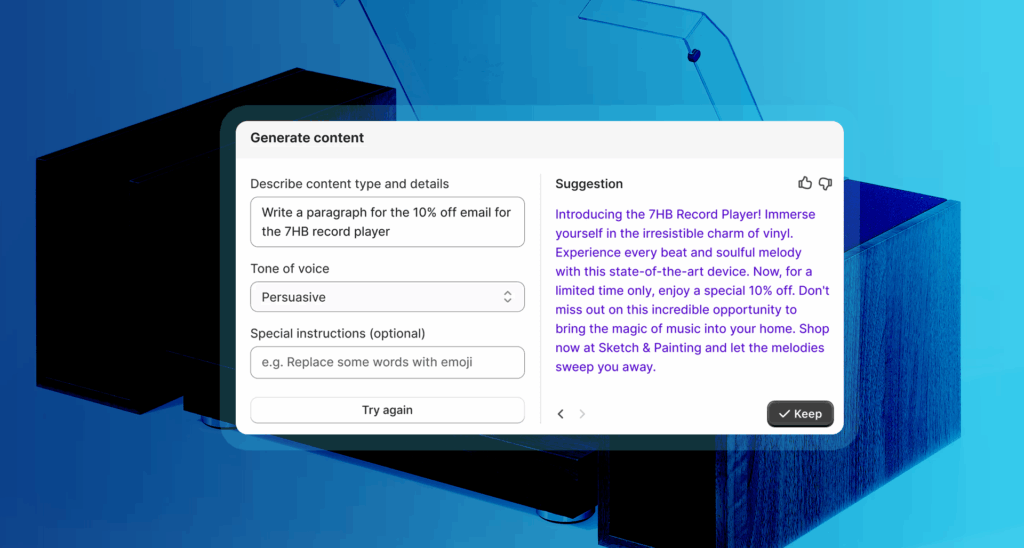
Show Me the Money: How Digital ECommerce Increases ROI for B2B Companies

While it sounds demanding and difficult to implement digitally, these needs are now table stakes to retain customers. Sadly, if their preferred vendor doesn’t offer this, customers are highly likely to find a new supplier who will.

Attract New Customers

Almost all the same considerations apply when attempting to attract new customers. Like your existing customers, new potential customers expect convenience, friction-free access to information, flexibility in payment methods, as well as robust shipping options. Digital commerce also provides an excellent tie in with social media and promotions targeting new customers. These provide new vectors to have people visit your site and browse your products. In order to successfully execute, it’s imperative for every stakeholder in the buying process to be able to do their role digitally with your business. For example, CSRs will still play an important role, but they might now be responding to questions via online chat features on your site in addition to traditional support over the phone.

Show Me the Money: How Digital ECommerce Increases ROI for B2B Companies

Increase Wallet Share

Since the dawn of time, every business owner and marketer has been trying to conceive ways to capture more of their customer market. Share of wallet is a reflection of how important your products are to your buyers. The higher the share of wallet, the more customers are dependent on your product to perform their jobs. Driving higher share of wallet is one of the most impactful growth opportunities for manufacturers. In addition to helping drive revenue and decreasing the average cost of goods created, higher share of wallet is the key to unlocking the retention brands dream about. With share of wallet being key to business prosperity, B2B and D2C (direct to consumer) ecommerce is imperative for companies who want to be able to compete for market share among today’s digitally savvy customers. As much as everyone is sick and tired of hearing about the Amazon Effect, it truly has changed the rules of customer engagement.

Show Me the Money: How Digital ECommerce Increases ROI for B2B Companies

Offer a Direct to Consumer (D2C) Channel

The past 18 months have seen the vast acceleration of manufacturers offering their own Direct to Consumer channels. As of Q3 2021, selling Direct to Consumer is the most popular topic in B2B marketing. Brand manufacturers who have set up a D2C channel have seen explosive, double digit revenue growth in the past year. While selling D2C does have business considerations to consider such as how fulfillment and shipping will differ, the ROI in adding a new stream of revenue has been revolutionary for companies, especially for those hit with hard economic times during the pandemic.

Provide B2B and Distributor Channels

Each of your customer types, or personas, desire to have a message tailored to them. The great news is that B2B software platforms like Optimizely and Shopify Plus make it relatively easy for clients to set up different channels, or branded microsites, for each type of customer. With these capabilities, it makes it more streamlined than ever to serve your longstanding and loyal distributors, while being able to directly onboard new businesses as well. Providing customers everything they need and more to do their job efficiently and effectively will grow your customer pipeline and earn increased share of wallet.

Grow Revenue Per Product

For years, manufacturers have fought to get their distributors to merchandise and market their products in the absolute best way in the absolute best locations. Unlike any other time in history, marketers are now in the driver’s seat themselves thanks to B2B ecommerce. Armed with websites and customer portals, savvy marketers are now able to reach their customers 24/7 to have their products in front of their customers at the moment of their decision. Superior digital merchandising, smart product recommendations and refined customer catalogs are driving increased revenue per product, while also increasing customer satisfaction and retention.

Show Me the Money: How Digital ECommerce Increases ROI for B2B Companies

Increase Customer Self-Service Activities

For years, manufacturers have been hesitant to enable customer self-service activities. Partly, this was due to not wanting to put people out of a job. However, as digital change has taken over the industry, roles have evolved. Now that customers are largely enabled to self-serve 24/7/365 through their customer portal, CSRs have matured from order takers to product experts. The immense value CSRs are now able to provide customers when they need help or product recommendations is unparalleled. With consumers being able to do all their research and purchasing activities in the portal and message their CSRs with questions, it provides a fast, feature rich, friction free and dependable purchasing process. Additionally, internal streamlining of CSR duties can enable companies to reduce their personnel expense and decrease overhead.

Decrease Cost Per Customer Acquisition

Calculating cost per customer or cost per acquisition could be an entire white paper in and of itself. However, the one consistent theme to all of the steps to calculate this cost is knowing your data. It’s critical to know where your customers are coming from, why they’re coming to your website, which products they’re interested in, how long it takes them to complete an order and what obstacles they run into. Analyzing all this data empowers your team to make adjustments, which in turn will decrease the cost per customer over time.

Expand Product Gross Margin

When calculating the ROI of an ecommerce solution, one of the most often overlooked sources of ROI is in the higher product gross margins that come from increased sales. Savings opportunities include buying materials used to make items at a reduced cost, calculating marketing costs across more merchandise and spreading overhead out across larger commodity quantities. When these savings are taken into consideration, it’s clear how quickly boosting your product gross margins can have a vast impact on your profitability, making a great case for ecommerce.

Show Me the Money: How Digital ECommerce Increases ROI for B2B Companies

The Ultimate Result? Boosting the Company’s Market Capitalization

For readers who may not understand market capitalization – It is the total value of all of a company’s shares of stock and is calculated by multiplying the number of stock shares outstanding by the current share price. For example, if a company has issued 1 million shares and its share price is $50, its market cap is $50 million. Shares outstanding includes all shares — those available to the public and restricted shares available to and held by specific groups. Market cap allows investors to size up a company based on how valuable the public perceives it to be. The higher the value, the “bigger” and “less risky” the company. For C-Level executives, increasing market capitalization is incredibly rewarding. Not only does it signify the company has been doing a great job, but it provides the opportunity to attract investors to help obtain cash for further growth initiatives.

In summary, there are a multitude of ways in which implementing a better ecommerce infrastructure can provide ROI for your company. BlueBolt helps manufacturers and distributors alike modernize their ecommerce offerings with platform recommendations and implementation, connecting legacy systems and integrating third party applications to create a sleek and efficient framework. The result is a user-friendly interface for customers which enables them to self-serve 24/7, while streamlining internal processes. The impact is a return on investment in many areas across the business which any discerning business leader will be excited to realize.

It Takes Two: How We Work with our Clients to Ensure Success

Aaron Shapiro

B y collaborating with a partner with deep experience in the software platform you are implementing, both teams gain access to the others’ skill sets, experience and viewpoints, which can greatly expand the scope of success.

Sonny and Cher. Bert and Ernie. Peanut butter and jelly. A lot of good things come in pairs and business relationships are no exception. In the software industry, what’s more important than just having good business ideas is having a trusted and experienced systems integration partner to help implement them.

I’ve been with BlueBolt for almost 15 years, and in this business even longer. Over time, I’ve learned what it takes to have a successful digital engagement that is delivered on time and on budget; it takes every member of the project team, including client stakeholders, to all work towards the same goals and be on the same page.

It Takes Two: How We Work with our Clients to Ensure Success

Yes, as professionals, we can take instructions and follow them exactly as outlined by our clients, but we understand that the quickest and easiest way to get results is through open and frequent communication as a team. While we pride ourselves on being expert strategists, developers and consultants, we know we can’t achieve our goals without making sure we’re helping our clients effectively achieve theirs throughout every step of their projects. It truly “takes two to make a thing go right.”

Be Prepared

Benjamin Franklin wisely said, “By failing to prepare you are preparing to fail.” As a client, when it comes to starting a project and getting through discovery, UX and creative on budget, it’s important to be prepared by looking at the project holistically. At BlueBolt, we do this by providing our clients with highly detailed documentation to complete well in advance of discovery in order to anticipate and address any roadblocks or issues that may arise throughout the project timeline.

In order to understand the importance of this and why our engagement model makes such a difference, I’ve outlined some differentiators of our process here in this blog post. I believe you’ll see just why what we do at BlueBolt is so important to our clients’ success and how following our model translates into better outcomes for all involved.

The Discovery Package

Before the discovery portion of a client engagement starts, our team will send a discovery package – a detailed document of questions – to our client. This document is meant to help the client prepare for the discovery engagement and is based off a standard template but is always tailored to each specific project. The discovery package includes questions that cover the whole gamut of what objectives the client wants and needs to accomplish by running their project and what’s expected of us as their partner.

It Takes Two: How We Work with our Clients to Ensure Success

Our clients complete this documentation and send it back in time to be reviewed before the discovery meetings start. This enables our project team to focus on areas of weakness and uncertainty and can really help streamline the discovery process.

We believe this discovery package helps the client in two ways:

  1. It prepares the client to consider the topics and questions that need to be discussed so the client can either provide the answers ahead of time or come prepared to discuss the answers during the discovery meetings.
  2. It also helps the client identify the stakeholders who need to be part of the discovery process in order to cover all areas of concern.

Assembling a Team

In my experience, it is incredibly important that discovery meetings be run efficiently which can only happen when you get the right answers to the right questions from the right people. We encourage our clients whenever possible to make sure they bring the people who have the necessary insights and answers to our meetings. We also do our best to prepare clients for meetings by sending over agendas ahead of time so they can understand who should be involved and what items might be missing.

It Takes Two: How We Work with our Clients to Ensure Success

I always emphasize that it is always better in the long run to reschedule a meeting or change the agenda rather than miss input from a key stakeholder. If the right people can’t attend, what could have taken one discovery session now winds up taking two or more. And when there are two or three billable resources per meeting, the costs of omission can quickly add up. It’s best to streamline the discovery process through proper planning and attendance by the appropriate people, something we count on our clients to assist with.

3 Major Pitfalls to Avoid During Discovery

As a trusted partner, we are always trying to ensure every step we take with our clients is in their best interests. As such, here are three pitfalls we have seen as obstacles to success which we try to ensure our clients avoid.

Untimely Approvals

One of the biggest risks to keeping a timeline intact and remaining on budget is the approval process. Many clients expect that they can turn around approvals quickly, but in reality, this is not often the case.

It Takes Two: How We Work with our Clients to Ensure Success

It takes a significant amount of time and resources to put together a project plan, and these plans are always developed to meet the clients’ deadline. However, client approvals often need to be handled by stakeholders who are not always part of the active project team, thus the time to get approvals takes longer than expected. When the client fails to deliver approvals, the project starts to accrue additional unplanned overhead that will have a negative impact on both timeline and budget. In an Agile project this can totally blow a sprint plan and result in future sprint plans having to be reworked, while in a waterfall project, stagnating approvals can be a major blocker that prevents the project from moving forward.

We always stress to our clients the importance of being realistic about the approval process and the overall timeline. If you know that external stakeholders are going to have a say in the approval process, then work with the partner team to plan your timeline accordingly. This saves both teams time and resources and keeps everyone moving forward.

Changes to Key Stakeholders

While it’s not always possible to avoid a scenario where a key stakeholder is removed from a project, it must be pointed out that this can and usually does cause issues with project cadence. In my years at BlueBolt, I’ve seen a number of stakeholders change out midstream and typically it leads to one of two scenarios, if not both:

  1. The project is paused while new stakeholders are brought up to speed
  2. The project direction is completely changed once those new stakeholders have an understanding of the project and insert their own opinions or requirements

While it may be obvious that this can impact a project timeline, what may not be as obvious is the impact these scenarios can have on a project budget once the team re-engages.

If a project is paused, we as an organization must reassign the project team to other ongoing projects. When this happens, the effort to re-engage in a project is complicated because depending on the situation, the same resources may be unavailable to continue with the project due to other assignments. In turn, this can lead to quite a bit of unplanned overhead while the project team acquaints new team members to the project. Even if the project team remains the same, it will still take time reacquaint them to any new project details.

Needless to say, timeline, scope, and budget will always need to be reevaluated at any point of reengagement. To help avoid these issues, we always work with our clients to try to plan for changes in team structure or address such changes as efficiently and quickly as possible with as little disturbance to the project.

Business Process Changes

Most of our work at BlueBolt involves projects that transform the way a client does business both internally and externally, which means both frontend and backend processes need to be adjusted. For instance, a client’s customer-facing website might have been built to align with certain back-office processes. However, the capabilities and needs of the website evolve over time and things in the backend must compensate for certain technological or business limitations that weren’t in place when a solution was first implemented. While a change to one part of the business is great, it can mean repercussions for other parts.

A new project often offers a great opportunity to fix such broken processes, but it’s not always easy to accomplish. Process changes require far greater planning than what most clients anticipate and are pretty difficult to work into a project that’s already underway unless all the stakeholders involved are on board and ready to facilitate that change.

Without having insight from our clients about their processes and organizational interdependencies, it’s very difficult to predict and plan for complications that might arise as a result of our implementation. Instead, we may have to stall our work and revert to a solution that more accurately aligns with the existing back-end process. When this happens, the timing of the project may not permit any changes and thus we go live before the client’s back-office process can be changed, causing harmful discrepancies within the organization. Additionally, changes that are made without input from all company stakeholders may cause a rift among teams and a disturbance to workflows.

Instead of waiting for such issues to arise, we at BlueBolt work with our clients to evaluate the current state of their processes and outline anticipated organizational changes beyond what’s outlined in the project at hand. When these procedural changes are acknowledged and addressed early with the necessary and appropriate stakeholders, the project team can develop solutions that better align to the company as a whole.

We Win Together

At BlueBolt we work hard to ensure that every engagement is successful. We do our best to help prepare our clients for what is to come. Of course, there will always be unforeseen circumstances that arise during the course of a project, but we believe strongly that if we work as a team and do our best to avoid the pitfalls I’ve outlined here, we will all win together.

If you’re looking for a trustworthy, transparent, and talented team to partner with for your next digital content, commerce, or search project, BlueBolt can help. Get in touch with us today!

Optimizing the B2B Digital Experience: Meeting Your Customers through Live Chat

Jason Lichon

O nce overlooked in B2B digital strategies, optimized customer experiences are a must have for companies looking to convert and engage with customers in today’s world.

With current COVID-19 restrictions on meeting in person, it’s even more important now than ever for B2B organizations to examine how they interact and engage with customers. Innovation in this time of crisis and beyond will enable you to provide more meaningful and personalized touchpoints in the buyer’s journey and help your business grow.

But don’t just take my word for it.

In their recent B2B Digital Experience Report, Optimizely gathered insights from 600 global B2B decision makers about digital experience tactics and technology. They inquired about everything from budgets, to Amazon, to AI. The most encompassing takeaway from the report is that in order to win in today’s digital economy, B2B businesses must focus on the customer by understanding who they are and what they need, and then provide the appropriate, personalized solutions to address those needs.

Optimizing the B2B Digital Experience: Meeting Your Customers through Live Chat

Though focusing on the customer may seem obvious, the customer journey can be complex, especially for B2B organizations. There are many moving parts to consider, and while making decisions can seem overwhelming, the biggest opportunity for businesses is to invest in products and services that better serve the customer throughout the buying lifecycle and beyond. It’s not a one-size-fits all type of process and instead should involve looking at problems from many different angles and finding the right solutions that truly deliver better customer experiences.

According to Optimizely’s report, the majority of B2B organizations (54%) define their customer relationships as strained, developing or non-existent. Clearly there’s a huge opportunity to improve in this area. B2B organizations should specifically look to connect with their customers where and when it makes most sense. One simple and effective solution is live chat.

Live chat leads to personalized digital experiences

Data from the Optimizely report shows that 60% of B2B leaders say that the top way that they want to learn about a fellow B2B company is through their website. Thirty seven percent of these same leaders also say live chat is the website feature/functionality they are most likely to adapt in the next 12 months. Combine these two points, and you’ve got an interesting opportunity. If the majority of people prefer accessing information about a company through that company’s website, and that website has a live chat solution implemented, then live chat can be a viable tool to engage with website visitors and improve customer experiences.

Optimizing the B2B Digital Experience: Meeting Your Customers through Live Chat
Hockeyshot // BlueBolt

B2B interactions often deal with quite a lot of complexity – customer-specific pricing, tight delivery schedules, endless numbers of SKU’s – and organizations need to be prepared to provide immediate and personal attention when their customers need it. Live chat is a powerful and convenient tool when it comes to assisting customers in real time.

Knowing that they are talking to a real person, not a bot, gives customers the confidence that their issues are being handled quickly and efficiently. Live chat also enables your reps to reach customers in unique and engaging ways, including video and file sharing – something that obviously cannot be supported through a typical phone call, email, or form submission. Beyond the front-end, user specific advantages, live chat is also an effective tool in gathering and recording data that can be used to improve customer experience across the whole of your organization, not just digitally. Finally, live chat can be personalized so that returning customers are addressed individually and previous interactions are recorded; after all, if the customer has interacted with you before, wouldn’t it make sense that you know who they are the next time you speak? This not only will save time but will also make your customers feel valued.

The big picture of personalization.

It’s more common now that most B2B companies have gone through at least some type of digital transformation. According to Optimizely’s report, most leaders say they have a digital foundation to work with, but many are looking for more to get the job done. This points to the need for organizations to take a holistic approach to enhancing customer experiences.

Of course, perfecting the digital experience is an ever-evolving process that encompasses more than just keeping up with competitors or the expectations of your customers; it’s about truly understanding your customers and using that data to deliver more personalized experiences to achieve digital success. One way to achieve this on the most basic of levels is through live chat, which when used correctly, can help support and manage better customer relationships, increase revenue, and improve customer loyalty.

Optimizing the B2B Digital Experience: Meeting Your Customers through Live Chat
Top Quality Manufacturing // BlueBolt

Live chat, combined with other customer experience tools, is the foundation from which organizations can ensure they are gathering the right data and providing the right solutions so customers remain central to the business.

If we can be of help in anyway, please connect with us as we are always happy to help.

Note: The original version of this article was posted by Paul Demery on DigitalCommerce360.com.

SMS Marketing in the Time of COVID

Jason Lichon

T he best consumer experiences are the ones that meet buyers consistently throughout all touchpoints of the customer journey.

Now, more than ever, mobile experiences are having a huge impact on how people shop. Consider the following data from the eCommerce marketing platform, Yotpo or Okendo.

  • During the pandemic, 57% of consumers are shopping online more than usual
  • 65% of consumers prefer to shop directly from their phone
  • There’s been a 30% increase in time spent on mobile phones since the COVID-19 pandemic began
Delivery personnel deliver goods to customers during the Covid-19 virus epidemic around the world,Therefore must wear a mask to prevent the spread of the disease, Express delivery . Quarantine

With such a big window of opportunity to reach your customers through mobile, short message service (SMS) marketing can be a valuable tactic. The average person already spends more than 4 hours a day on a mobile device and checks their phone more than 150 times in that same span (Yotpo). By using SMS marketing to send your customers the right mobile messages at the right time, you’ll be able to capitalize on this channel by not only converting browsers into buyers now, but also by building meaningful relationships and encouraging customer loyalty well into the future.

Here are just a few scenarios where SMS marketing can move the needle with your customers:

  • Using messaging automation, you can trigger perfectly timed, personalized messages to encourage conversions. For instance, if a buyer abandons items in a cart, sending an SMS reminder that they’ve forgotten something can inspire them to go back and buy
  • Segment out audiences to hyper-target buyers based on advanced data like past behaviors and transactions
  • Have a new product or campaign launch? Use SMS to easily and quickly notify customers instead of getting lost in a sea of other marketing emails in their inboxes. After all, SMS has a 6-8x higher engagement rate than email with an average open rate of a whopping 98%
  • Provide more engaging and personalized customer service through managed chats and helpdesk integrations
Text message marketing examples

To learn more about these features and how to create a winning SMS marketing strategy for your brand, check out Yotpo’s Complete Guide to Generating Fast ROI With SMS Marketing. The guide includes best practices for more personalized mobile experiences and real-life examples from a variety of brands finding success through SMS marketing.

In a time when customers crave highly targeted mobile experiences more than ever, brands need to deliver. It’s clear that shoppers love to use mobile, and I think they’d love for you to as well.

The Clock is Ticking: What Merchants Should Consider When Migrating from Magento 1

Chris Risner

J une 30, 2020 is the end of life for Magento 1, both Commerce and Open Source. It’s been a long time coming since the news of its end was first announced in November 2015. Yet, even just days before the deadline, some merchants may still be trying to wrap their heads around what to do. If you’re one of them, here’s some information that might help.

Remain Calm, but Don’t Wait!

Before any remaining Magento 1 merchants start to completely panic, please know that the end of Magento 1 will not serve as a light-switch that shuts off your online store as soon as July rolls around. Instead, it means that your store will still exist, but any support previously provided by Magento, like security patches or updates, will not be provided.

Merchants will be solely responsible for any security breaches and their Magento 1 sites will fall out of compliance with the Payment Card Industry Data Security Standards (PCI DSS). And while there are companies out there offering solutions and support for Magento 1 merchants after June 30, the truth is, the ability to remain competitive and keep up with customer expectations will diminish significantly the longer you wait to make a move. So even though your store will remain on, it’s in your best interest and the interests of your customers to migrate platforms.

magento-migration

At a time when many businesses across all industries are trying to rein in spending to weather the current global crises, it may seem risky to invest in a platform migration for your online store – even we can admit the costs and timelines can sometimes seem daunting!

However, we cannot stress enough how important it is for merchants to take action now. By doing so, you will be better prepared for success down the line, even well after things have settled. Your customers will still be shopping and are still expecting a certain level of service and security from your store, regardless of outside forces. The rewards of pursuing a migration now far outweigh the risks of staying with Magento 1.

person holds credit card over keyboard

Options for Migrating from Magento 1

While migrating to Magento 2 is an option for all merchants, it won’t be any less effort to implement a completely new platform, since there is no simple upgrade path. Plus, the documented issues and ongoing expenses with Magento did not evaporate with M2 – they have continued on. Keeping all this in mind, we encourage you to take a look at commerce platforms available to you, including ShopifyOptimizely, BigCommerce and others. Whether your business is B2C, B2B, or both, the various platforms offer robust and unique solutions for merchants of all kinds. If you’re not sure of where to start, we can help.

Migrating away from Magento 1

BlueBolt’s expert strategists and developers have helped hundreds of clients over the years by providing best practices and information to make decisions on what’s best for each individual client’s business. We work to thoroughly understand your business and requirements, and make recommendations based on what specific needs your business has.  As you embark on the next step in your digital transformation journey, let us help you take control of your future and make decisions that will enable you to reach your goals – contact us today!

How to Easily Authenticate Shopify Customers with Auth0

Jason Lichon

I t’s no secret that the more you know your customer, the more easily you will be able to create personalized experiences, build brand loyalty, and increase conversions. One of the best ways to gather customer information to better meet these goals is through account registration and logins. However, this can become a friction point in a customer journey if not done right.

One of the best solutions to overcoming this barrier is by using a central authentication source like Auth0 that will allow your customers to have one username and password that works across all your properties. Not only will this approach reduce “login fatigue” on the customer side, but also, your team can get a better single, unified view of your customers across brands, partners, and digital touch points.

Recently, a BlueBolt client started an organization-wide implementation of Auth0 as their authentication service across all their customer-facing properties. Part of this rollout includes replacing the native Shopify logins with an Auth0 authentication user flow. In this blog, I will expand upon the primary steps involved in this process, which are:

  1. Enable Multipass on the Shopify account
  2. Create an Auth0 Application
  3. Add an Auth0 rule to create Multipass token and redirect user
  4. Update Shopify Theme with Auth0 Links
  5. Optional: Capture First & Last Name During Signup
  6. Prerequisites

Before we get started, you’ll need to make sure you’re ready to go with the following requirements. First, Shopify requires a Shopify Plus storefront. If you’re a Shopify Partner, you can create development stores to test out any functionality you need to implement on a Plus store.

Second, an Auth0 account is also required. Auth0’s free tier includes everything necessary, but even if it didn’t, a newly created instance includes all paid features for a few weeks to get you started.

1. Enable Multipass on Shopify account

In order to enable Multipass, log into the Shopify store, go to the Settings page and click into the Checkout window. Make sure customer accounts are set to either optional or required.

How to Easily Authenticate Shopify Customers with Auth0

This is an important step in ensuring Shopify can verify that a Multipass is legitimate; the encryption routine can now create a cipher that Shopify will be able to decrypt. If you ever suspect that your Multipass key has been compromised, then disable and re-enable Multipass. This will generate a new secret key which you will need to copy into Auth0.

2. Create an Auth0 Application

Within the Auth0 dashboard, go to Applications, click Create Application, give it a name like “Shopify Store” (it’s important to note that the name of the application is publicly visible!) . Then choose the Regular Web Application.

How to Easily Authenticate Shopify Customers with Auth0

Skip the Quick Start and go to Settings.

For the following sections, you need to substitute {shopify-domain} with the domain of your particular store (ex: sample-store.myshopify.com)

Allowed Callback URLs: https://{shopify-domain}/account
Application Login URI: https://{shopify-domain}/account/login
Allowed Logout URLs: https://{shopify-domain}/account/logout

Expand the Advanced Settings section and add these two key/value pairs under Application Metadata:

Key: shopify_domain; Value: {shopify-domain}
Key: shopify_multipass_secret; Value {multipass-secret}

How to Easily Authenticate Shopify Customers with Auth0

3. Add Auth0 rule to create Multipass token and redirect user

Now that we have a landing point for the Shopify store to send users to, we need to be able to pass the authenticated user back to the Shopify store. This is where Multipass comes into play.

How to Easily Authenticate Shopify Customers with Auth0

1 function (user, context, callback) {
2 if (context.clientMetadata && context.clientMetadata.shopify_domain && context.clientMetadata.shopify_multipass_secret)
3 {
4 const RULE_NAME = ‘shopify-multipasstoken’;
5 const CLIENTNAME = context.clientName;
6 console.log(${RULE_NAME} started by ${CLIENTNAME});
7
8 const now = (new Date()).toISOString();
9 let shopifyToken = {
10 email: user.email,
11 created_at: now,
12 identifier: user.user_id,
13 remote_ip: context.request.ip
14 };
15 if (context.request && context.request.query && context.requ.query.return_to){
16 shopifyToken.return_to = context.request.query.return_to;
17 }
18
19 if (context.user_metadata)
20 {
21 shopifyToken.first_name = user.user_metadata.given_name;
22 shopifyToken.last_name= user.user_metadata.family_name;
23 }
24
25 const hash = crypto.createHash(“sha256”).update(context.clientMetadata.shopify_multipass_secret).digest();
26 const encryptionKey = hash.slice(0, 16);
27 const signingKey = hash.slice(16, 32);
28
29 const iv = crypto.randomBytes(16);
30 const cipher = crypto.createCipheriv(‘aes-128-cbc’, encryptionKey, iv);
31 const cipherText = Buffer.concat([iv, cipher.update(JSON.stringify(shopifyToken), ‘utf8’), cipher.final()]);
32
33 const signed = crypto.createHmac(“SHA256”, signingKey).update(cipherText).digest();
34
35 const token = Buffer.concat([cipherText, signed]).toString(‘base64’);
36 const urlToken = token.replace(/+/g, ‘-‘).replace(/\//g, ‘_’);
37
38 context.redirect = {
39 url: https://${context.clientMetadata.shopify_domain}/account/login/multipass/${urlToken}
40 };
41 }
42 return callback(null, user, context);
43 }

view rawauth0-rule-shopify-multipass.js hosted with love by GitHub.


  • Line 2
    : since Auth0 runs all rules for all authentications, we want to restrict this to just when the Auth0 Application has declared the shopify_domain and shopify_multipass_seceret metadata.
  • Line 4-6: Some minor logging, just to verify that the rule is being run.
  • Line 8-14: Shopify requires at least the email and created_at data points. For added information, we are also passing an identifier (in case multiple Auth0 accounts have the same email address) and remote_ip to ensure that this Multipass request can only be used by the same computer that sent the initial login request.
  • Line 15-17: If there is a return_to value in the query string, then add this to the Shopify token.
  • Line 19-23: In another post of mine concerning TalentLMS/Auth0, I describe how to grab first/last name when signing up a user. If that is in place, this will also add those data points to the Shopify account.
  • Line 25-36: These lines that do the actual encryption were taken from a repository that I found on GitHub, so thanks go to Cory Smith from Calgary, AB for this one.
  • Line 38-40: This sets the destination for the authenticated user.

Once this rule runs, the user will be redirected back to the Shopify store. This is important, because if there are any Auth0 rules after this one, they will be completely skipped.

4. Update Shopify Theme with Auth0 Links

For this example, we are just going to add a login link for Auth0. If you want to completely replace the Shopify Login process with Auth0, then instead of presenting the user with a login page, you can redirect the user directly to Auth0. As a proof-of-concept, though, this will require the user to manually click the link.

Start by editing the current theme (or whatever theme you want to use to test this out).

How to Easily Authenticate Shopify Customers with Auth0

Within the Login page, typically under Templates you’ll find the customers/login.liquid file. Find a good place to add the link; you can see below that I put it next to the “Create account” link.

<a href=”{{ settings.auth0_login_url }}”>Log in with Auth0</a>

How to Easily Authenticate Shopify Customers with Auth0

You may also want to put a link on the registration page, located in the customers/register.liquid template. If you are completely replacing Shopify logins with Auth0, then this will be another page where you will redirect the user straight to Auth0 instead of requiring them to click on a specific link.

Next up is to replace the logout link with the Auth0 logout. There is a logout link on the account page, found in customers/account.liquid. If your theme has a logout link anywhere else, that will also need to be replaced with the following:

<a href=”{{ settings.auth0_logout_url }}”>{{ ‘layout.customer.log_out’ | t }}</a>

Finally, we need to configure the theme settings to allow a user to paste the login and logout URLs. Open the settings_schema.json file and paste the following snippet to the end of the array. This will provide an admin user the ability to key in the URL value without having to modify the theme templates directly.

How to Easily Authenticate Shopify Customers with Auth0

You may also want to put a link on the registration page, located in the customers/register.liquid template. If you are completely replacing Shopify logins with Auth0, then this will be another page where you will redirect the user straight to Auth0 instead of requiring them to click on a specific link.

Next up is to replace the logout link with the Auth0 logout. There is a logout link on the account page, found in customers/account.liquid. If your theme has a logout link anywhere else, that will also need to be replaced with the following:

<a href=”{{ settings.auth0_logout_url }}”>{{ ‘layout.customer.log_out’ | t }}</a>

Finally, we need to configure the theme settings to allow a user to paste the login and logout URLs. Open the settings_schema.json file and paste the following snippet to the end of the array. This will provide an admin user the ability to key in the URL value without having to modify the theme templates directly.

How to Easily Authenticate Shopify Customers with Auth0
  • auth0-instance: the URL for your Auth0 instance.
  • clientid: the value from Auth0
  • shopify-domain: the domain you want the user sent back to. This must match the Allowed
  • Callback URLs initially specified.
  • return-to-path: this can either be set as a hardcoded value (like “account”) or it can be dynamically replaced with JavaScript on the page. This is helpful if you want to override the login on the Cart page.

https://{auth0-instance}.auth0.com/authorize?response_type=code&client_id={clientid}&return_to=https://{shopify-domain}/{return-to-path}&scope=SCOPE&state=STATE

The logout URL looks very similar:

  •  auth0-instance: the URL for your Auth0 instance.
  • clientid: the value from Auth0
  • shopify-domain: the domain you want the user sent back to. This must match the Allowed Logout URLs initially specified.

https://{auth0-instance}.auth0.com/v2/logout?response_type=code&client_id={clientid}&returnTo=https://{shopify-domain}/account/logout

Now you can go back to the Themes page and click the Customize button and switch to the Theme settings, then expand the Auth0 Config section, and paste the URLs from above.

How to Easily Authenticate Shopify Customers with Auth0

5. Optional: Capture First & Last Name During Signup

The final step is to customize the Sign Up page to require the user to enter values for First and Last name. The simplest way that I have found to do this is to customize the login page in Auth0. Under Universal Login, click on the Login tab, toggle the “Customer Login Page” and select the “Lock” Default Template. This uses the Auth0Lock and for our purposes, we will be utilizing the additionalSignUpFields array configuration option. Add the following JSON snippet to the code block:

additionalSignUpFields:[{

  name: “given_name”,

  placeholder: “Enter your First Name”

},

{

  name:”family_name”,

  placeholder:”Enter your Last Name”

}],

And it should look something like this:

How to Easily Authenticate Shopify Customers with Auth0

Click Save Changes and that should be it! Go back to Shopify’s login page to test it out. To make sure it really works, log yourself out of Shopify, and when logging back in, click the Log in with Auth0 link you created earlier. You can go through the Sign Up workflow, which should require First name, Last name, Email, and Password.

In Production

Once you are ready to require all users to use Auth0 to login, the customers/login.liquid template can be completely replaced with a redirect to the auth0_login_url. All links to the login page can be replaced with direct links to the same setting. Also, all logout links need their URL to be replaced with the auth0_logout_url setting.

Conclusion

As mentioned in the beginning of this article, replacing native Shopify logins with Auth0 enables a centralized authentication service which can be combined with other third-party websites. By following the steps I’ve outlined above, you and your team can focus less on building your own authentication solution and more on delivering trusted and innovative digital experiences to your customers.

Note: The original version of this article was posted on Rovani in C#, a blog owned and written by BlueBolt Senior Solutions Architect, David Rovani.

How Small Adjustments Can Make a Big Impact on Digital Stores During COVID-19

Chris Risner

R Recently, I came across a really helpful blog post from Shopify Plus that focuses on short-term digital marketing strategies for online retailers during COVID-19.

It includes great tips for optimizing short-term messaging, reviewing short-term digital marketing budgets, and creating more specific audiences for digital campaigns – all valuable insights to help retailers get through this unprecedented time.   After reading the post, I thought there might be a few more short-term tactics digital retailers could consider as they adjust their current digital strategies. 

Examine Website Performance

While historical data may have helped shape the view of your customer in the past, things are a lot different now. Since the new normal is anything but normal, you should reexamine how customers are interacting with your eCommerce website. Look at certain website performance metrics to see how new shopping patterns may be affecting your shopping experience.  

How small website adjustments can lead to big improvements
Back view of IT developer team programming code on computer screen and brainstorming for new project at modern office.

For instance, as people have more time to spend online, your site may begin to garner attention from sources you’re not used to. Looking at new and unique visitor traffic can help determine what your “new normal” customer base looks like and help you consider what changes you may want to make to your site or in your processes to better serve their needs and keep them as customers in the future. 

Take Time to Focus on Content

Delivering the right content on your site enables you to create a customer experience that’s engaging, valuable, and develops a more meaningful connection with your customers. Businesses that don’t take advantage of content strategies miss the opportunity to build experiences to meet increasingly high customer expectations.  

However, developing great content can take a lot of time and effort. If you’re working with a small marketing team, this may be a great time to review your content marketing and see what’s working and what’s not (as mentioned above, you can gather such insights by examining website metrics). As certain business initiatives begin to slow down during this time, refocusing resources and time on creating and managing better content will help your customer experience not only now, but in the long run. 

How small website adjustments can lead to big improvements 2
Portrait of handsome bearded businessman standing by desk discussing work project with contemporary young developer coding at his computer in office

Especially in times like these, your content can differentiate and humanize your brand. Consumers want to spend money with the brands they know, trust, and love. Establishing such a relationship with your customers begins with the human side of your brand rather than focusing on conversion rates. By sharing personal stories and talking about shared experiences, consumers might feel more connected to you in this time of uncertainty. Make sure you bring value to your target audience by creating genuine connections, aligning with their needs and wants, and offering support and service when needed. 

Reward Customer Loyalty

In these uncertain times, as people change their spending patterns, your business may not be able to rely on the customer base that has historically driven your revenue numbers. Remaining close to high-value and loyal customers through communications and special offers is a must. By making these customers feel appreciated, they’ll be more open and willing to spend with you, even now. Furthermore, building a referral marketing program can turn customer advocacy from these loyal customers into more business for you by potentially gaining multiple new customers for every loyal one. 

How small website adjustments can lead to big improvements 2
Young casual Business man holding credit card and using touchscreen smartphone for online shopping while making orders in the cafe.business, lifestyle, technology, ecommerce and online payment concept

Remember, while we’re living through a time of changes and uncertainties, there is one thing we can count on: this too shall pass. Making powerful changes to your digital strategies today will bring you opportunity and success in the future. If we can help you increase engagement and conversions, please contact us.

Blended Content & Commerce: The peanut butter and jelly of digital commerce

Jason Lichon
ON DEMAND WEBINAR

Enjoy the replay of this educational session from BlueBolt and Optimizely (formerly Episerver), “Blended Content and Commerce – The Peanut Butter and Jelly of Digital Commerce.” Our experts discuss the importance and benefits of combining content with commerce, explain the maturity levels that frame organizational strategies, review best practices and show real world examples, and give actionable insights to implement within your own business straight away.

Developing robust content and commerce strategies takes effort, but the results will elevate your brand and help you take a bite out the competition. Satisfy your hunger for success by watching this informative session.