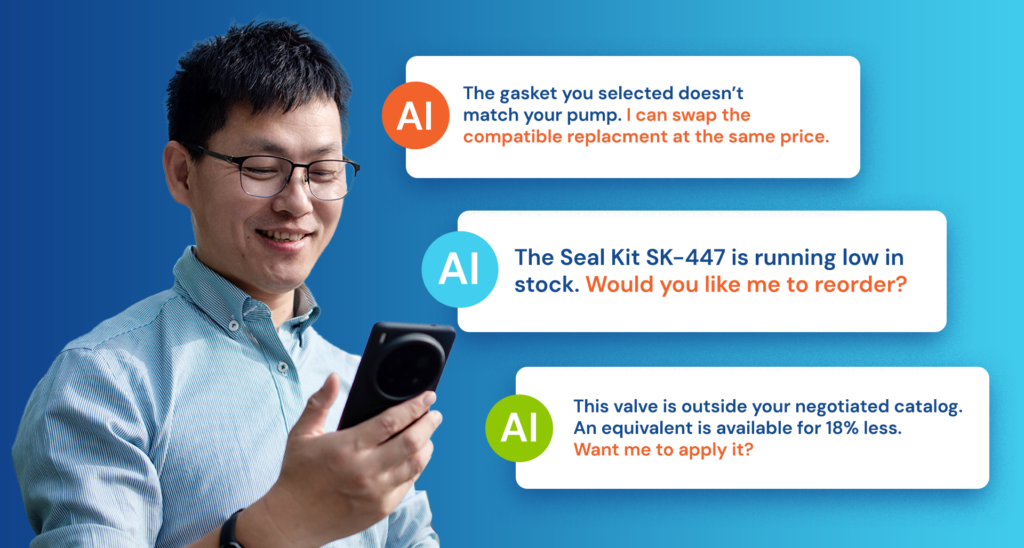
T he quick answer: Agentic commerce is online buying where an AI agent (not a person) handles discovery, comparison, checkout, and follow-up.
During the 2025 holiday season, AI influenced 20% of global online orders, worth $262 billion (Salesforce). For eCommerce SaaS platforms and the merchants on them, the shift mirrors the move from UX to APIs: the storefront still matters, but the real competition is happening at the infrastructure layer.
Something quiet happened over the 2025 holidays. While shoppers thought they were browsing, a growing share weren’t clicking through storefronts at all. They were asking an agent to do it.
Salesforce’s Shopping Index reported that AI influenced 20% of all retail sales during the holiday window, driving $262 billion in revenue. By March 2026, AI-referred traffic was converting 42% better than other channels a complete reversal from March 2025, when that same traffic converted 38% worse (Adobe Digital Insights).
AI shopping queries grew 4,700% year-over-year as of July 2025, with holiday season AI traffic up 693% year-over-year and Q1 2026 traffic up 393% year-over-year. Visa documented a 1,200% increase in AI-driven traffic from generative AI sites to merchant websites during 2024.
These aren’t rounding errors. They’re the early signal of a buying interface changing under our feet.
This post is for the people who have to respond: eCommerce SaaS stakeholders, agencies, and merchants weighing which platform can carry them through it. We’ll cover the numbers, the parallel to the headless transition many of you already lived through, the protocol landscape, and why B2B agentic commerce is a different animal entirely.
What Is Agentic Commerce?
Agentic commerce describes a transaction where an AI agent (not a human clicking buttons) executes the buying steps on someone’s behalf. The agent browses, compares SKUs, completes checkout, and can handle returns. It might live inside ChatGPT, Google’s AI Mode, Perplexity’s Comet browser, Amazon’s Alexa for Shopping, or a retailer’s own app.
What it is not: a chatbot answering FAQs, a recommendation widget, or a search box with autocomplete. Those are conversational features. Agentic commerce is software that holds a budget, calls APIs, parses inventory, picks products, executes payment, and resolves disputes. The infrastructure to do that safely arrived in the last twelve months.
The buyer, in other words, is becoming a bot. And bots don’t shop the way people do.
The Numbers That Should Get Your Attention
| Metric | Figure | Source |
|---|---|---|
| AI-influenced share of global holiday orders, 2025 | 20% ($262B) | Salesforce Shopping Index |
| AI traffic conversion premium, March 2026 | +42% vs. non-AI channels | Adobe Digital Insights |
| AI shopping query growth (July 2025 YoY) | 4,700% | Adobe Digital Insights |
| AI retail traffic growth, 2025 holiday season | 693% YoY | Adobe |
| AI retail traffic growth, Q1 2026 | 393% YoY | Adobe |
| AI-driven traffic to merchant sites (2024) | +1,200% from GenAI sources | Visa |
| Shopify AI-driven order growth, Q1 2026 | ~13x YoY | Shopify Q1 2026 Earnings |
| US agentic commerce spend by 2030 | $190B–$385B | Morgan Stanley |
| Global agent-orchestrated retail revenue by 2030 | $3T–$5T | McKinsey |
Count it however you like. The direction holds. Every credible estimate points up and to the right.
One note on speed: Andreessen Horowitz has described agent workloads as “recursive, bursty and massive.” A single agent goal can fire thousands of sub-tasks in milliseconds. Backends built for a one-human-to-one-system rhythm aren’t ready for that.
From Dashboards to APIs: The Parallel You’ve Seen Before
If this feels familiar, it should. Many of you watched the same arc play out when commerce went headless. The pretty admin dashboard stopped being the product. The API became the product.
Agentic commerce repeats that pattern, just faster. When a human shops, your storefront UX does the heavy lifting: the hero image, the size selector, the trust badges near checkout. When an agent shops, none of that matters. The agent reads your product feed through an API and makes a decision in 600 milliseconds. It never sees your homepage.
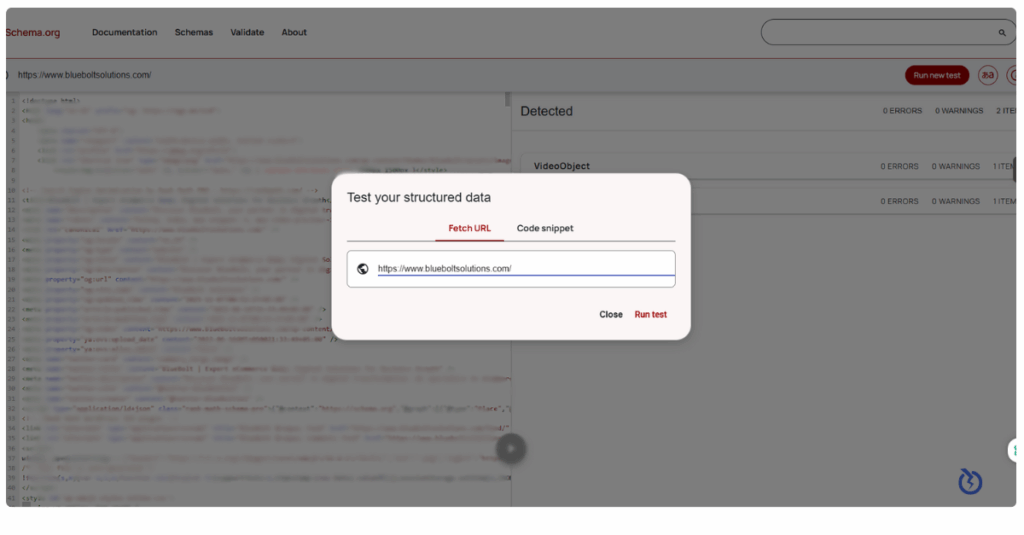
The competitive surface moves. It shifts from how your store looks to how cleanly your data flows. The platforms that win this round aren’t the ones with the slickest themes. They’re the ones with the cleanest catalog APIs, real-time inventory webhooks, and tokenized checkout endpoints an agent can call without a human in the loop.
The part most teams underestimate: this is an infrastructure refresh cycle, not a redesign. Different budget, different team, different timeline.
Why Product Data Just Became Your Front Door
When an agent can’t see your storefront, your product data is your storefront.
Think about what an agent needs to transact: SKU-level inventory, accurate pricing, shipping cost, tax, lead time, dimensions, and clear variant logic. If an agent has to normalize your data before it can act, you’ve already lost the comparison to a competitor whose feed answers cleanly in one call.
This is where many merchants are quietly exposed. Years of patched-together PIM systems, inconsistent attributes across categories, and tribal knowledge about which SKUs are “really” in stock. A human shopper forgives some of that. An agent doesn’t. It routes to the cleaner feed.
BigCommerce leaned into this early, positioning its API-first stack (REST and GraphQL) as agent-readable infrastructure. Its Feedonomics acquisition handles the messy work of getting product data clean and syndicated. The lesson generalizes: product data quality is no longer a back-office hygiene task. It’s a front-door competitive variable.
Shopify has formalized this into a product. Shopify Catalog (confirmed in both Q1 2026 earnings and Spring ’26 Editions) automatically standardizes and enriches product data across over 1 billion products. Data syndicated through Shopify Catalog drives 2x more conversion in AI chats than traffic from general AI searches that rely on scraped or outdated data.
How Are Shopify and BigCommerce Responding?
The two platforms our clients ask about most are moving fast, in different lanes.
Shopify has reorganized its stack around agents. CEO Tobi Lütke told analysts that “AI is now Shopify’s native language.” In Q1 2026, the company reported $3.2 billion in revenue (up 34% YoY), GMV of $101 billion (up 35%), and AI-driven orders up nearly 13x year-over-year. Shopify activated Agentic Storefronts for all merchants in March 2026, and shipped an open-source AI Toolkit on April 9, 2026, letting developers build apps and manage stores using Claude Code, OpenAI Codex, Cursor, and Gemini CLI.
BigCommerce is playing the composable card. Its API-first, headless-friendly architecture was built for this moment. Add the Feedonomics data layer and support for both major agentic commerce protocols, and you get a platform positioned as agent-ready infrastructure rather than a storefront with AI bolted on.
Both stories point the same direction: clean APIs, machine-readable feeds, tokenized checkout. The difference is emphasis. Shopify is building the agent experience into its native rails. BigCommerce is betting that composable openness wins when merchants want to plug into whichever agent ecosystem matters most to them.
The Protocol Landscape: ACP, UCP, and Where Things Stand
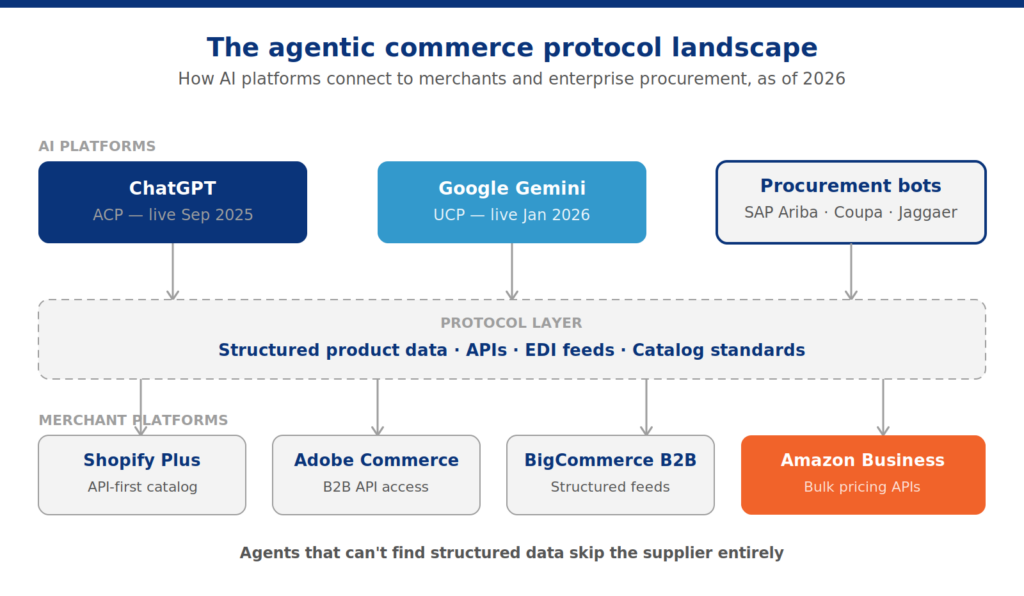
Until recently, there were two competing standards for how AI agents transact with merchants. As of April 2026, the picture has largely resolved — though both protocols remain active.
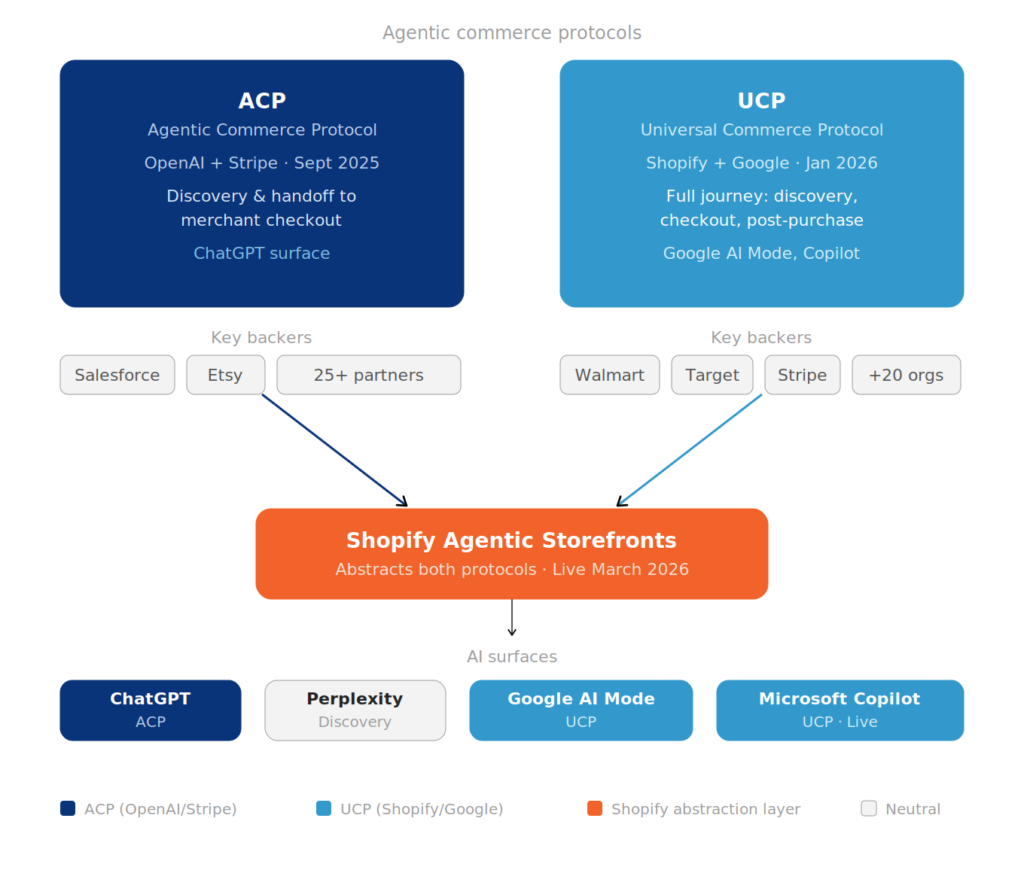
ACP (Agentic Commerce Protocol) was co-developed by OpenAI and Stripe, launched September 2025. It originally powered ChatGPT’s Instant Checkout a feature that let users complete purchases without leaving the chat window. OpenAI shut that down in March 2026, roughly five months in, after fewer than 15 of Shopify’s millions of merchants ever went live.
The reasons were structural: product data synchronization at scale proved difficult, tax collection infrastructure wasn’t built out, and users preferred completing purchases on familiar sites where they had saved accounts. ACP itself survived the shutdown. ChatGPT now uses it as a discovery-and-handoff layer surfacing product recommendations and routing shoppers to the merchant’s own checkout, not completing the transaction in-chat.
Seven major retailers are currently live via ACP (Target, Sephora, Nordstrom, Lowe’s, Best Buy, The Home Depot, and Wayfair), and all Shopify merchants are automatically included via Shopify Catalog.
UCP (Universal Commerce Protocol) was co-developed by Shopify and Google, announced at NRF in January 2026, with backing from Etsy, Wayfair, Target, and Walmart, and endorsement from over 20 organizations including Visa, Mastercard, Adyen, Best Buy, and Flipkart. UCP covers the entire commerce journey (discovery, checkout, post-purchase support) and is designed so merchants declare their own capabilities for agents to negotiate against.
As of Spring ’26 Editions, Microsoft Copilot is live as a UCP-powered checkout surface: Shopify merchants’ products are purchasable directly in Copilot chat, paid via Shop Pay. Meta ads are next, listed as coming soon.
In April 2026, Amazon, Meta, Microsoft, Salesforce, and Stripe joined the UCP Tech Council, consolidating broad industry support. UCP is now the dominant standard for agent-driven commerce infrastructure.
For merchants and the SaaS teams serving them, the practical guidance is straightforward. Think of ACP as your ChatGPT discovery channel — it gets your products surfaced in conversation and routes interested shoppers to your storefront. UCP is the broader infrastructure play, connecting your catalog to Google AI Mode, Gemini, and any agent that adopts the open standard. On Shopify, Agentic Storefronts handles both. Off Shopify, prioritize UCP for Google surface reach and make sure your catalog is clean enough to be found. Tokenize your payments either way — Mastercard Agent Pay and Visa’s Trusted Agent Protocol both assume you’ve moved past passing raw card numbers through your stack.
Why B2B Agentic Commerce Is a Different Animal
Most headline numbers describe B2C. B2B is different, and pretending otherwise is how good projects go sideways.
Forrester found that 89% of B2B buyers now use generative AI as part of their procurement process. But only roughly 7–10% of retailers have fully scaled agentic commerce. That gap is the whole story.
Why the lag? B2B transactions carry complexity that consumer carts don’t:
- Account-specific pricing. Contract rates, volume tiers, and negotiated discounts that vary by customer.
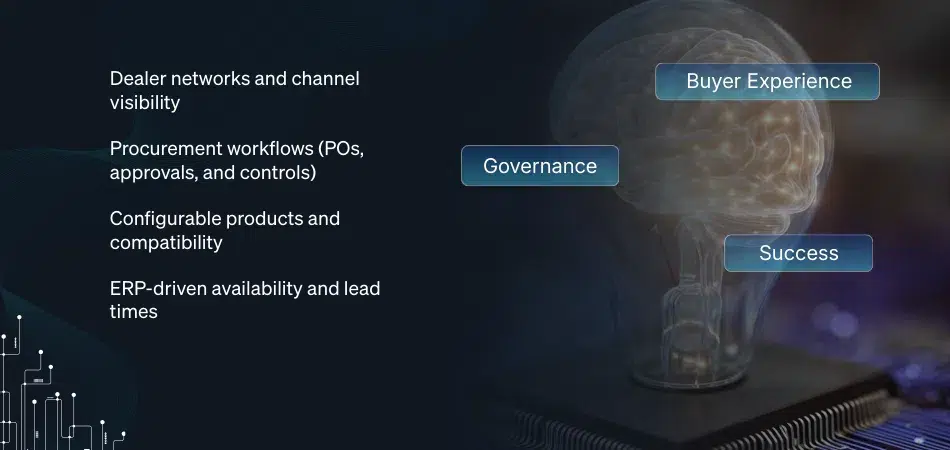
- Approval workflows. Purchases above a threshold need sign-off, not one-click checkout.
- Contracts and terms. Net-30 payment, catalog restrictions, and legal terms baked into the relationship.
- Multi-party buying. A procurement agent might assemble a cart that three people approve and a fourth pays for.
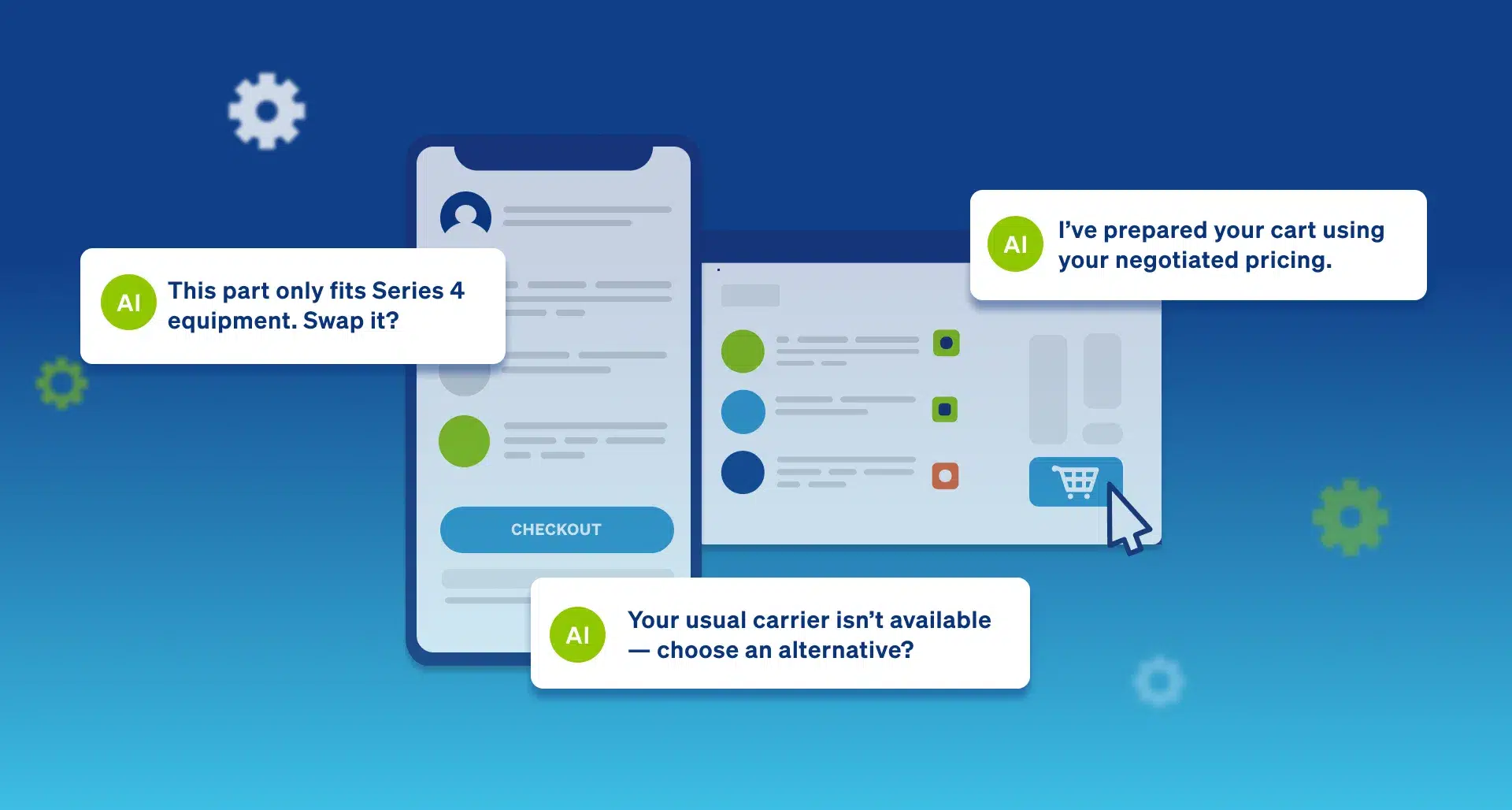
An agent built for a B2C impulse buy chokes on all of that. B2B agentic commerce has to respect governance, not bypass it. The agent’s job isn’t to skip the approval step. It’s to navigate it faster.
The B2B Platform Landscape
Salesforce Agentforce Commerce brings agent capabilities into an ecosystem already rich in CRM data, account hierarchies, and approval logic. Strong fit when the buying relationship already lives in Salesforce.
commercetools offers the composable, API-first depth that complex B2B catalogs and pricing rules demand, and has integrated directly with Stripe’s Agentic Commerce Suite.
BigCommerce B2B Edition pairs agent-ready architecture with B2B-specific features like quoting, customer groups, and tiered pricing.
OroCommerce remains a B2B-native option built around the workflow, quote, and account-management needs that consumer platforms treat as afterthoughts.
One gap worth naming: Shopify’s B2B story still trails its B2C one. It’s excellent for direct-to-consumer agentic flows, but deeper B2B governance complex approval chains, account-specific contract pricing at scale is where it’s still catching up.
Spring ’26 Editions does move the needle somewhat: company profiles, volume pricing, and up to three B2B catalogs are now available on Basic, Grow, and Advanced plans at no extra cost, lowering the barrier to entry. But that’s table-stakes access, not a substitute for the governance depth that commercetools, OroCommerce, or BigCommerce B2B Edition provide.
If your business is heavily B2B, platform selection remains a real criterion, not a footnote.
The Hidden Bottleneck: Fulfillment and Delivery Data
There’s a piece of this almost nobody puts on the slide. An agent can find the product, compare it, and pay for it in under a second. Then what? Someone still has to ship it.
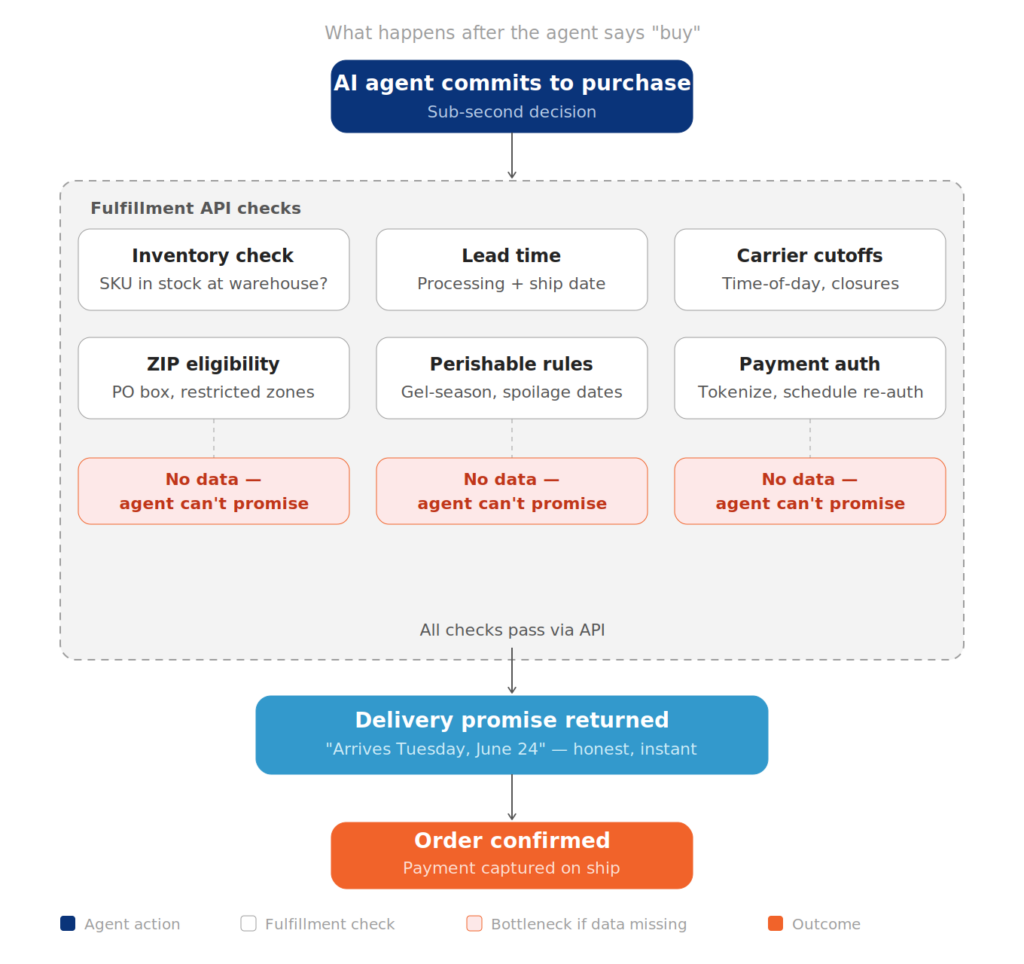
Fulfillment readiness is the quiet bottleneck. If an agent is going to commit to a purchase, it needs accurate delivery data at the moment of checkout: real shipping options, real lead times, real cutoffs. An agent’s promise is only as good as the shipping logic behind it.
We’ve lived this firsthand. When we worked with Godiva on Shopify, the hard part wasn’t the storefront it was the shipping and payment logic behind it. Godiva sells chocolate that melts and strawberries that spoil. Their system had to account for gel-season dates, warehouse and carrier closures, ZIP code and PO Box ineligibility, and time-of-day cutoffs, all to calculate an honest delivery date.
Then there was the payment timing problem: Shopify and card processors authorize charges for roughly 10 days, but customers wanted to schedule gifts months ahead. We solved it with Downpay, using Shopify’s Subscription API to tokenize payment and re-authorize the card about 7 days before shipment, capturing the full charge only once the order shipped.
That kind of API-driven checkout and delivery logic is exactly what agentic commerce demands at scale. The brands that win agent traffic will be the ones whose back end can answer “when will this actually arrive?” through an API, instantly and honestly.
Key Takeaways for eCommerce SaaS
Treat product data as front-door infrastructure. Audit whether an agent can pull SKU-level inventory, pricing, shipping, and tax in a single clean API call. If the answer is “after some normalization,” fix that first.
Favor composable, API-first architecture. Whether you choose Shopify, BigCommerce, commercetools, or another platform, the deciding factor is how cleanly agents can read and transact against your stack.
Get clear on protocol support. UCP now has the broadest industry backing. ACP still matters for ChatGPT-driven discovery. On Shopify, you get both by default. Off Shopify, prioritize based on where your buyers live. Tokenize payments either way.
Respect B2B governance. If you sell B2B, account-specific pricing, approval workflows, and contract terms aren’t optional. Pick a platform that navigates them.
Don’t forget fulfillment. API-driven checkout and accurate delivery data are part of the agentic stack, not an afterthought.
Mobile was a ten-year tailwind for eCommerce. Agentic commerce looks shorter and steeper. Three years out, a platform that can’t serve agent traffic natively will feel like a 2014 store without mobile checkout. The work to avoid that is measured in months, not years.
If you’re weighing which platform actually fits your catalog, your buyers, and your fulfillment reality, that’s the kind of complex commerce problem we like. Proof over promises. Start with the data, then build.