
H ere's the reality of enterprise commerce: native Shopify B2B solves selling. It doesn't fully solve purchasing governance.
The gap isn’t the storefront. Shopify handles catalogs, price lists, company profiles, inventory locations, and ordering exceptionally well. If you need a B2B storefront live fast, Shopify gives you a reliable foundation and a clean buyer experience to match.
The real problem shows up later — when operations start to scale.
Enabling Commerce vs. Governing Purchasing
There’s a meaningful difference between enabling a transaction and governing a purchase.
Enabling commerce means a fast website, accurate pricing, and a smooth checkout. Governing purchasing means answering harder operational questions: Who’s allowed to buy? What are they allowed to buy? How do those purchases get approved and tracked?
According to Forrester’s 2024 State of Business Buying report, the average B2B purchase now involves 13 stakeholders, and nearly 89% of buying decisions cross multiple departments. That’s not a single buyer clicking “place order.” That’s a chain of approvals, budget owners, and compliance requirements none of which live natively in a commerce platform. Traction Complete
A 2025 Gartner survey found that 67% of B2B buyers prefer a rep-free purchasing experience, and buyers are progressing through critical buying tasks in increasingly autonomous, digital ways. That autonomy is exactly what makes governance non-negotiable. When buyers can self-serve, organizations need guardrails baked into the platform not bolted on afterward. Gartner

Where Shopify B2B Runs Into Its Ceiling
Shopify B2B has matured fast. Company profiles, role assignment, draft order workflows, payment terms these are real enterprise capabilities. But for large organizations with complex purchasing structures, the platform still has a ceiling.
If buyers require five or more levels of purchase approval (with role-based permissions, budget thresholds, and multi-department sign-off) native order review rules won’t cover the full chain. Custom applications on the Storefront API or checkout extensions can fill the gap, but that’s custom development, not configuration. Coderapper
In practice, Shopify supports only the most common B2B use cases. Things like account-based pricing that varies by contract or region, integration with procurement systems via punchout catalogs, and complex approval workflows aren’t yet fully supported. For organizations with these requirements, Shopify’s limitations can become a serious bottleneck. Alokai
The scenarios that break native Shopify B2B are real and common:
- A junior buyer needs to submit a cart for approval rather than complete checkout directly
- A department has a strict $50,000 monthly budget cap with automatic enforcement
- Any order over $10,000 requires sign-off from finance before it can process
- Regional managers should only approve orders for their specific warehouse locations
- Certain buyer roles are restricted to pre-approved product categories
None of these are exotic edge cases. They’re standard procurement policy in mid-market and enterprise companies. Without them, organizations either compromise on controls or resort to workarounds.
The Hidden Cost of Workarounds
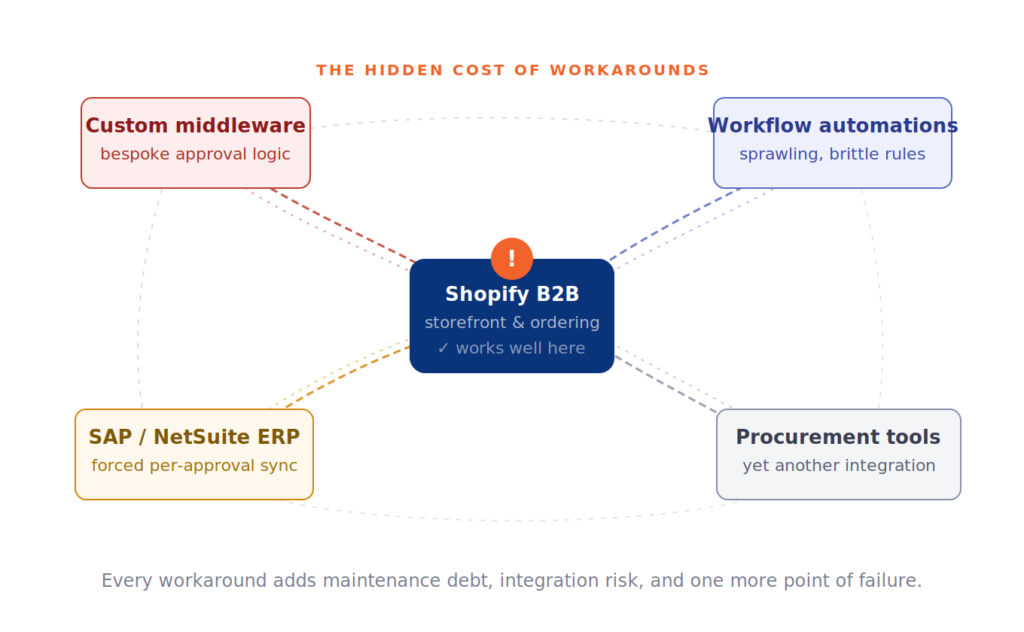
When platforms don’t support governance natively, teams improvise. The typical pattern: custom middleware, complex ERP logic forcing Shopify to communicate with SAP or NetSuite on every approval, sprawling workflow automations, and third-party procurement tools stitched together.
A 2023 survey of over 1,000 U.S. finance and accounting professionals found that nearly 80% said their company faces challenges purchasing through digital channels and nearly one-third described their B2B purchasing process as broken. Half said stakeholders lack sufficient visibility into their purchasing and approval process. That number tracks. Visibility breaks down when governance lives outside the commerce platform. financialcontent
ProcureAbility’s 2025 research reports that 65% of procurement organizations cite digital transformation as their most important initiative going forward. Organizations that leave the governance layer to workarounds are fighting against that transformation, not participating in it. Procurement Tactics
What the Governance Layer Actually Looks Like
The missing governance layer isn’t a separate procurement system. It’s enterprise-grade purchasing controls built directly inside the commerce experience so buyers keep the Shopify storefront they already know, while finance and operations get the policy enforcement they need.
That means targeted capabilities like:
- Buyer budget controls — enforce spend limits at the buyer or department level, automatically
- Advanced approval workflows — multi-tier routing with role-based sign-off and threshold rules
- Conditional order rules — auto-hold, auto-route, or auto-reject based on configurable logic
This is the gap the BlueBolt B2B Company Controls roadmap is built to close. For over two decades, we’ve translated complex business requirements into Shopify implementations that actually hold up at scale without wrecking the platform’s core simplicity.
Strategy Has to Come Before the Build
Custom development should solve business problems, not create new ones. The merchants who end up with expensive middleware sprawl are usually the ones who started building before they mapped the governance requirements.
McKinsey’s B2B Pulse research shows that 71% of B2B buyers are willing to spend over $50,000 through self-service or remote models and 27% are comfortable with transactions exceeding $500,000 without any direct sales contact. The dollars are there. The willingness to buy digitally is there. What has to be there too is the infrastructure to govern those purchases safely. Demodazzle
Shopify B2B enables commerce. The governance layer is what makes it enterprise-ready. Done right, you don’t have to choose between them.
Frequently Asked Questions
Does Shopify B2B natively support multi-level approval workflows?
Only at a basic level. If buyers require five or more levels of purchase approval (with role-based permissions, budget thresholds, and multi-department sign-off ) native order review rules won’t cover the full chain. Custom applications on the Storefront API or checkout extensions can fill the gap, but that’s custom development, not configuration. For organizations with complex approval chains, a purpose-built governance layer is needed on top of the native platform
What’s the difference between enabling commerce and governing purchasing?
Enabling commerce means giving buyers a fast storefront, accurate pricing, and a smooth checkout. Governing purchasing means controlling who can buy, what they can buy, and how those purchases get approved before they process. By enforcing role-based permissions, company accounts ensure every action aligns with business rules (reducing errors, preventing overspending, and ensuring compliance). Approval workflows complement company accounts by automating governance instead of bottlenecking decisions. Most native platforms handle the first part well; the second requires deliberate configuration or custom development.
What happens when enterprises try to work around Shopify’s governance limits?
The typical pattern is expensive and fragile. Teams end up stitching together custom middleware, ERP integrations that force Shopify to sync with SAP or NetSuite on every approval, sprawling workflow automations, and third-party procurement tools. B2B purchases often involve more complex workflows than a simple “add to cart and checkout,” and platforms that can’t handle multi-step approvals natively push companies toward brittle custom scripts. Every layer added increases maintenance debt and integration risk.
What specific governance controls do enterprise B2B buyers actually need?
The most common requirements include buyer budget caps enforced at the department level, multi-tier approval routing based on order value or product category, role-based permissions that restrict which buyers can complete a checkout vs. submit for approval, and full audit trails for compliance and finance teams. A mature B2B platform should automatically put orders on hold based on configurable rules like total cost, route the order to the right manager based on user role, and let approvers approve or deny with a single action. These aren’t edge cases; they’re standard procurement policy in most mid-market and enterprise organizations.
Can Shopify B2B realistically serve enterprise procurement teams, or does it require a separate system?
It can with the right development approach. Shopify’s B2B checkout supports draft order submission and approval, locked pricing and inventory reservation during review, and procurement-ready fields like PO number capture. However, it lacks custom checkout flexibility for complex requirements, and doesn’t support Checkout Extensibility for bespoke multi-step approval or buyer-tiered workflows. The answer isn’t replacing Shopify; it’s building the governance layer directly inside the commerce experience so buyers keep the storefront they know while finance and operations get the policy controls they require.




 By Aaron Shapiro