

What Is Shopify Markets and How Does It Simplify International eCommerce?
Shopify Markets is Shopify’s native solution for managing international eCommerce from a single store. It allows merchants to localize pricing, currencies, domains, taxes, and content by region without creating multiple storefronts.
Shopify Markets simplifies global eCommerce by:
- Eliminating the need for multiple stores
- Centralizing operations in one Shopify admin
- Localizing pricing, currency, and payment methods
- Calculating duties and taxes at checkout
- Supporting international SEO and domains
Why Shopify Markets Replaces Multi-Store Setups
Before Shopify Markets, international expansion required:
- Separate Shopify stores per region
- Duplicate product catalogs
- Manual pricing updates
- Fragmented analytics
Shopify Markets eliminates this model by allowing region-specific customization within a single backend.
Result: Lower operational overhead and faster global scaling.
Key Benefits of Shopify Markets for Global eCommerce
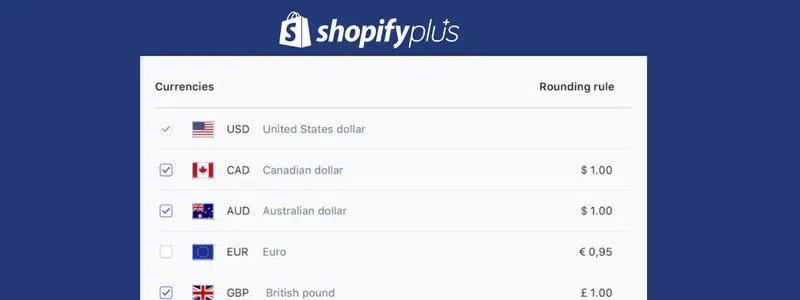
1. Localized Currencies and Payments
International conversion rates often drop at checkout due to unfamiliar currencies or limited payment options.
Shopify Markets automatically:
- Detects customer location
- Displays prices in local currency
- Enables region-specific payment methods
For example:
- China → Alipay
- Netherlands → iDEAL
- United States → Credit cards
Why it matters: Payment localization is a top driver of international conversion rate optimization.
2. Market-Specific Pricing and Catalogs
Different markets require different pricing strategies due to purchasing power, competition, and demand.
With Shopify Markets, you can:
- Set regional pricing rules
- Adjust margins by country or region
- Customize product availability per market
B2B advantage: Wholesale pricing and negotiated rates can be managed without creating duplicate stores; critical for scaling complex commerce operations.
3. Duties and Taxes
International selling used to mean endless confusion about duties and import taxes. Shoppers would abandon carts the moment they saw “taxes calculated at delivery” or got hit with surprise fees. Unexpected import fees are one of the top causes of cart abandonment in cross-border commerce.
Shopify Markets:
- Calculates duties and import taxes upfront
- Displays total landed cost at checkout
- Eliminates surprise fees at delivery
Result: Increased trust, fewer abandoned carts, and reduced customer support issues.
4. SEO and Content Localization
To rank high in local search engines, you need localized content and SEO. Shopify Markets supports local domains, languages, and SEO. Ranking in international search results requires more than translation; it requires localization.
Shopify Markets supports:
- Country-specific domains (e.g., .de, .co.uk)
- Multi-language storefronts
- Regionally optimized SEO signals
Example:
German customers see German-language content and localized SEO structure, improving visibility in regional search engines.
SEO Impact:
Localized SEO signals improve rankings in regional search engines and AI-generated answers.
5. Unified Operations in One Store
The biggest operational advantage is consolidation.
Instead of managing multiple stores, Shopify Markets allows you to:
- Maintain a single inventory system
- Centralize order management
- View unified analytics and reporting
- Manage customers in one database
Business impact:
- Faster decision-making
- Reduced operational complexity
- Cleaner data

Real-World Example of Shopify Markets in Action
Take a consumer electronics brand that managed four separate Shopify stores: one for the US, one for the UK, one for the EU, and one for Australia. Every product launch meant uploading products four times. Every price change required adjustments in four different backends. Reporting meant manually combining numbers from four separate dashboards.
This led to:
- Duplicate product uploads
- Manual price updates across stores
- Fragmented reporting
After migrating to Shopify Markets:
- All operations moved into a single store
- Regional experiences remained fully localized
- Reporting became centralized and accurate
Outcome: Reduced operational overhead and improved scalability.
Why Shopify Markets Matters for eCommerce Growth
Global eCommerce is rapidly expanding, but operational complexity often limits growth.
Shopify Markets removes key barriers by:
- Eliminating the need for multiple storefronts
- Delivering localized customer experiences
- Simplifying backend operations
Bottom line:
Merchants can scale internationally without scaling complexity.
Shopify Markets vs Multiple Stores
| Feature | Shopify Markets | Multiple Stores |
|---|---|---|
| Store Management | Single admin | Multiple backends |
| Localization | Built-in | Manual |
| Reporting | Unified | Fragmented |
| Scalability | High | Limited |
| Operational Cost | Lower | Higher |
FAQ: Shopify Markets
What is Shopify Markets?
A built-in Shopify solution that enables merchants to manage international selling from a single store while delivering localized experiences.
Do I need multiple Shopify stores to sell internationally?
No. Shopify Markets eliminates the need for separate regional stores.
Can I control pricing by country?
Yes. You can set market-specific pricing and product availability.
Does Shopify Markets handle taxes and duties?
Yes. It calculates and displays duties and taxes at checkout.
Is Shopify Markets good for B2B?
Yes. It supports region-specific pricing and helps manage complex global buyer structures.
Key Takeaways
- Shopify Markets = single-store global commerce infrastructure
- Eliminates store duplication
- Improves conversion rates through localization
- Reduces operational complexity
- Supports international SEO and discoverability
Final Takeaway
Shopify Markets transforms international eCommerce from a fragmented, high-maintenance model into a centralized, scalable system. For merchants, that means: lower operational costs, faster expansion into new markets, and better data and insights. For customers, it means a seamless, localized shopping experience anywhere in the world. As a certified Shopify Plus Partner, BlueBolt can help.


 By Jason Lichon