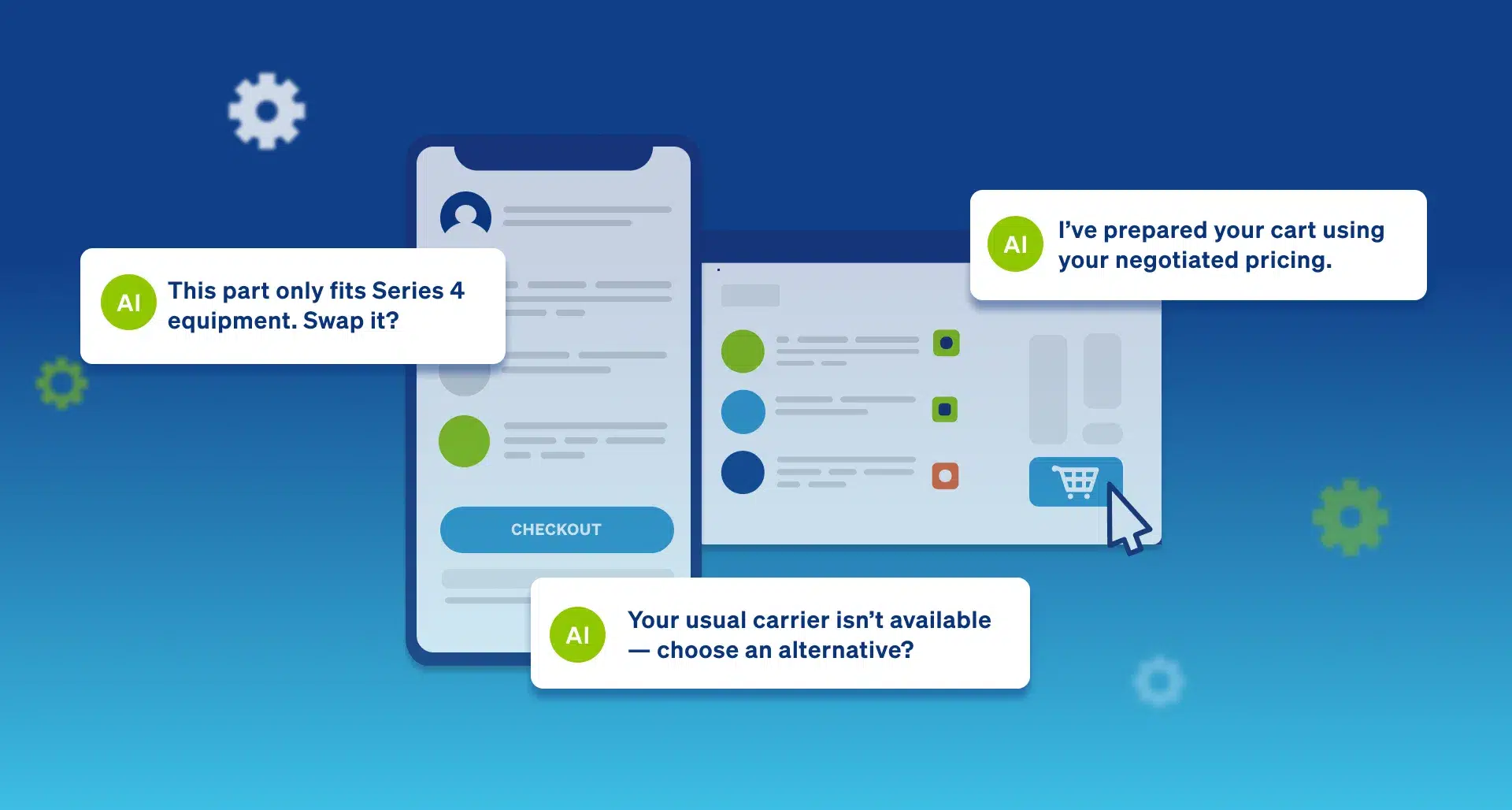
Y our next biggest customer might not be a person at all; it might be an algorithm with a purchase order.
What is Universal Commerce, and Why it Matters Now
“Universal commerce” is the idea that buying does not happen in one place anymore. Your customers might start in a portal, an email, a product data sheet, a procurement system, a marketplace, or a chatbot. The expectation is consistent: accurate product information, correct pricing, reliable availability, and a smooth path to order confirmation.
Now add AI agents to the mix. Instead of a buyer clicking through your eCommerce website design, an agent can research, compare, assemble a cart, request approvals, and execute checkout. For B2B manufacturing eCommerce teams, this is not a futuristic edge case. It is a natural next step for time-starved buyers and procurement workflows that already prioritize speed, accuracy, and repeatability.
The opportunity is not about replacing your sales team or relationships. It is about making your digital commerce strategy resilient, so you can serve humans and agents with the same trusted data and rules
How AI agents Change the B2B Buying Journey
In manufacturing, buyers rarely want a simple add-to-cart experience. They want confidence:
- The right SKU, pack size, and compatible accessories
- The right price for their account, contract, or tier
- Clear lead times and substitutions when needed
- The right purchasing path (credit card, PO, terms, or invoicing)
- Documentation (spec sheets, compliance, warranty, SDS, certificates)
AI agents can help buyers navigate this complexity. But agents also surface a hard truth: if your commerce stack relies on manual steps, hidden rules, and one-off exceptions, an agent will struggle to complete an order reliably. That does not mean your stack is “wrong.” It means the next wave of eCommerce optimization will focus on clarity, consistency, and integration.
In other words, the checkout is becoming an interface for systems, not just a page for people.
What “Agent-Ready Checkout” Means in Practice
Agent-ready does not mean you need a fully automated robot buyer. It means your commerce experience is structured so that an assistant, a procurement integration, or a customer service rep can all achieve the same outcome with fewer back-and-forth steps.
Here is a practical definition: an agent-ready checkout is one where pricing, eligibility, and fulfillment rules are explicit, accessible, and enforceable across channels.
Key capabilities to plan for:
- Clean product data: normalized attributes, variants, units of measure, and compatibility rules
- Account-aware pricing: customer-specific price lists, contract pricing, and promotions applied consistently
- Inventory and lead time clarity: availability, backorders, and realistic shipping promises
- Identity and permissions: who can see what, who can buy, who can approve
- Integrations that behave predictably: ERP, PIM, OMS, CRM, tax, shipping, and payments
- A consistent API surface: so tools can query catalog, pricing, and cart rules without scraping pages
This is not only about AI. These are also the fundamentals of strong eCommerce implementation in B2B.
Practical Examples for Complex B2B Manufacturing Workflows
Universal commerce becomes real when it meets the scenarios your team handles every day. Here are a few examples where AI agents can add value, and what your platform and integrations need to support.
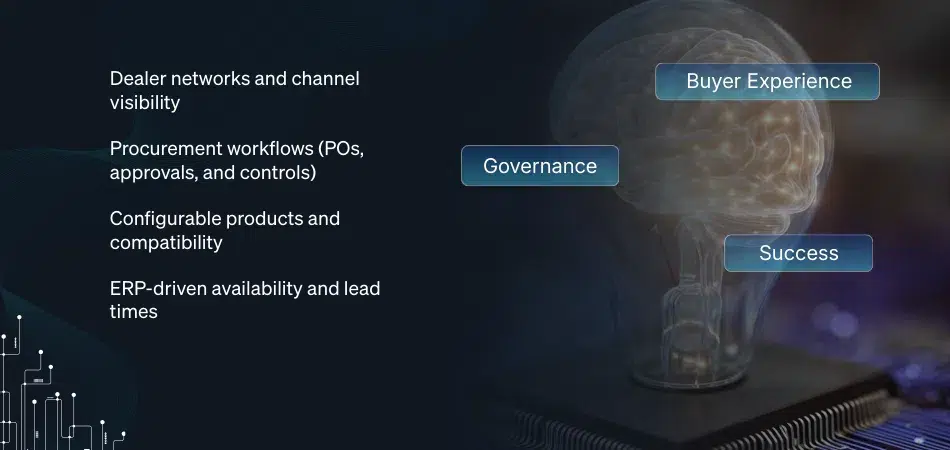
Example 1: Dealer networks and channel visibility
Scenario: A dealer should see dealer pricing, limited assortments, and specific freight options.
What to support:
- Segmented catalogs and customer groups
- Price lists by account or group
- Shipping rules tied to region, warehouse, or dealer tier
- Clear role-based access for reps and dealer users
Result: An agent can assemble the right cart without accidentally selecting restricted SKUs or incorrect terms, protecting the dealer relationship and the b2b buyer experience.
Example 2: Procurement workflows (POs, approvals, and controls)
Scenario: A buyer needs to build a cart, submit for approval, then place the order on terms.
What to support:
- Quote-to-order workflows, or draft orders with approvals
- Purchase order capture and reference fields
- Payment terms and invoicing paths where appropriate
- Audit trails and user permissions
Result: Your checkout becomes a controlled process, not just a payment page.
Example 3: Configurable products and compatibility
Scenario: A buyer needs a motor, mounting kit, and controller that must be compatible.
What to support:
- Structured product attributes and compatibility mapping (often PIM-led)
- Guided selling or bundled recommendations
- Clear documentation and constraints surfaced on product pages and in cart rules
Result: An agent can recommend and validate combinations, reducing returns and support burden.
Example 4: ERP-driven availability and lead times
Scenario: Availability changes by warehouse and customer priority, and lead times vary.
What to support:
- Real-time or near-real-time inventory signals (with sensible caching)
- Backorder rules and split shipment options
- Clear messaging and order confirmation behavior
Result: Fewer surprises after checkout and fewer manual interventions, which is a major lever for eCommerce re-platforming ROI.
Platform-Positive Implementation Considerations
For B2B manufacturing brands, platforms like Shopify Plus and Optimizely can all be strong foundations. The right fit depends on priorities like speed-to-market, cost of ownership, required customization, and the complexity of your integrations.
A few platform-positive considerations to evaluate:
- Data model alignment: how your catalog structure, pricing, and account hierarchy map to the platform
- Extensibility: the best approach for custom workflows (apps, APIs, middleware, or platform features)
- Integration strategy: where to put business logic so it is reusable across channels
- Operational ownership: who maintains what after launch, and how change requests are handled
In some use cases, teams may want additional flexibility around pricing logic, quoting, or procurement integrations. This is where a complementary tool or a different architecture can be a better fit, while still keeping the commerce platform as the system of experience.
At BlueBolt, we stay platform-positive and requirements-led. If Shopify Plus is the best fit, we lean into its ecosystem and speed. If Optimizely aligns better with your content, experimentation, or commerce roadmap, we design around that. The goal is a maintainable, scalable foundation that supports universal commerce patterns.
A Roadmap: How to Prepare Your Universal Commerce Stack in 60 to 120 days
You do not need to boil the ocean. Start by making your current buyer journey more explicit and more integrated.
Step 1: Map your “checkout truth table”
Document the rules that determine whether an order is valid:
- Who can buy which products
- How pricing is determined
- What minimums apply (MOQs, pack sizes, pallet quantities)
- What shipping and payment options apply by account
- What approvals are required
This becomes the blueprint for agent-ready commerce.
Step 2: Fix the data foundations
Prioritize:
- Product attributes and variants that reflect how buyers actually specify products
- Units of measure and packaging clarity
- Documentation that is easy to find and consistently structured
- A plan for PIM (if needed) to reduce platform-side workarounds
Step 3: Design your integration layer for reuse
Many brands benefit from integration patterns that centralize rules and reduce point-to-point fragility:
- ERP and OMS for availability and order creation
- PIM for product content and attributes
- Tax and shipping services for accurate totals
- Middleware or iPaaS for orchestration where it improves reliability
This is the heart of eCommerce integration and a key lever for long-term eCommerce optimization.
Step 4: Upgrade the buyer experience with clarity, not complexity
Focus on high-impact improvements:
- Account-aware navigation and merchandising
- Saved lists, reorders, and quick order by SKU
- Clear lead time messaging and backorder behavior
- Quote request paths for products that require it
Step 5: Add governance for agent-driven interactions
Define:
- What an agent can do (and cannot do) on behalf of a user
- Approval thresholds and audit logging
- Rate limits and monitoring for automated activity
- Support workflows when an order fails validation
This is operational readiness, not just technology.
What Success Looks Like (Metrics and Governance)
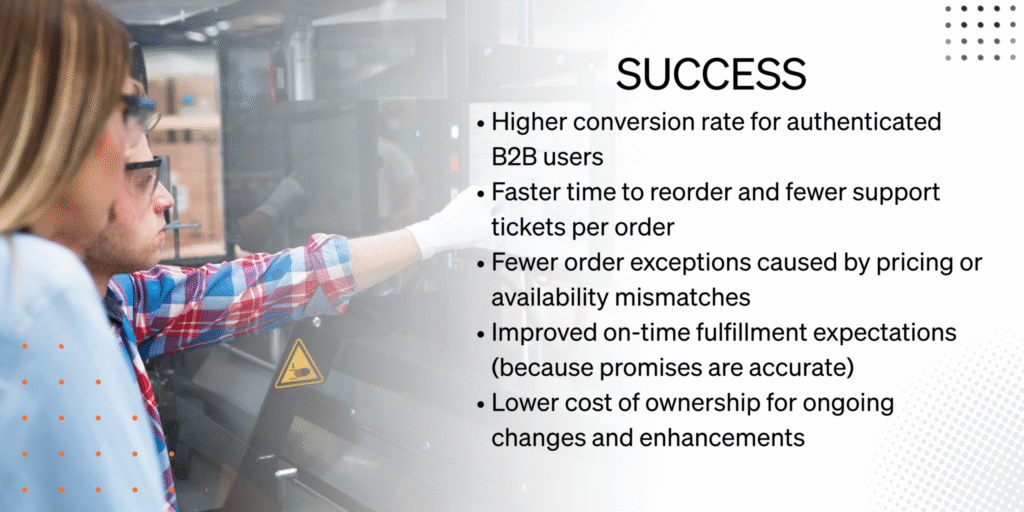
Universal commerce readiness should show up in measurable outcomes:
- Higher conversion rate for authenticated B2B users
- Faster time to reorder and fewer support tickets per order
- Fewer order exceptions caused by pricing or availability mismatches
- Improved on-time fulfillment expectations (because promises are accurate)
- Lower cost of ownership for ongoing changes and enhancements
Equally important: internal confidence. Your sales, service, and operations teams should trust that the eCommerce experience enforces the same rules they do.
Conclusion and Next Step
AI agents will not replace your relationships, your expertise, or your channel strategy. But they will raise the bar for how clearly your commerce systems express pricing, eligibility, and fulfillment logic. For B2B manufacturing brands with complex catalogs, dealer networks, or procurement workflows, this is a practical moment to modernize your foundation and make every channel easier to buy from.



 By Jason Lichon