T he fundamental rhythm of eCommerce has been the same for twenty years: a person searches, browses, clicks, and buys. But that rhythm is changing.
We’re at the beginning of a major architectural shift, moving from an era of human-driven search to one of AI-delegated action. This is the dawn of agentic commerce, and it represents a change as profound as the invention of the search engine itself.
For business leaders and technical teams, this isn’t a “wait and see” trend. With AI-driven traffic to retail sites surging 805% year-over-year, the platforms that are ready today will be the ones that lead tomorrow. The core question is no longer just about driving traffic; it’s about whether your infrastructure is built to speak the language of AI.
What is Agentic Commerce?
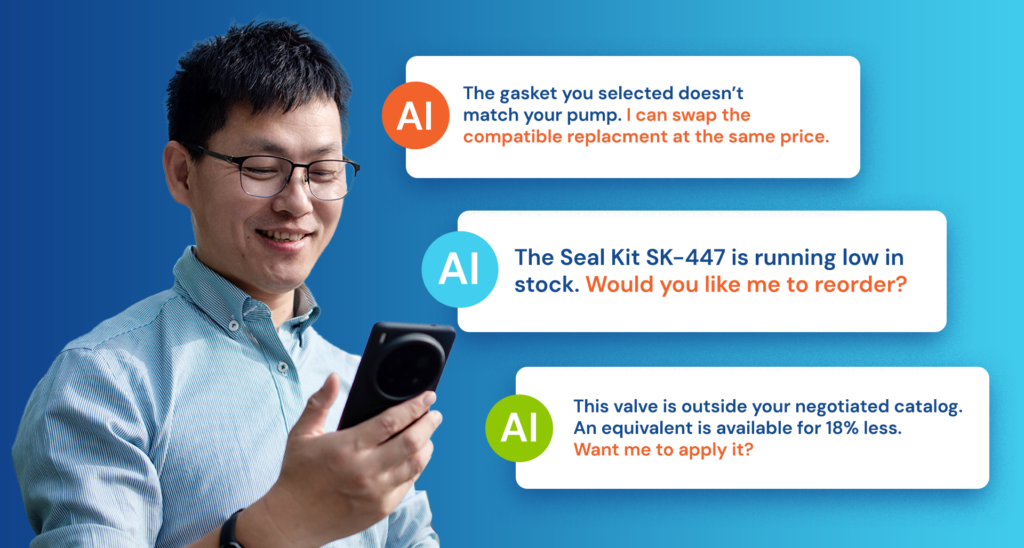
Agentic commerce describes transactions that are partially or fully handled by an autonomous AI agent acting on a consumer’s behalf. It’s the difference between a person searching for “best waterproof running shoes” and simply telling their AI assistant, “Find and buy the best-rated, waterproof trail running shoes in my size for under $150, and get them here by Friday.”
In this scenario, the AI agent performs the discovery, comparison, verification, and purchase. It interacts directly with a store’s data, not its visual interface. This transition from “searching” to “doing” is already underway, and its momentum is building fast.
- Market Projections: McKinsey forecasts that agentic commerce will drive $5 trillion in global volume by 2030.
- Traffic Transformation: Adobe has already tracked an 805% increase in AI-driven traffic to retail sites.
This is a clear signal that a new, high-volume channel is opening up. However, access to this channel depends entirely on your store’s technical readiness.

The Visibility Gap: Why Legacy Systems Are Invisible to AI
AI agents don’t browse. They don’t get swayed by beautiful design or clever marketing copy. They parse data. They query APIs. Their decision-making is ruthlessly efficient, and if your platform can’t answer their questions in milliseconds, you are functionally invisible.
This creates a “visibility gap” for many businesses running on traditional or monolithic platforms. These systems often fail at two critical tasks:
- Providing Real-Time Data: An AI agent must verify product availability instantly. If your inventory data is updated on a delay, the agent can’t trust it. It will move on to a competitor whose system can provide immediate confirmation.
- Structuring Product Information: Agents need structured, machine-readable data to understand product attributes like size, material, and compatibility. Without proper schema markup, an agent has to guess, and AI agents are programmed to avoid ambiguity. They will simply ignore products with messy or incomplete data.
In the age of agentic commerce, poor data quality isn’t just a backend headache—it’s a direct barrier to revenue.
Shopify’s Open Ecosystem vs. The Walled Garden
As this new landscape takes shape, two competing philosophies are emerging.
On one side are the “walled gardens” like Amazon and Walmart. These giants are integrating agentic AI to keep customers within their closed ecosystems. While effective for them, this strategy turns third-party brands into commodities and keeps valuable customer data away from the merchants themselves. The AI serves the marketplace, not your business.
On the other side is Shopify’s open ecosystem model. Instead of building higher walls, Shopify is helping build the universal standards for the future of retail. Through the co-developed Universal Commerce Protocol (UCP) with Google, Shopify is standardizing the language of agentic shopping.
This approach gives merchants a powerful advantage. It ensures your product catalog is a structured, validated data feed ready for AI assistants like Google Gemini. By choosing an open standard, you make your products discoverable by any agent, on any platform that adopts the protocol. You retain control over your brand, your data, and your customer relationships.
The Technical Foundation for an AI-Driven Future
Preparing for agentic commerce isn’t about adding a chatbot. It’s about ensuring your core infrastructure is built for data-first interactions. Shopify’s platform, especially its Agentic Plan, is engineered to provide these foundational capabilities.
- Real-Time Inventory Sync: Shopify’s APIs are built for high-velocity synchronization, giving agents the instant stock validation they require to complete a purchase confidently.
- Complex Cart Building: Agents fulfill complex goals, not just single-item purchases. Shopify’s architecture supports multi-item, cross-category cart building via API, handling requests that would cause friction on legacy platforms.
- Structured Data Readiness: Through its support for UCP, Shopify helps ensure your product data is structured correctly, allowing AI agents to understand your catalog with near-zero error.
Future-Proof Your Business Today
The shift to agentic commerce is happening now. The businesses that will thrive are those that invest in the right data infrastructure today. Waiting to see what competitors do means you’ll already be behind.
The first step is to assess your current capabilities. Can your platform provide real-time inventory data? Is your product information structured and machine-readable? For many retailers, the honest answer is no.
Shopify provides a direct path to agentic readiness. We believe in replatforming for strategic advantage, and this is a moment of profound strategic importance.



 By Aaron Shapiro