The Pulse of Progress: Why DXPs Are Vital for Healthcare and Education in 2026

Honey Olesen

I n the halls of a modern university or the corridors of a sprawling hospital network, the mission is clear: serve the individual.

Whether that individual is a prospective student navigating financial aid or a patient seeking a specialist, their digital journey should be as compassionate and clear as their in-person experience.

Yet, for too long, content-heavy organizations in healthcare and education have grappled with a digital paradox. They possess vast amounts of valuable information but struggle to deliver it effectively across disjointed systems.

By 2026, the solution has shifted from simple content management to comprehensive Digital Experience Platforms (DXPs). These platforms are no longer just “nice-to-have” upgrades; they are the critical infrastructure unifying fragmented digital channels into seamless, personalized journeys.

The Challenge of Fragmentation in Mission-Driven Sectors

Healthcare and education share a common struggle: complexity. A single university might manage hundreds of microsites for different departments, alumni portals, and student learning systems. Similarly, a healthcare provider navigates patient portals, appointment scheduling tools, and vast libraries of health information.

Historically, these systems operated in silos. A patient might receive a personalized email about a check-up but land on a generic homepage that doesn’t recognize them. A student might log into a learning portal that feels entirely disconnected from the university’s main website.

This fragmentation isn’t just an annoyance; it’s a barrier to trust. When digital experiences feel disjointed, users feel unseen.

Operational inefficiency is the other side of this coin. Marketing and IT teams waste countless hours duplicating content across platforms or wrestling with legacy systems that don’t talk to each other. In 2026, with budgets tighter and expectations higher, this inefficiency is unsustainable.

The DXP Solution: From Chaos to Cohesion

A Digital Experience Platform (DXP) solves these challenges by acting as the central nervous system of an organization’s digital presence. Unlike a traditional Content Management System (CMS), which focuses primarily on creating and publishing web pages, a DXP integrates content, data, and commerce to orchestrate experiences across every touchpoint—web, mobile, email, and even IoT devices.
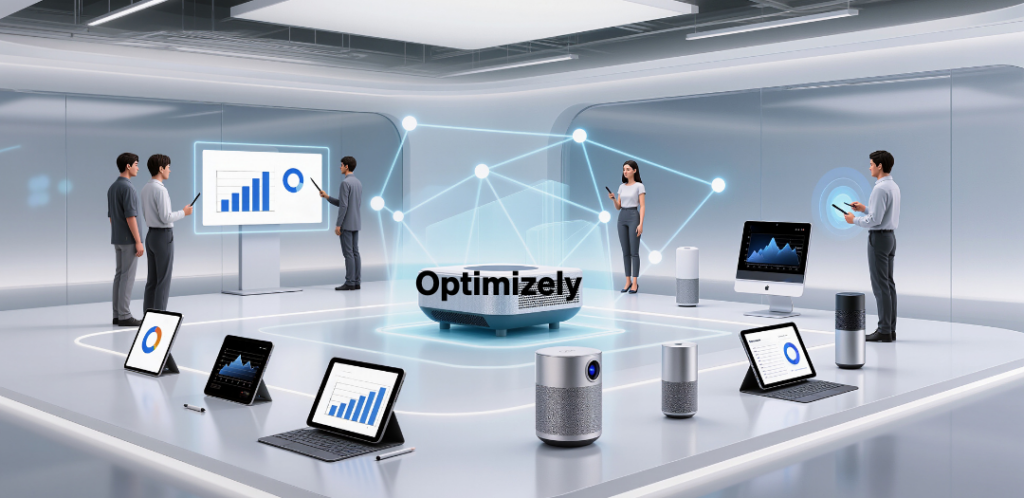
AI image of different computers with a central hub with Optimizely superimposed

For medical and educational institutions, this shift is transformative.

1. Unifying the Digital Ecosystem

Imagine a hospital system where the website, the mobile app, and the patient portal share a single brain. A DXP makes this possible through API-first architectures.

In 2026, the trend toward composable architecture has reached maturity. Organizations no longer have to buy a monolithic suite where they only use 40% of the features. Instead, they can assemble a “best-of-breed” stack. They might choose a DXP like Optimizely for content and experimentation, integrate it with a specialized patient record system (EMR), and connect a separate marketing automation tool.

This modularity allows for seamless integration. Data flows freely between systems, meaning the platform “knows” the user regardless of where they interact. For a university, this means a student’s interaction with a recruitment ad can inform the content they see on the homepage, creating a sense of belonging before they even apply.

2. The Era of Hyper-Personalization

Personalization in 2026 goes far beyond “Hello, [First Name].” It is about context, intent, and anticipation.

In healthcare, trust is paramount. A DXP powered by AI-driven personalization can analyze user behavior—safely and compliantly—to serve relevant content. If a user has been reading articles about prenatal care, the homepage can dynamically shift to highlight obstetrics providers and birthing classes rather than generic urgent care hours.

stethoscope, clip board, arrow climbing up

Recent data underscores the impact of this approach. Research indicates that organizations implementing advanced personalization see revenue uplifts of up to 15-20% and significant improvements in customer retention. For non-profits and educational institutions, “revenue” translates to higher enrollment yields and increased donor engagement.

In education, this means tailoring the journey based on the prospect. An international applicant sees visa information and virtual tour options immediately. A returning alum sees continuing education courses and donation opportunities. The DXP ensures that the right message finds the right person at the exact moment of relevance.

3. Operational Efficiency and Scalability

For IT and marketing teams, a DXP is a liberation tool. Instead of managing five different CMS instances, teams work from a centralized hub. Content is created once and deployed everywhere (COPE).

This scalability is crucial for organizations that need to pivot quickly. During a public health crisis or a campus emergency, the ability to push consistent, accurate updates across all channels instantly is a safety requirement, not just a marketing convenience.

Trends Defining 2026: AI and Omnichannel Maturity

Two major trends are shaping how medical and educational organizations utilize DXPs this year:

AI as the Co-Pilot

Artificial Intelligence has moved from a buzzword to a utility. In modern DXPs, AI engines automatically tag content, making it easier to find and reuse. They analyze traffic patterns to predict which content will perform best.

Generative AI helps content teams produce drafts for hundreds of service pages or course descriptions, which human editors then refine. This human-in-the-loop approach maintains the authoritative voice required in regulated industries while drastically increasing output speed.

True Omnichannel Integration

The distinction between “online” and “offline” has blurred completely. A DXP connects the digital to the physical.

  • In Healthcare: A patient checks in for an appointment via the app. The DXP triggers a notification to the front desk and, post-visit, automatically sends digital discharge instructions and a satisfaction survey to the patient’s preferred channel.
  • In Education: A student attends an open house event. Their check-in connects to their digital profile. Later that day, they receive a personalized email with links to the specific programs they visited.

Security and Compliance: The Non-Negotiables

For medical organizations, security isn’t a feature; it’s the foundation. Medical organizations must navigate HIPAA; educational institutions handle FERPA data. Modern DXPs in 2026 are built with these rigorous standards in mind. They offer robust identity management, granular user access controls, and secure data storage options (often cloud-based with specific compliance certifications).

The Human Element of Technology

Technology is only as good as the strategy behind it. A DXP is a powerful engine, but it needs a skilled driver. Implementing these platforms requires a shift in mindset. It demands collaboration between IT, marketing, and operational teams. It requires viewing the user journey not as a series of transactions, but as a relationship that evolves over time.

Next Steps for Your Organization

If your organization is struggling with disjointed systems, duplicated efforts, or a user experience that feels stuck in the last decade, it is time to evaluate your digital maturity.

Ask yourself:

  • Does our website speak to everyone generally, or to individuals personally?
  • How much time does our team spend managing the tool versus managing the strategy?
  • Are our systems secure, scalable, and ready for what comes next?

The transition to a Digital Experience Platform is a journey, but it is one you do not have to walk alone.

Ready to modernize your digital infrastructure?

Beyond Search: Is Your Store Ready for Agentic Commerce?

Chris Risner

T he fundamental rhythm of eCommerce has been the same for twenty years: a person searches, browses, clicks, and buys. But that rhythm is changing.

We’re at the beginning of a major architectural shift, moving from an era of human-driven search to one of AI-delegated action. This is the dawn of agentic commerce, and it represents a change as profound as the invention of the search engine itself.

For business leaders and technical teams, this isn’t a “wait and see” trend. With AI-driven traffic to retail sites surging 805% year-over-year, the platforms that are ready today will be the ones that lead tomorrow. The core question is no longer just about driving traffic; it’s about whether your infrastructure is built to speak the language of AI.

What is Agentic Commerce?

Person holding a cell phone

Agentic commerce describes transactions that are partially or fully handled by an autonomous AI agent acting on a consumer’s behalf. It’s the difference between a person searching for “best waterproof running shoes” and simply telling their AI assistant, “Find and buy the best-rated, waterproof trail running shoes in my size for under $150, and get them here by Friday.”

In this scenario, the AI agent performs the discovery, comparison, verification, and purchase. It interacts directly with a store’s data, not its visual interface. This transition from “searching” to “doing” is already underway, and its momentum is building fast.

  • Market Projections: McKinsey forecasts that agentic commerce will drive $5 trillion in global volume by 2030.
  • Traffic Transformation: Adobe has already tracked an 805% increase in AI-driven traffic to retail sites.

This is a clear signal that a new, high-volume channel is opening up. However, access to this channel depends entirely on your store’s technical readiness.

Agents need structured, machine-readable data to understand product attributes like size, material, and compatibility.

The Visibility Gap: Why Legacy Systems Are Invisible to AI

AI agents don’t browse. They don’t get swayed by beautiful design or clever marketing copy. They parse data. They query APIs. Their decision-making is ruthlessly efficient, and if your platform can’t answer their questions in milliseconds, you are functionally invisible.

This creates a “visibility gap” for many businesses running on traditional or monolithic platforms. These systems often fail at two critical tasks:

  1. Providing Real-Time Data: An AI agent must verify product availability instantly. If your inventory data is updated on a delay, the agent can’t trust it. It will move on to a competitor whose system can provide immediate confirmation.
  2. Structuring Product Information: Agents need structured, machine-readable data to understand product attributes like size, material, and compatibility. Without proper schema markup, an agent has to guess, and AI agents are programmed to avoid ambiguity. They will simply ignore products with messy or incomplete data.

In the age of agentic commerce, poor data quality isn’t just a backend headache—it’s a direct barrier to revenue.

Shopify’s Open Ecosystem vs. The Walled Garden

As this new landscape takes shape, two competing philosophies are emerging.

On one side are the “walled gardens” like Amazon and Walmart. These giants are integrating agentic AI to keep customers within their closed ecosystems. While effective for them, this strategy turns third-party brands into commodities and keeps valuable customer data away from the merchants themselves. The AI serves the marketplace, not your business.

On the other side is Shopify’s open ecosystem model. Instead of building higher walls, Shopify is helping build the universal standards for the future of retail. Through the co-developed Universal Commerce Protocol (UCP) with Google, Shopify is standardizing the language of agentic shopping.

This approach gives merchants a powerful advantage. It ensures your product catalog is a structured, validated data feed ready for AI assistants like Google Gemini. By choosing an open standard, you make your products discoverable by any agent, on any platform that adopts the protocol. You retain control over your brand, your data, and your customer relationships.

The Technical Foundation for an AI-Driven Future

Preparing for agentic commerce isn’t about adding a chatbot. It’s about ensuring your core infrastructure is built for data-first interactions. Shopify’s platform, especially its Agentic Plan, is engineered to provide these foundational capabilities.

  • Real-Time Inventory Sync: Shopify’s APIs are built for high-velocity synchronization, giving agents the instant stock validation they require to complete a purchase confidently.
  • Complex Cart Building: Agents fulfill complex goals, not just single-item purchases. Shopify’s architecture supports multi-item, cross-category cart building via API, handling requests that would cause friction on legacy platforms.
  • Structured Data Readiness: Through its support for UCP, Shopify helps ensure your product data is structured correctly, allowing AI agents to understand your catalog with near-zero error.

Future-Proof Your Business Today

The shift to agentic commerce is happening now. The businesses that will thrive are those that invest in the right data infrastructure today. Waiting to see what competitors do means you’ll already be behind.

The first step is to assess your current capabilities. Can your platform provide real-time inventory data? Is your product information structured and machine-readable? For many retailers, the honest answer is no.

Shopify provides a direct path to agentic readiness. We believe in replatforming for strategic advantage, and this is a moment of profound strategic importance.

Ready to see how your infrastructure stacks up?

The Impact of AI on eCommerce in 2026: A Structural Reckoning

Honey Olesen

I t wasn’t long ago that artificial intelligence felt like a futuristic concept—something reserved for sci-fi movies or the R&D labs of tech giants.

Today, it’s the engine running the world’s most sophisticated commerce operations. As we move into 2026, the eCommerce industry is undergoing a structural reset. It is no longer just about incremental upgrades or adding a chatbot to your homepage. We are witnessing a fundamental shift in how products are discovered, how supply chains operate, and how businesses compete.

In 2026, the competitive edge belongs to those who prioritize operational speed, data quality, and system reliability. The era of “digital transformation” as a buzzword is over; we have entered the age of connected intelligence, where people, data, and digital workers operate in unison. For mid-to-enterprise businesses in retail, wholesale, and manufacturing, understanding these shifts isn’t just about staying ahead; it’s about staying relevant.

This structural reckoning is driven by three massive forces: the maturity of AI-powered shopping, the rise of autonomous network operations, and significant global tariff changes reshaping supply chains. Let’s explore how these forces are rewriting the playbook for 2026.

AI-Powered Product Discovery

For decades, the “search bar” was the front door to the internet. If a customer wanted a product, they typed a keyword into Google or Amazon and sifted through pages of results. That dynamic has changed. Discovery has moved upstream, shifting away from keyword matching and toward conversational intent.

The Rise of Conversational Commerce

conversational search on a mobile phone

In 2026, customers don’t just search; they converse. Tools like Amazon’s Rufus, a conversational assistant that analyzes catalog data, reviews, and user context, have set a new standard. These generative shopping assistants provide tailored product guidance, answering complex questions like, “What’s the best running shoe for flat feet training for a marathon in rainy weather?”

This shift means your product data must do more than just exist; it must be “machine-readable” in a way that AI agents can understand and serve up in conversation. If your product attributes, naming conventions, and compliance documentation aren’t structured for these machines, you lose the sale before a human ever sees your brand. The battleground for visibility has moved from the search results page to the AI’s training data.

Recommendation Engines Evolve

Marketplace recommendation engines have also evolved from simple “customers who bought this also bought that” logic to complex predictive models. These engines now factor in operational performance metrics like delivery reliability, return rates, and regional availability directly into search rankings. A great product with poor backend logistics will effectively become invisible.

Generative AI’s Personalization

Personalization has been a goal for marketers for years, but in 2026, generative AI has finally delivered on the promise of “segments of one.” We aren’t just talking about inserting a customer’s first name into an email subject line. We are seeing the real-time generation of entire storefront experiences.

Dynamic Product Detail Pages (PDPs)

Dynamic Product Page of a lamp

Generative AI is now capable of rewriting product detail pages (PDPs) on the fly to match the specific intent of the buyer.

  • For a technical buyer: The PDP might highlight specifications, compatibility charts, and warranty information.
  • For a lifestyle buyer: The same URL might display benefits-focused copy, user-generated content, and emotional imagery.

Platforms like Shopify have paved the way with tools like Shopify Magic, which allows merchants to generate high-quality product descriptions in seconds. In 2026, this technology has matured to the point where technical summaries and buyer-specific content are produced autonomously, reducing decision fatigue for customers and support volume for merchants.

The End of Static Content

This shift signals the end of static content. Companies that rely on rigid, one-size-fits-all product descriptions are finding themselves outpaced by competitors who use AI to speak directly to the customer’s immediate need. This level of fluidity requires a content management system (CMS) that is not just a repository, but an active participant in the sales process, capable of delivering flexible, modular content at scale.

Autonomous Network Operations

As AI takes a more active role in the front-end customer experience, the back-end infrastructure supporting it has had to evolve. We are moving from “AI operations” to agentic operations where digital workers autonomously manage the network stack.

From Firefighting to Supervision

In 2026, IT teams are no longer spending their days fighting fires. Instead, they are supervising systems that can detect, diagnose, and remediate outages on their own. Autonomous agents are now responsible for:

  • Enforcing access and identity policies.
  • Optimizing routing for inference workloads.
  • Coordinating performance across cloud and edge environments.

As Snorre Kjesbu from Cisco noted, human intelligence remains at the center, but it stops being the bottleneck. This shift allows technical teams to focus on strategic initiatives (like architecture and innovation) rather than maintenance.

Reliability as a Ranking Factor

This operational reliability isn’t just an IT concern; it’s a commercial one. As mentioned earlier, marketplace algorithms are now penalizing businesses for backend failures. If your autonomous systems can’t maintain uptime or manage data flow efficiently, your front-end visibility suffers. Operational excellence is now directly tied to revenue.

The Shift from Contract Buyers to AI-Discovered Buyers

In the B2B sector, a distinct divide has emerged. For years, B2B eCommerce was synonymous with complex procurement portals and negotiated contracts. While those still exist, a new path has opened up.

Two Distinct Journeys

  1. Contract Buyers: These are traditional procurement teams operating through negotiated pricing, approvals, and strict compliance rules. They value stability and integration. In 2026, their experience is accelerated by platforms that automatically enforce entitlements and account-level pricing, removing friction from complex transactions.
  2. AI-Discovered Buyers: These are new, long-tail buyers entering through public channels: AI engines, marketplaces, and comparison platforms. They value speed, transparency, and ease of access.

The mistake many businesses made in 2025 was forcing both groups through the same funnel. If you put a login screen or a “request a quote” form in front of an AI-discovered buyer, they won’t wait. They’ll find an alternative in seconds. In 2026, successful merchants are separating these journeys and measuring them differently.

The New Benchmark: Time to Change

Speed is the currency of 2026. The new essential metric for eCommerce performance is time to change. How fast can your organization respond to a tariff adjustment? How quickly can you onboard a new brand or route around a supply chain disruption?

  • Companies on monolithic, rigid architectures are losing years of competitiveness in months.
  • Companies on modular, composable architectures (MACH) are adapting in real-time.

Every hour spent waiting for a code deployment is margin lost.

Tariff Changes and Supply Chains

a cargo ship loaded up with containers in the harbor

Perhaps the most tangible structural change in 2026 is the end of the de minimis exemption in the United States. For years, this policy allowed low-value imports (under $800) to enter the U.S. duty-free, fueling the rise of direct-to-consumer giants from overseas.

The End of Duty-Free Imports

The U.S. formally ended this exemption on August 29, 2025. Now, even small, low-value packages require formal customs entry and are subject to duties. This policy shift has effectively erased the cost advantage of shipping millions of cheap items directly to consumers from overseas warehouses.

Reshaping Logistics Gravity

This change has forced a massive rethinking of network design. Companies are moving away from cross-border direct shipping and are instead investing in:

  • Regional Warehousing: Positioning inventory closer to the end consumer within the U.S.
  • Nearshoring: shifting assembly and fulfillment to Mexico and Canada.
  • Logistics Hubs: We are seeing a shift in “logistics gravity” toward regions like Chattanooga, Columbus, Kansas City, and Phoenix—cities with favorable cost structures and transportation access.

In 2026, fulfillment is no longer just a cost center; it is a demand accelerator. The ability to navigate these tariff changes and position inventory strategically is a key competitive differentiator.

Connected Intelligence

All these trends (AI discovery, personalization, autonomous ops, and logistics shifts) converge on one concept: Connected Intelligence.

Siloed systems are the enemy of AI. You cannot have a generative AI assistant on your storefront if it can’t access real-time inventory data from your warehouse. You cannot optimize supply chain routing if your order management system doesn’t talk to your logistics provider.

In 2026, data synchronization is a revenue lever. Event-driven data flows are replacing old-school batch processing. This means data moves instantly between your ERP, PIM, WMS, and CRM. The result is:

  • Accurate reorder dates.
  • Automated contract enforcement.
  • Faster customer support resolution.
  • Higher conversion rates.

As BigCommerce executives have noted, data velocity and data cleanliness are merging. The operational cost of stale data is now visible on the balance sheet.

How to Thrive in 2026

view of the ocean sunset through a person holding a camera lens.

So, where does this leave your business? The structural reckoning of 2026 is not a warning to fear; it is an invitation to adapt.

To thrive in this landscape, mid-to-enterprise businesses must focus on three core areas:

  1. Structure Your Data: Ensure your product data is clean, consistent, and structured for AI. Your catalog is your new storefront.
  2. Embrace Composable Tech: Move away from rigid monoliths. Adopt modular systems that allow you to reduce your “time to change.”
  3. Unify Your Operations: Break down silos. Connect your systems so that data flows freely from the back office to the front end.

At BlueBolt, we have spent over two decades helping businesses navigate exactly these kinds of shifts. We don’t just build websites; we architect the digital ecosystems that power growth. Whether you are navigating the complexities of B2B procurement or trying to capture the AI-discovered buyer, we act as an extension of your team to ensure your technology stack is ready for the future.

The future of eCommerce isn’t just about AI; it’s about the intelligence that connects it all.

Need Help With Your AI Strategy?

From A/B to ROI: A Guide to Advanced Testing Methods

Honey Olesen

D ata-driven teams have long relied on controlled experiments to guide smarter decisions.

Compare two experiences, measure performance, and declare a winner. Reliable, repeatable, and foundational. But when optimization demands speed and deeper understanding, that playbook starts to feel limited. Is a marginal lift truly a win or just statistical noise? And how confident are you when the stakes are high and time is tight?

That’s where a more sophisticated approach to experimentation becomes necessary. Advanced methods like multivariate and sequential testing, combined with a firm understanding of statistical significance, allow you to move beyond simple comparisons. They help you understand how elements interact, accelerate your learning cycles, and make decisions with calculated confidence. This guide will walk you through these advanced techniques, explain what statistical significance truly means, and show you how to build a more powerful and reliable testing program.

Understanding Statistical Significance

Before diving into advanced methods, it’s crucial to master the concept of statistical significance. It’s the measure of your confidence that a test’s outcome is genuine and not the result of random chance.

The industry standard for confidence is 95%. This means if you were to run the same test 100 times, you would expect the same result in at least 95 of them. It’s your safeguard against acting on false positives.

Statistical significance is determined by three key factors:

  1. Sample Size: The more users in your test, the more stable and reliable the results will be. Small samples can produce misleading swings in data.
  2. Baseline Conversion Rate: A higher starting conversion rate generally requires less traffic to detect a meaningful change.
  3. Minimum Detectable Effect (MDE): This is the smallest improvement you decide is worth measuring. Detecting a massive 30% lift requires far less data than detecting a subtle 1% improvement.

A test is considered complete only when it has run long enough to account for a full business cycle (like a week or two), collected a sufficient number of conversions per variation, and reached your predetermined confidence threshold.

What to Do with Inconclusive Results (e.g., 70% Confidence)

It’s a common scenario: you run a test, and the results come back with only 70% confidence. This doesn’t mean the test was useless, but it does require careful interpretation. A 70% confidence level means there is a 30% chance the observed lift is due to randomness.

Here’s a framework for how to proceed:

  • Consider the Effect Size: Is the reported lift massive or tiny? A 40% lift at 70% confidence is a strong directional signal worth exploring further. A 2% lift is likely just noise.
  • Factor in the Business Stakes: For low-stakes changes like a button color, acting on a 70% confidence level might be acceptable since the risk is minimal. For high-stakes decisions like pricing or core checkout functionality, you should always wait for 90-95% confidence.
  • Iterate or Re-test: Treat an inconclusive result as a learning opportunity. You can either refine the hypothesis and run a new test or roll out the change to a small segment of traffic and monitor its performance closely before a full launch.
AB Testing  mobile phones

Beyond A/B: Multivariate Testing (MVT)

While A/B testing compares one version against another, multivariate testing (MVT) allows you to test multiple elements and their variations simultaneously. Instead of running separate tests for a headline, an image, and a call-to-action, MVT creates every possible combination and tests them all at once.

For example, you could test:

  • Headline: Headline A vs. Headline B
  • Image: Product Shot vs. Lifestyle Photo
  • CTA Button: “Buy Now” vs. “Learn More”

MVT would automatically create and test all eight combinations (2 headlines x 2 images x 2 CTAs) to find the single best-performing experience.

Benefits of Multivariate Testing

The primary value of MVT is its ability to uncover interaction effects. It moves beyond “what works best?” to answer “what works best together?”. You might discover that your new lifestyle photo only performs well when paired with Headline B, an insight a series of A/B tests would likely miss. This allows for a more holistic optimization of your pages.

Drawbacks and When to Use It

The biggest challenge with MVT is its need for a large sample size. Since each combination needs sufficient traffic to reach statistical significance, MVT is best suited for high-traffic websites, like large retailers or enterprise SaaS companies. For sites with lower traffic, an MVT experiment can take months to produce a reliable result.

Use multivariate testing for:

  • High-traffic environments.
  • Testing interdependent page elements.
  • Major redesigns where multiple components are changing.
team looking at ui ux board

Gaining Speed with Sequential Testing

Sequential testing addresses one of the biggest constraints of traditional experimentation: time. Instead of setting a sample size and waiting weeks for a test to complete, sequential testing allows you to monitor results as data comes in and stop the test early once a clear winner emerges.

Think of it like a race where one runner takes a commanding lead. You don’t need to wait for them to cross the finish line to know they are going to win. Sequential testing applies this logic to experiments, using statistical models to determine when a result is conclusive enough to make a decision.

Benefits of Sequential Testing

The main advantage is speed. By cutting losing variations early, you can redirect traffic to the winning experience faster, minimizing lost conversions. This agility is invaluable for time-sensitive campaigns, such as a Black Friday promotion or a limited-time product launch, where waiting weeks for results is not an option.

Drawbacks and When to Use It

Sequential testing requires strict statistical discipline. “Peeking” at results and stopping a test prematurely without proper methodology can easily lead to false positives. It’s essential to use testing platforms with built-in sequential analysis capabilities to ensure the integrity of your results.

Use sequential testing for:

  • Time-critical campaigns and promotions.
  • Ongoing optimization programs where you want to move through ideas quickly.
  • Situations where you want to minimize exposing users to underperforming variations.

Building a Mature Experimentation Program

A/B testing remains the bedrock of a healthy optimization strategy. It’s perfect for clear, single-variable questions. However, by adding multivariate and sequential testing to your toolkit, you equip your team to answer more complex questions and operate with greater agility.

  • A/B Testing: Your foundation for straightforward, focused experiments.
  • Multivariate Testing: Your tool for understanding interaction effects on high-traffic pages.
  • Sequential Testing: Your accelerator for making fast, confident decisions when time is critical.

The real key to success isn’t just knowing the definitions. It’s developing the expertise to know which method to apply in which context. By balancing statistical rigor with business reality, you can transform your testing program from a simple validation tool into a powerful engine for learning, innovation, and growth.

Need Help?

The Hidden Risks and Rewards of eCommerce Migration

Honey Olesen

T o keep up with the changes in eCommerce, companies are increasingly moving to more powerful, adaptable, and feature-laden platforms.

Migrating an eCommerce site is a tricky business; like swapping out a car’s engine while it’s still running. One mistake can cause your business to grind to a halt. But, when done correctly, you will see the growth results.

At BlueBolt, we’ve been helping businesses navigate successful eCommerce migrations for over twenty years. With extensive experience and a solid history of success, we help you through the complexity of replatforming, all while helping you realize your full potential. Let’s explore the potential risks, the benefits, and the steps to ensure your migration achieves its intended outcomes.

The Rewards: Why Businesses Are Making the Leap

Replatforming is more than just a passing fad; it’s a calculated strategy for maintaining a competitive edge. The migration landscape of 2025 clearly favors Shopify, which has captured a significant portion of the replatforming market. WooCommerce continues to draw in those who value adaptability, and BigCommerce remains a strong choice for businesses on the rise.

Here’s the reasoning behind these choices:

Improved Functionality
Contemporary platforms boast sophisticated features, including AI-powered personalization, effortless omnichannel integrations, and automation tools that far surpass the capabilities of older systems. It’s a considerable leap forward in terms of what businesses can achieve. Speed of Innovation: A full 78% of organizations emphasize the necessity of platforms that keep pace with AI advancements and the evolving needs of modern commerce.

Growth Scalability
It is expected that the global eCommerce market will hit six trillion dollars, which would be about one fifth of all retail sales. If a business wants to keep growing, it needs to learn how to scale its eCommerce business. When making a move, 79% of businesses in recent studies think flexibility and user experience are very important

A Better Experience for Users
A fast, simple, and mobile-friendly shopping experience increases the number of people who buy things. Current platforms focus on user experience, which makes customers happy and leads to more conversions.

Cost Effectiveness
Moving to a SaaS platform means you don’t have to worry about maintenance, managing servers, or installing fixes all the time. You can then use those savings to help your business grow.

Following the Rules and Keeping Safe
In 2025, the cost of a data breach was $5.2 million, a clear sign that cybersecurity risks are getting worse. Today’s platforms come with strong, business-level security, automatic compliance updates, and fraud detection features that all protect your business and users.

The Risks: What Could Go Wrong?

Migrating your eCommerce store can be a game-changer, but it’s also a tricky process with potential downsides.

Here are some key points to monitor:

Data Loss or Corruption
Transferring a significant amount of data (such as customer information, inventory, and order histories) can easily lead to issues if not handled properly. Missing SKUs or compromised user data can cause serious problems and erode trust.

SEO Problems
Issues like broken URL redirects or metadata errors can negatively impact your search engine rankings. Without a robust strategy, you risk losing organic traffic and the associated visibility.

Taking a Break
A poorly executed launch can damage your company’s reputation. Even a minor delay can result in lost revenue and dissatisfied customers.

Integration Hurdles
Ensuring that your new platform integrates smoothly with existing tools such as CRMs, ERPs, or payment systems may require more effort than you expect.

Internal Pushback
Change requires adaptation. Without sufficient training and clear communication, your team may struggle to accept new processes, leading to wasted time and decreased overall productivity.

Hidden Rewards You Didn’t See Coming

man at desk looking at laptop

A successful platform migration offers more than just the anticipated technical upgrades; it frequently uncovers significant, previously unseen advantages. Consider it a strategic growth opportunity that impacts every facet of your digital footprint.

A Chance to Revitalize Your Brand.
A migration presents an ideal moment to assess and refresh your website’s design, content, and overarching brand message. It’s the perfect time to ensure your digital presence accurately represents your business as it stands now.

Enhanced Operational Transparency.
Transitioning your platform demands a thorough examination of your current workflows. This in-depth review is essential for data cleanup, process optimization, and a general boost to your business operations, ultimately fostering sustained efficiency.

A Catalyst for Innovation.
Shifting to a new platform opens the door to new tools and sophisticated features. This frequently sparks fresh ideas and strategies, enabling your team to discover novel approaches to fuel growth and enhance the customer experience.

The eCommerce Migration Checklist

man writing in a journal

We don’t just migrate platforms; we transform businesses. Our team ensures a seamless transition, minimizing risks and maximizing rewards. From strategy to execution, we handle every detail so you can focus on growing your business. We’ve built this before. We know the pitfalls. Here’s a step-by-step guide to ensure your migration is smooth and successful:

Phase 1: Discovery & Strategy

  • Define business goals and objectives.
  • Audit your current platform’s performance and pain points.
  • Choose the right platform based on scalability, features, and cost.
  • Assemble a cross-functional migration team.
  • Develop a detailed timeline and risk mitigation plan.

Phase 2: Data Management

  • Audit and clean your data (customers, orders, SKUs, content).
  • Map data fields for seamless transfer.
  • Back up all data—twice.

Phase 3: UX & Design

  • Redesign your site with a mobile-first approach.
  • Optimize navigation, accessibility, and page speed.
  • Ensure brand consistency across all touchpoints.

Phase 4: Development & Integration

  • Build or customize necessary plugins and integrations.
  • Test compatibility with CRMs, ERPs, and other tools.
  • Set up secure payment gateways and tax logic.

Phase 5: Testing & QA

  • Conduct functional, performance, and security testing.
  • Test the checkout flow and payment processing.
  • Perform SEO audits and ensure proper redirects.

Phase 6: Launch & Post-Go-Live

  • Soft launch to monitor performance and address issues.
  • Track KPIs like traffic, conversion rates, and bounce rates.
  • Train your team on new workflows.
  • Schedule regular updates and optimizations.

Final Thoughts: Migration as a Growth Catalyst

eCommerce migration is more than a technical upgrade: it’s a strategic opportunity to future-proof your business. With the right partner, you can navigate the complexities of migration with confidence and emerge stronger, faster, and more competitive.

For over two decades, BlueBolt has translated ambitious business goals into powerful, reliable digital platforms. We are not just a vendor; we are an extension of your team, providing the strategic guidance and deep technical expertise to architect, build, and optimize the systems that power your growth.

Ready to take the leap? Let’s make your migration a success story.

Thinking About Migrating?

Need a great partner?
We would love to connect.

Rather talk to someone? Call + 312 316 0295